


Beschrijving
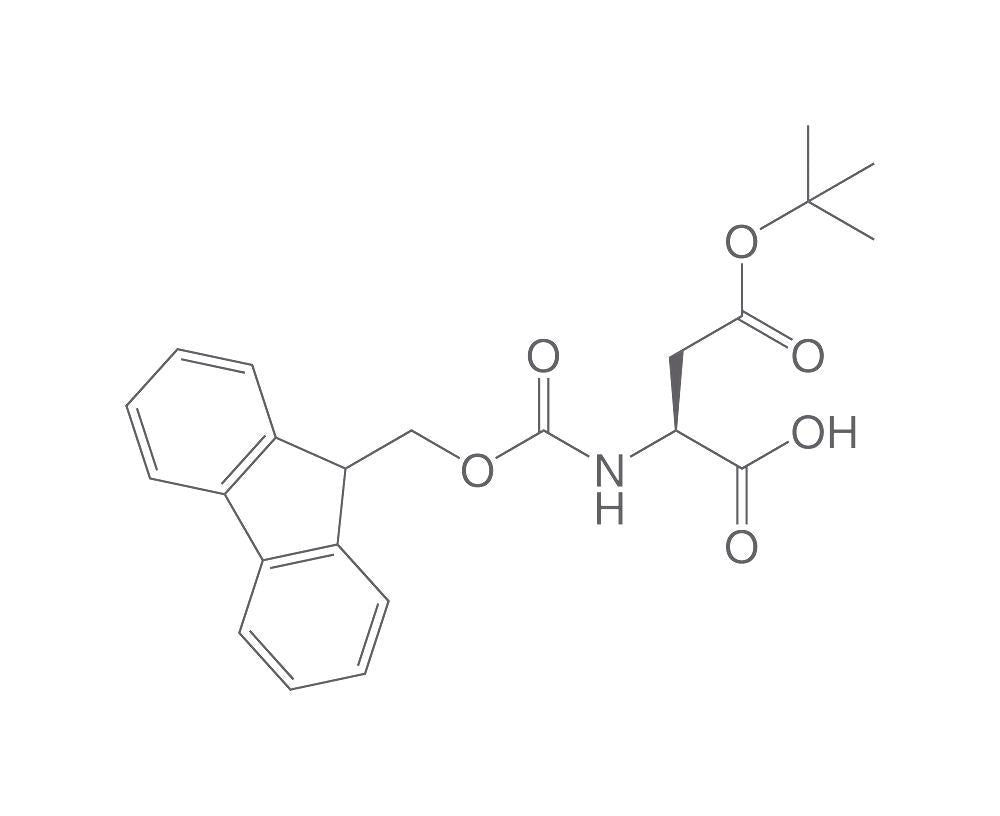
Fmoc-L-asparaginezuur-(OtBu) is een aan de zijketen beschermd aminozuurderivaat dat wordt aangeboden in PEPTIPURE®-kwaliteit met een minimumzuiverheid van 96% voor de biochemie. Geïdentificeerd door CAS-nummer 71989-14-5 en de empirische formule C₂₃H₂₅NO₆, combineert het een N-terminale Fmoc-groep met een tert-butylester aan de zijketen van het asparaginezuur, wat selectieve beschermingsstrategieën bij vast-fase-peptidesynthese ondersteunt. De molaire massa is 411,46 g/mol. Deze beschermde bouwsteen van fabrikant Carl ROTH past in standaard op Fmoc gebaseerde workflows waar tijdelijke afscherming van de zijketen van asparaginezuur vereist is tijdens de ketenverlenging. Biochemici en peptidechemici gebruiken het om Asp-residuen te introduceren onder omstandigheden die de integriteit van de ruggengraat behouden, terwijl latere ontscherming mogelijk blijft. De gedefinieerde specificatie en PEPTIPURE®-aanduiding helpen de consistentie te waarborgen bij koppelings-, was- en afsplitsingsstappen in onderzoek en preparatief peptideonderzoek.
Dit artikel hoort bij Zuren, in Zuren & basen.
Belangrijkste kenmerken
- Uiterlijk: wit poeder
- Gehalte (titr.): ≥96,0 %
- Zuiverheid (HPLC): ≥99,0 %
- Water (KF): ≤1,0 %
- Spec. rotatie [α] c (1 % in DMF): -25,5° tot -22,5°
- Enantiomere zuiverheid: ≤0,3 % D-enantiomeer
- CAS-nummer: 71989-14-5
- Verpakkingsgrootten: 5 g, 25 g, 100 g
- EG-nr.: 276-251-7
- Zuiverheid: PEPTIPURE® min. 96 %
- Empirische formule: C₂₃H₂₅NO₆
- Molaire massa: 411,46 g/mol
- Technisch informatieblad:

- Veiligheidsinformatieblad:
Recent bekeken
Misschien vind je dit ook leuk
Browse related categories
Category
Sub-category
Catalogue
Brand
Questions about Fmoc-L-asparaginezuur-(OtBu), PEPTIPURE® min. 96 %, voor biochemie, 5 g, glas
What is this article?
Fmoc-L-asparaginezuur-(OtBu), PEPTIPURE® min. 96 %, voor biochemie, 5 g, glas is the article on this page. Luminix Health distributes Carl Roth for laboratory use. It sits in Acids, inside Acids & bases, in Chemicaliën.
An acid on this shelf is the substance itself, concentrated or as a stated solution: hydrochloric, sulfuric, nitric, acetic and the rest. Concentration, purity and the trace metals decide the use. A concentrated acid and a volumetric solution of the same name are different products, and both burn.
An acid donates a proton. A base accepts one. In the bottle, the practical differences are the concentration, the purity and the anion or cation that comes along. Concentrated mineral acids are a different article from a dilute volumetric solution. The water in the acid, and the trace metals, decide whether it can be used for analysis. Check the substance on PubChem and the classification on ECHA CLP. Transport is the UNECE dangerous-goods framework. The legal texts are the CLP Regulation and REACH.
Which category should I open next?
The category is Acids & bases. The sub-category is Acids. The catalogue is Chemicaliën.
Shelves beside this one are Bases & alkalis.
What should I check before I order?
The technical information on this page is the manufacturer's sheet. Read that, not a rewritten specification.
When this page shows a safety data sheet, use that manufacturer file. Hazard text does not belong in the sales description. For a pack size, a grade or a certificate that is not on the page, send a quote request or contact the team.
How does ordering and shipping work?
Luminix Health distributes this article from the heart of Europe. Articles in stock ship within 2–5 business days. Standard delivery is free from €250 excl. VAT. Cold-chain goods and dangerous goods under ADR are never included in that free delivery. The terms are in the Shipping Policy. The full brand index is on shop by brand. Who we are is on about us.
Which other categories should I open?
The seven catalogues are Labware, Lab chemicals, Lab instruments, Lab consumables, Chromatography equipment, Lab safety equipment and Life Science & Microbiology.