
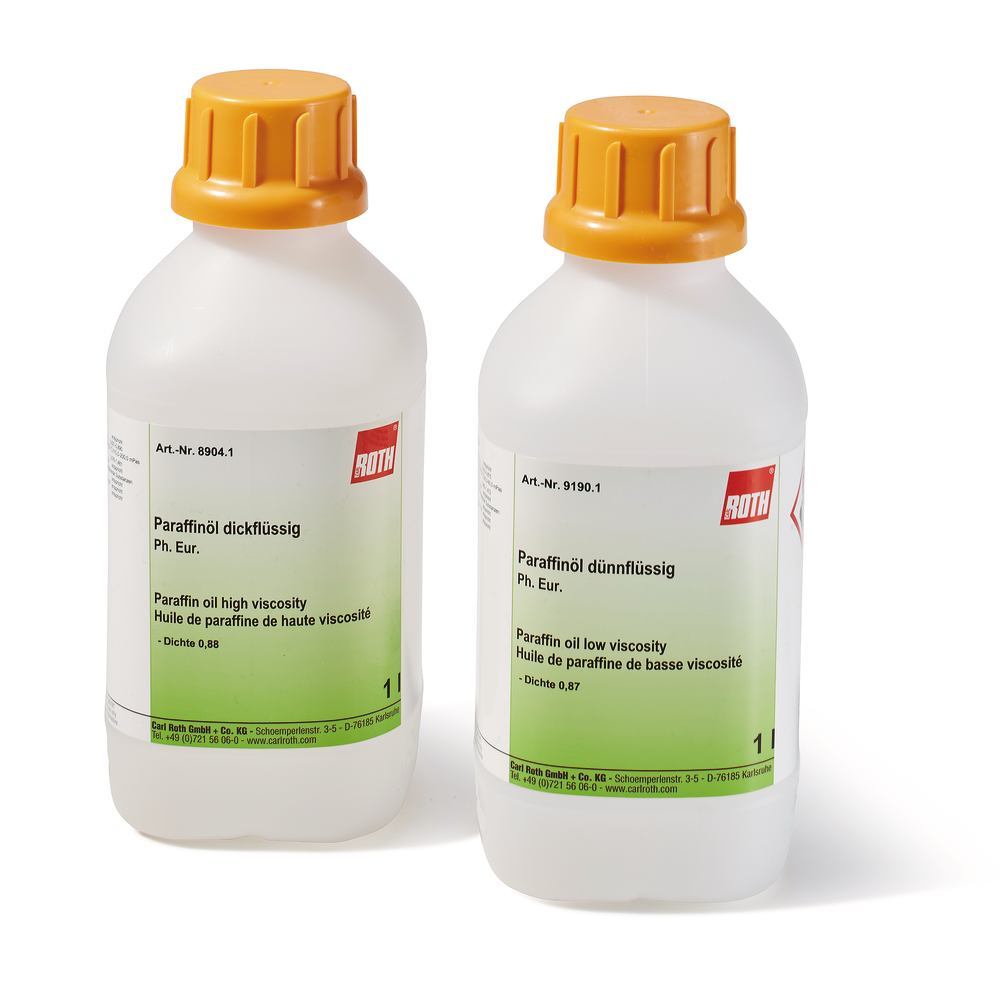


Beschrijving
Paraffineolie met lage viscositeit is een minerale olie van ROTI®Pharm Excipient-kwaliteit die voldoet aan de Ph.Eur.-vereisten en wordt aangeboden voor farmaceutische en laboratoriumtoepassingen als hulpstof. Deze paraffineolie met lage viscositeit, geïdentificeerd door CAS-nummer 8042-47-5 en EG-nr. 232-455-8, heeft een dichtheidsbereik van 0,81 tot 0,875 g/cm³, een vlampunt boven 112 °C en een kookbereik van 218 tot 800 °C. Typisch gebruik omvat hulpstofrollen in preparaten waarvoor paraffineolie met gecontroleerde fysische eigenschappen vereist is. Duidelijke gegevens over dichtheid, vlampunt en kookpunt helpen laboratoria bij het selecteren van de juiste viscositeitsgraad naast gerelateerde varianten met een hoge viscositeit. Deze olie van ROTI®Pharm-kwaliteit is verpakt voor eenvoudig gebruik op de werkbank of in ondersteunende productieruimtes en biedt een consistente Ph.Eur.-hulpstofoptie voor gereguleerde en onderzoeksomgevingen die gedocumenteerde kenmerken van minerale olie vereisen.
Dit artikel hoort bij Viscositeitsmeters, in Dichtheids- en viscositeitsmeting.
Belangrijkste kenmerken
- Relatieve dichtheid (20 °C): 0,81-0,875
- Dynamische viscositeit (20 °C): 25-80 mPas
- Brekingsindex: 1,462-1,472
- Reactie met H2SO4: voldoet
- Zure of alkalische stoffen: voldoet
- Polycyclische aromatische koolwaterstoffen: voldoet
- Vaste paraffines: voldoet
- Productiedatum: zie analysecertificaat
- CAS-nummer: 8042-47-5
- Verpakkingsgrootten: 1 l, 5 l, 25 l
- EG-nr.: 232-455-8
- Dichtheid: 0,81 tot 0,875 g/cm³
- Vlampunt: >112 °C
- Technisch informatieblad:

- Veiligheidsinformatieblad:
Compliance & Safety Information
 Gevaar
Hazard Statements (H-Phrases)
Precautionary Statements (P-Phrases)
Recent bekeken
Misschien vind je dit ook leuk
Questions about Paraffineolie lage viscositeit, ROTI®Pharm Excipient, 1 l, kunststof
What is this article?
Paraffineolie lage viscositeit, ROTI®Pharm Excipient, 1 l, kunststof is the article on this page. Luminix Health distributes Carl Roth for laboratory use. It sits in Viscometers, inside Density & viscosity measurement, in Instrumenten.
A capillary viscometer times the flow of a liquid through a tube. A rotational viscometer twists a spindle in the liquid. Both need a stated temperature. Kinematic and dynamic viscosity are different numbers. The capillary size has to put the flow time in the range the method allows.
Density is mass divided by volume. A hydrometer floats at a depth that depends on the density of the liquid. A pycnometer is a vessel of known volume that is weighed full. Viscosity is the resistance to flow. A capillary viscometer times how long a volume takes to fall through a tube. Both measurements need a stated temperature, because liquids change density and viscosity as they warm. The units trace to the BIPM and to NIST.
Which category should I open next?
The category is Density & viscosity measurement. The sub-category is Viscometers. The catalogue is Instrumenten.
Shelves beside this one are Hydrometers and Density meters & pycnometers.
What should I check before I order?
The technical information on this page is the manufacturer's sheet. Read that, not a rewritten specification.
When this page shows a safety data sheet, use that manufacturer file. Hazard text does not belong in the sales description. For a pack size, a grade or a certificate that is not on the page, send a quote request or contact the team.
How does ordering and shipping work?
Luminix Health distributes this article from the heart of Europe. Articles in stock ship within 2–5 business days. Standard delivery is free from €250 excl. VAT. Cold-chain goods and dangerous goods under ADR are never included in that free delivery. The terms are in the Shipping Policy. The full brand index is on shop by brand. Who we are is on about us.
Which other categories should I open?
The seven catalogues are Labware, Lab chemicals, Lab instruments, Lab consumables, Chromatography equipment, Lab safety equipment and Life Science & Microbiology.