
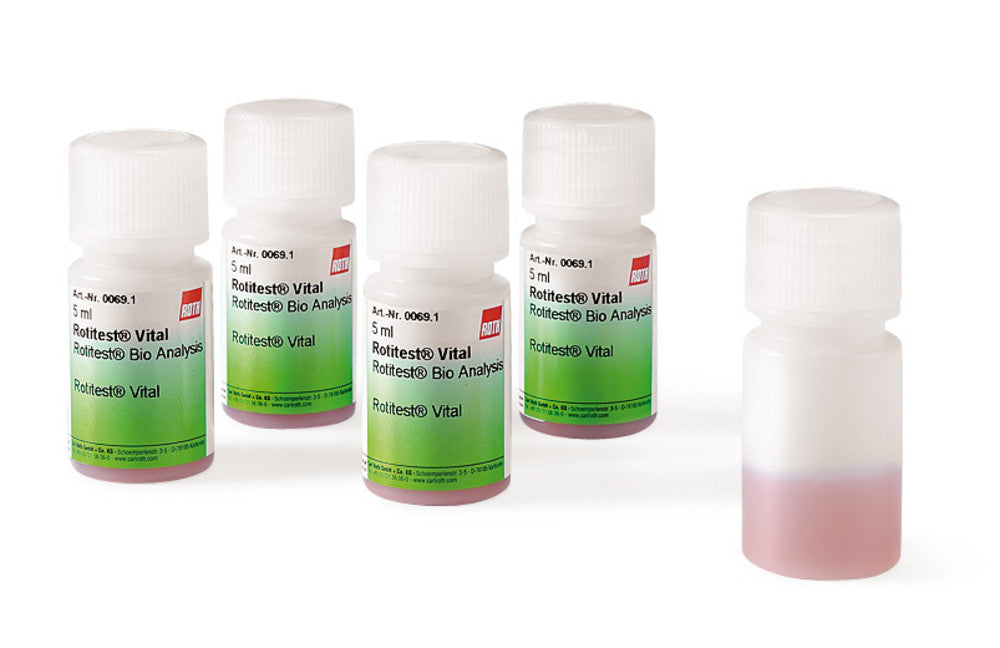


Beschrijving
ROTITEST® Vital, steriel, gebruiksklaar, ROTItest® Bio Analyse, Dichtheid (D) 1,37 g/cm³, Kookpunt (kp) 100 °C, Opslagtemp. +4 °C
Snel en eenvoudig testsysteem voor de niet-radioactieve kwantificering van prolifererende cellen. Ook zeer geschikt voor cytotoxiciteitstesten.
- Cellen blijven vitaal
- Zeer eenvoudige hantering
- Eén-component-systeem zonder radioactiviteit
- Voor adherente cellen en suspensiecellen
- Fotometrisch resultaat in 1 tot 4 uur
- Sterke correlatie tussen absorptie en celnummer
- Geschikt voor alle kweekmedia
De gevoeligheid van het gebruikte tetrazoliumzout is hoger dan die van standaardreagentia zoals MTT, XTT, MTS of WST-1. Er is aangetoond dat de resultaten een zeer sterke correlatie vertonen met [3H]-thymidine-incorporatietesten, waardoor ze zowel de vitaliteit als de proliferatiestatus van de cellen weergeven (Tominaga et al., Anal. Commun. 1999 (36) 47-50). In alle levende cellen worden NADH en NADPH gevormd door de ademhalingsketen. ROTITEST®vital is gebaseerd op het (kleurloze) WST-8, dat fungeert als acceptor voor NADH/NADPH-dehydrogenase terwijl het tijdens het proces wordt gereduceerd tot (gekleurd) formazaan.
De testoplossing wordt direct aan de gekweekte cellen in 96-wells platen toegevoegd. Tijdens een incubatie van enkele uren wordt door vitale cellen een in water oplosbare formazaankleurstof geproduceerd, die wordt afgegeven aan het omringende medium. De resulterende oranje kleur wordt fotometrisch gemeten (ca. 450 nm). Ook geschikt voor kweekmedia die fenolrood bevatten. Elke verpakking bevat een eenvoudig te volgen gebruiksaanwijzing.
Recent bekeken
Misschien vind je dit ook leuk
Browse related categories
Category
Organic chemicals & synthesis reagents
Sub-category
Organic building blocks & synthesis reagents
Catalogue
Brand
Questions about ROTITEST® Vital, steriel, gebruiksklaar, 1 ml, plastic
What is this article?
ROTITEST® Vital, steriel, gebruiksklaar, 1 ml, plastic is the article on this page. Luminix Health distributes Carl Roth for laboratory use. It sits in Organic building blocks & synthesis reagents, inside Organic chemicals & synthesis reagents, in Chemicaliën.
A building block is an organic molecule bought to become part of a larger one. The structure, the CAS number and the purity decide it. A 95 percent reagent and a 99.9 percent reagent of the same name leave different impurities in the product. The functional groups are the reason it was chosen.
An organic chemical is built on carbon. In this category it is a building block or a reagent for making another molecule: a starting material, a coupling agent, a polymer, a PEG. Purity is a specification of which impurities remain. The structure, the CAS number and the grade decide whether two bottles are the same substance. Structures and properties are on PubChem. Nomenclature is IUPAC. Classification follows ECHA and the CLP Regulation.
Which category should I open next?
The category is Organic chemicals & synthesis reagents. The sub-category is Organic building blocks & synthesis reagents. The catalogue is Chemicaliën.
Shelves beside this one are Polymers, PEGs & silicones and Click chemistry, bioconjugation & synthesis reagents.
What should I check before I order?
When this page shows a safety data sheet, use that manufacturer file. Hazard text does not belong in the sales description. For a pack size, a grade or a certificate that is not on the page, send a quote request or contact the team.
How does ordering and shipping work?
Luminix Health distributes this article from the heart of Europe. Articles in stock ship within 2–5 business days. Standard delivery is free from €250 excl. VAT. Cold-chain goods and dangerous goods under ADR are never included in that free delivery. The terms are in the Shipping Policy. The full brand index is on shop by brand. Who we are is on about us.
Which other categories should I open?
The seven catalogues are Labware, Lab chemicals, Lab instruments, Lab consumables, Chromatography equipment, Lab safety equipment and Life Science & Microbiology.