


Beschrijving
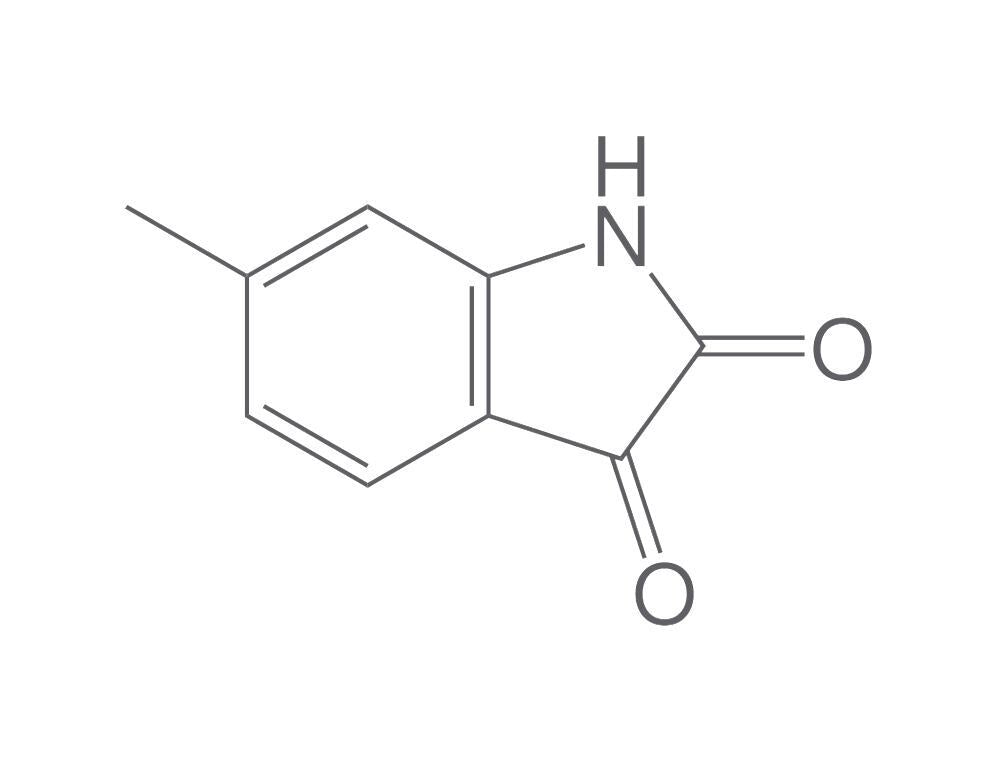
6-Methyl-1H-indole-2,3-dione is een van indole afgeleid dion dat wordt geleverd met een minimale zuiverheid van 95 % voor laboratorium- en biochemisch onderzoek. Geregistreerd onder CAS-nummer 1128-47-8, heeft de verbinding de empirische formule C₉H₇NO₂ en een molaire massa van 161.16 g/mol. De 6-methylsubstitutie op het isatin-achtige skelet biedt een gedefinieerd heterocyclisch motief dat vaak wordt gebruikt bij het opbouwen van uitgebreidere indole-raamwerken. Molaire-massagegevens van 161.16 g/mol maken betrouwbare stoichiometrische planning in meerstapssequenties mogelijk. Deze kwaliteit is verkrijgbaar van fabrikant Carl ROTH onder chemicaliën en biochemicaliën die bedoeld zijn voor gecontroleerd laboratoriumgebruik. Transparante CAS- en formule-etikettering ondersteunt voorraadsystemen, veiligheidsdossiers en regelgevende traceerbaarheid. hoeveelheid sluit aan bij de behoeften van onderzoeksteams die een gemethyleerd indole-2,3-dione-intermediair nodig hebben zonder grote voorraden aan te houden. Consistente identiteitsparameters vergemakkelijken de opname in gedocumenteerde experimentele workflows in medicinale en organische chemieomgevingen waar reproduceerbare bouwstenen essentieel zijn.
Dit artikel maakt deel uit van Gedehydrateerde kweekmedia (agar- & bouillonbases), in Kweekmedia & microbiologie. Zie ook Petrischalen.
Kenmerken
- Gehalte: ≥ 95 %
- Kleur: gerapporteerd
- Vorm: gerapporteerd
- CAS-nummer: 1128-47-8
- Verpakkingsgroottes: 5 g, 10 g, 25 g
- Zuiverheid: min. 95 %
- Brutoformule: C₉H₇NO₂
- Molaire massa: 161.16 g/mol
- Technisch datablad:

- Veiligheidsinformatieblad:
Compliance & Safety Information
 Waarschuwing
Hazard Statements (H-Phrases)
Recent bekeken
Misschien vind je dit ook leuk
Browse related categories
Category
Sub-category
Gedehydrateerde kweekmedia (agar- & bouillonbases)
Catalogue
Brand
Questions about 6-Methyl-1H-indole-2,3-dione, min. 95 %, 5 g
What is this article?
6-Methyl-1H-indole-2,3-dione, min. 95 %, 5 g is the article on this page. Luminix Health distributes Carl Roth for laboratory use. It sits in Gedehydrateerde kweekmedia (agar- & bouillonbases), inside Kweekmedia & microbiologie, in Microbiologische media.
A dehydrated medium is a powder the laboratory dissolves, sterilises and pours. The formulation name, the supplements it still needs, and the grams per litre are the specification. Two powders with similar names, one selective and one not, grow different organisms.
A culture medium is the food and the solid or liquid home of a microorganism. Dehydrated media are powders the laboratory dissolves and sterilises. Ready-to-use plates and tubes are already that. A Petri dish is the plate. Selective media let one kind of organism grow and hold another back. The formulation and the supplements, not the colour of the agar, are the specification. Reference strains are at ATCC. Methods are on PubMed. Biosafety practice is the WHO laboratory biosafety topic.
Which category should I open next?
The category is Kweekmedia & microbiologie. The sub-category is Gedehydrateerde kweekmedia (agar- & bouillonbases). The catalogue is Microbiologische media.
Shelves beside this one are Petrischalen, Gebruiksklare kweekmedia (platen, buizen, flessen), Microbiologie (overig), Entogen, uitstrijkers & naalden and Microbiële identificatie, hygiënebewaking & sneltests.
What should I check before I order?
When this page shows a safety data sheet, use that manufacturer file. Hazard text does not belong in the sales description. For a pack size, a grade or a certificate that is not on the page, send a quote request or contact the team.
How does ordering and shipping work?
Luminix Health distributes this article from the heart of Europe. Articles in stock ship within 2–5 business days. Standard delivery is free from €250 excl. VAT. Cold-chain goods and dangerous goods under ADR are never included in that free delivery. The terms are in the Shipping Policy. The full brand index is on shop by brand. Who we are is on about us.
Which other categories should I open?
The seven catalogues are Labware, Lab chemicals, Lab instruments, Lab consumables, Chromatography equipment, Lab safety equipment and Life Science & Microbiology.