
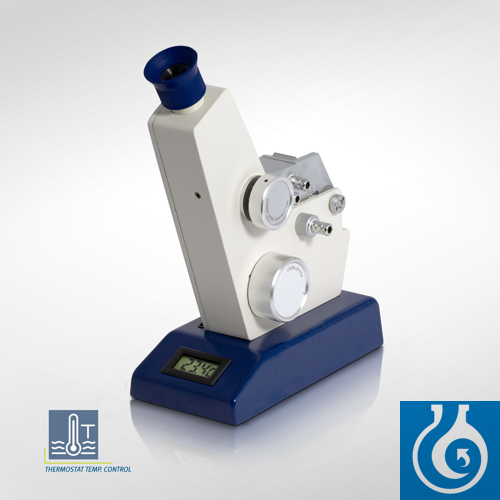


Beschrijving
Klassieke Abbe-refractometer AR4 maakt het mogelijk de brekingsindex en %Brix te meten en af te lezen via het oculair voor traditionele optische laboratoriumanalyse. Dit instrument volgt het gevestigde Abbe-principe en geeft operators directe visuele toegang tot de meetschaal via het oculair voor transparante vloeibare monsters. Het is geschikt voor onderwijslaboratoria, routinematige kwaliteitscontrole en toepassingen waarbij de voorkeur uitgaat naar een robuuste optische refractometer zonder digitale elektronica. Het nettogewicht is 2.5 kg en het brutogewicht is 3 kg, wat een compact maar stabiel tafelinstrument voor dagelijks gebruik oplevert. Brix-schaalverdeling ondersteunt de bepaling van het gehalte aan oplosbare vaste stoffen naast brekingsindexmetingen en dekt gangbare behoeften in de levensmiddelentechnologie, chemische laboratoria en materiaalcharacterisatie. Geleverd als één complete eenheid en afkomstig uit Duitsland, blijft de klassieke Abbe-refractometer van fabrikant Krüss een betrouwbare keuze waar optische helderheid, eenvoudige bediening en vertrouwde Abbe-geometrie vereist zijn. De op het oculair gebaseerde uitlezing houdt de workflow eenvoudig en onafhankelijk van externe voeding voor het optische observatiepad zelf.
Dit artikel maakt deel uit van Refractometers & polarimeters, in Spectroscopie & fotometrie.
Kenmerken
- Verpakkingsgrootte: 1 stuk
- Producttype: Refractometer
- Model: AR4
- Meetparameters: Brekingsindex en %Brix
- Uitlezing: Oculair / optisch
- Technisch datablad:

Recent bekeken
Misschien vind je dit ook leuk
Browse related categories
Category
Sub-category
Catalogue
Brand
Questions about Klassieke Abbe-refractometer
What is this article?
Klassieke Abbe-refractometer is the article on this page. Luminix Health distributes Krüss for laboratory use. It sits in Refractometers & polarimeters, inside Spectroscopie & fotometrie, in Instrumenten.
A refractometer reads the refractive index of a liquid, often expressed as Brix for sugar. A polarimeter reads the rotation of polarised light. Both depend on temperature. A handheld refractometer and a thermostated benchtop instrument are different accuracies.
A photometer or spectrophotometer sends light through a sample and reads how much was absorbed. In the range where the Beer–Lambert relation holds, absorbance tracks concentration. A refractometer reads how a liquid bends light, which tracks dissolved solids. A polarimeter reads the rotation of polarised light, the classical measurement for sugars. The lamp, the wavelength and the cuvette path length are the three things that have to be right before the number means anything. The optical quantities trace to NIST and the BIPM.
Which category should I open next?
The category is Spectroscopie & fotometrie. The sub-category is Refractometers & polarimeters. The catalogue is Instrumenten.
Shelves beside this one are Fotometers & spectrofotometers and Lampen, cuvettehouders & accessoires.
What should I check before I order?
When this page shows a safety data sheet, use that manufacturer file. Hazard text does not belong in the sales description. For a pack size, a grade or a certificate that is not on the page, send a quote request or contact the team.
How does ordering and shipping work?
Luminix Health distributes this article from the heart of Europe. Articles in stock ship within 2–5 business days. Standard delivery is free from €250 excl. VAT. Cold-chain goods and dangerous goods under ADR are never included in that free delivery. The terms are in the Shipping Policy. The full brand index is on shop by brand. Who we are is on about us.
Which other categories should I open?
The seven catalogues are Labware, Lab chemicals, Lab instruments, Lab consumables, Chromatography equipment, Lab safety equipment and Life Science & Microbiology.