
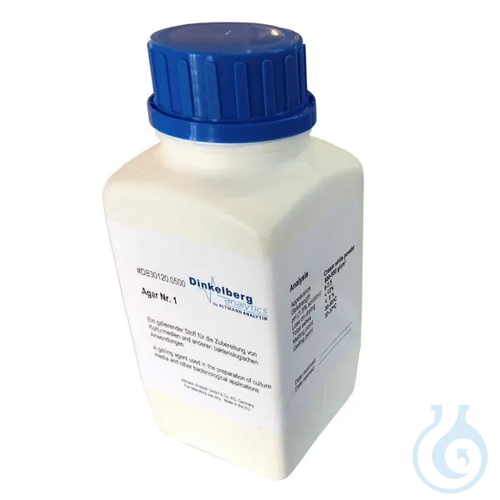


Beschrijving
Lactose (1%) Phenol Red Broth is een differentieel kweekmedium dat wordt gebruikt om lactosefermentatie door micro-organismen te beoordelen in het klinische, levensmiddelen- en algemene microbiologisch laboratorium. De formulering combineert 1% lactose met een phenol red pH-indicator, zodat zuurproductie uit koolhydraatgebruik tijdens incubatie als kleurverandering kan worden waargenomen. Geleverd als een verpakking van 500 g is het bedoeld voor de bereiding van bouillonbuizen of andere formaten volgens de gevalideerde mediaprotocollen van het laboratorium. Dit medium van fabrikant Dinkelberg ondersteunt workflows voor biochemische karakterisering, onderwijslaboratoria en kwaliteitscontrolepanels waarin lactosefermentatie een belangrijk diagnostisch criterium is. Duidelijke benoeming van de lactoseconcentratie en het indicatorsysteem helpt analisten de juiste bouillon te selecteren voor methodebladen en schema's voor organismenidentificatie. Het land van herkomst is Hongarije. Bereidt en gebruikt u het volgens standaard aseptische techniek om een betrouwbare differentiatie bij opeenvolgende testreeksen te handhaven.
Dit artikel maakt deel uit van Koolhydraten & suikers, in Biochemicaliën & reagentia.
Kenmerken
- Verpakkingsgrootte: 500 g
- Producttype: Lactose (1%) Phenol Red Bouillon
- Formaat: Gedehydrateerd kweekmedium
- Land van oorsprong: Hongarije
Recent bekeken
Misschien vind je dit ook leuk
Browse related categories
Category
Sub-category
Catalogue
Brand
Questions about Lactose (1%) Phenol Red Broth , 500g
What is this article?
Lactose (1%) Phenol Red Broth , 500g is the article on this page. Luminix Health distributes Dinkelberg for laboratory use. It sits in Koolhydraten & suikers, inside Biochemicaliën & reagentia, in Microbiologische media.
A carbohydrate reagent is a sugar or a derivative, specified by identity, anomer where it matters, and purity. Hydrate and anhydrous forms change the mass. A culture-grade sugar and an analytical standard of the same name are different bottles.
A biochemical is a molecule of life, sold as a reagent: an amino acid, a sugar, a nucleotide, a lipid, an enzyme, an antibiotic. The difference from a bulk chemical is that the use is a biological one, and the impurities that matter are the ones that change that use. An enzyme is specified by activity, not only by mass. An antibiotic is specified by potency. Papers are on PubMed. Structures are on PubChem. Strains and lines that consume these reagents are at ATCC.
Which category should I open next?
The category is Biochemicaliën & reagentia. The sub-category is Koolhydraten & suikers. The catalogue is Microbiologische media.
Shelves beside this one are Aminozuren & peptiden, Co-enzymen, nucleotiden & vitaminen, Biochemicaliën (overig), Enzymen & substraten, Antibiotica & antimycotica, Lipiden, steroïden & vetzuren and Detergenten & oppervlakteactieve stoffen.
What should I check before I order?
When this page shows a safety data sheet, use that manufacturer file. Hazard text does not belong in the sales description. For a pack size, a grade or a certificate that is not on the page, send a quote request or contact the team.
How does ordering and shipping work?
Luminix Health distributes this article from the heart of Europe. Articles in stock ship within 2–5 business days. Standard delivery is free from €250 excl. VAT. Cold-chain goods and dangerous goods under ADR are never included in that free delivery. The terms are in the Shipping Policy. The full brand index is on shop by brand. Who we are is on about us.
Which other categories should I open?
The seven catalogues are Labware, Lab chemicals, Lab instruments, Lab consumables, Chromatography equipment, Lab safety equipment and Life Science & Microbiology.