
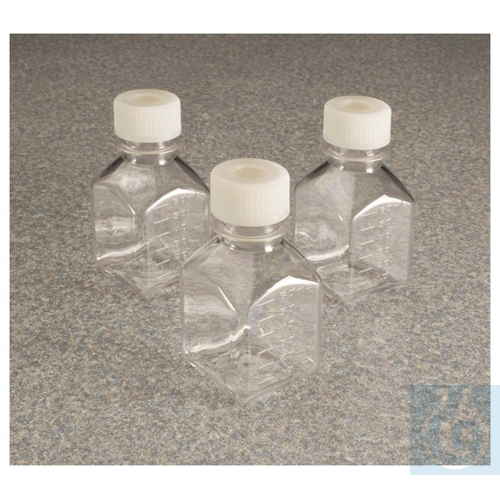



Beschrijving
Nalgene™ vierkante PETG-mediaflessen met septumsluiting zijn steriele, in trays verpakte containers voor het verpakken van biologische en diagnostische reagentia die steriel vullen of toevoeging van supplementen met een spuit vereisen. Elke transparante fles van 500 ml is gevormd uit robuust, breukbestendig PETG in een vierkant formaat dat waardevolle opslag- en werkbankruimte bespaart. De high-density polyethylene sluiting bevat een silicone/PTFE-septum, zodat vloeistofcontact bij toegang met een naald alleen plaatsvindt met een inert, antiaanbakkend PTFE-oppervlak. De sluitingsmaat met wijde opening is 38–430 met een halsbinnendiameter van 28 mm; de totale afmetingen zijn ongeveer 2.9 in. diameter en 6.97 in. hoogte. Flessen en sluitingen bieden een SAL van 10⁻⁶ en zijn lekvrij volgens de gedefinieerde Nalgene™-criteria. De op cleanrooms gerichte levering plaatst eenheden op kunststof trays, dubbel in plastic zakken verpakt. Deze Nalgene™-mediaflessen van fabrikant Thermo Scientific - Laboratory Plastics voldoen aan de normen USP Class IV en zijn niet-cytotoxisch. Zij ondersteunen steriele reagensverpakking, aseptisch vullen en gecontroleerde introductie van additieven. Geleverd als een doos van 40 stuks voor laboratorium- en productiegebruik.
Dit artikel maakt deel uit van Laboratoriumglasflessen, in Flessen & verpakkingen.
Kenmerken
- Verpakkingsgrootte: 40 stuks
- Materiaal: PETG
- Nominaal volume: 500 ml
- Vorm: Vierkant, ruimtebesparend
- Sluiting: HDPE met silicone/PTFE-septum, 38–430
- Steriliteit: Steriel, SAL 10⁻⁶
Recent bekeken
Misschien vind je dit ook leuk
Browse related categories
Category
Sub-category
Catalogue
Brand
Questions about STER. PETG-FLES M/SEPTUM; 500ML
What is this article?
STER. PETG-FLES M/SEPTUM; 500ML is the article on this page. Luminix Health distributes Thermo Scientific - Laboratory Plastics for laboratory use. It sits in Laboratoriumglasflessen, inside Flessen & verpakkingen, in Labmateriaal.
A laboratory glass bottle is borosilicate or soda-lime, with a stated capacity and a neck for a screw cap or a ground stopper. Glass is the choice when the liquid attacks a plastic, or when the bottle will be heated or autoclaved.
A laboratory bottle is a closed container with a stated volume and a neck that takes a cap, a stopper or a dispenser. Borosilicate glass is the choice when the liquid is a solvent, or when the bottle will be heated or autoclaved. Polyethylene and polypropylene are the choice when the bottle must not shatter, or when hydrofluoric acid would attack glass. A narrow mouth pours. A wide mouth is for powders and for reaching the bottom. Laboratory ware of this kind is indexed under ISO laboratory glassware. Traceable volume sits with the BIPM and NIST Physical Measurement.
Which category should I open next?
The category is Flessen & verpakkingen. The sub-category is Laboratoriumglasflessen. The catalogue is Labmateriaal.
Shelves beside this one are Plastic flessen (nauwe & wijde hals), Monstercontainers & potten, Bidons & jerrycans, Spuitflessen and Flesaccessoires (schenkringen, dispensers, doppen).
What should I check before I order?
When this page shows a safety data sheet, use that manufacturer file. Hazard text does not belong in the sales description. For a pack size, a grade or a certificate that is not on the page, send a quote request or contact the team.
How does ordering and shipping work?
Luminix Health distributes this article from the heart of Europe. Articles in stock ship within 2–5 business days. Standard delivery is free from €250 excl. VAT. Cold-chain goods and dangerous goods under ADR are never included in that free delivery. The terms are in the Shipping Policy. The full brand index is on shop by brand. Who we are is on about us.
Which other categories should I open?
The seven catalogues are Labware, Lab chemicals, Lab instruments, Lab consumables, Chromatography equipment, Lab safety equipment and Life Science & Microbiology.