


Beschrijving
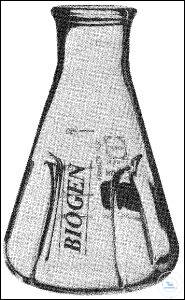
Trypsiniseringskolf 2000 ml is een groter kweekvat bedoeld voor cel- en weefselkweektoepassingen die een groter werkvolume nodig hebben. Zij biedt een nominaal volume van 2 l, een kolfdiameter van 166 mm en een hoogte van 305 mm, samen met een halsdiameter van 50 mm. Vier ingebouwde schotten bevorderen effectieve menging en gelijkmatig enzymcontact tijdens trypsiniserings- en cellosmakingsprocedures. Gemaakt van borosilicaatglas 3.3 door fabrikant Witeg, levert de kolf de chemische duurzaamheid en thermische prestaties die vereist zijn in alledaagse laboratoriumkweekomgevingen. De transparante glasconstructie maakt continue visuele inspectie van kweken en media mogelijk, terwijl het ontwerp met schotten een homogene suspensie ondersteunt zonder hard mechanisch roeren. Dit formaat van 2000 ml is goed geschikt voor workflows met weefselkweekkolven en celkweekkolven in incubatoren en steriele werkstations waarin opschaling en betrouwbare hantering van belang zijn. Het nettogewicht is 0.544 kg, wat capaciteit in evenwicht brengt met praktisch gebruik op de laboratoriumtafel.
Dit artikel maakt deel uit van Enzymen & substraten, in Biochemicaliën & reagentia.
Kenmerken
- Verpakkingsgrootte: 1 stuk
- Nominaal volume: 2 l
- Kolvendiameter: 166 mm
- Hoogte: 305 mm
- Halsdiameter: 50 mm
- Materiaal: Borosilicate glass 3.3
Recent bekeken
Misschien vind je dit ook leuk
Browse related categories
Category
Sub-category
Catalogue
Brand
Questions about Trypsiniseringskolf 2000 ml Ø 166 mm
What is this article?
Trypsiniseringskolf 2000 ml Ø 166 mm is the article on this page. Luminix Health distributes Witeg for laboratory use. It sits in Enzymen & substraten, inside Biochemicaliën & reagentia, in Microbiologische media.
An enzyme is sold by activity, in units defined by a stated reaction, not only by milligrams. Source and specific activity are the specification. A substrate is the molecule that enzyme converts, often a chromogenic one so the reaction can be seen. Units from two suppliers are comparable only when the definition matches.
A biochemical is a molecule of life, sold as a reagent: an amino acid, a sugar, a nucleotide, a lipid, an enzyme, an antibiotic. The difference from a bulk chemical is that the use is a biological one, and the impurities that matter are the ones that change that use. An enzyme is specified by activity, not only by mass. An antibiotic is specified by potency. Papers are on PubMed. Structures are on PubChem. Strains and lines that consume these reagents are at ATCC.
Which category should I open next?
The category is Biochemicaliën & reagentia. The sub-category is Enzymen & substraten. The catalogue is Microbiologische media.
Shelves beside this one are Aminozuren & peptiden, Koolhydraten & suikers, Co-enzymen, nucleotiden & vitaminen, Biochemicaliën (overig), Antibiotica & antimycotica, Lipiden, steroïden & vetzuren and Detergenten & oppervlakteactieve stoffen.
What should I check before I order?
When this page shows a safety data sheet, use that manufacturer file. Hazard text does not belong in the sales description. For a pack size, a grade or a certificate that is not on the page, send a quote request or contact the team.
How does ordering and shipping work?
Luminix Health distributes this article from the heart of Europe. Articles in stock ship within 2–5 business days. Standard delivery is free from €250 excl. VAT. Cold-chain goods and dangerous goods under ADR are never included in that free delivery. The terms are in the Shipping Policy. The full brand index is on shop by brand. Who we are is on about us.
Which other categories should I open?
The seven catalogues are Labware, Lab chemicals, Lab instruments, Lab consumables, Chromatography equipment, Lab safety equipment and Life Science & Microbiology.