
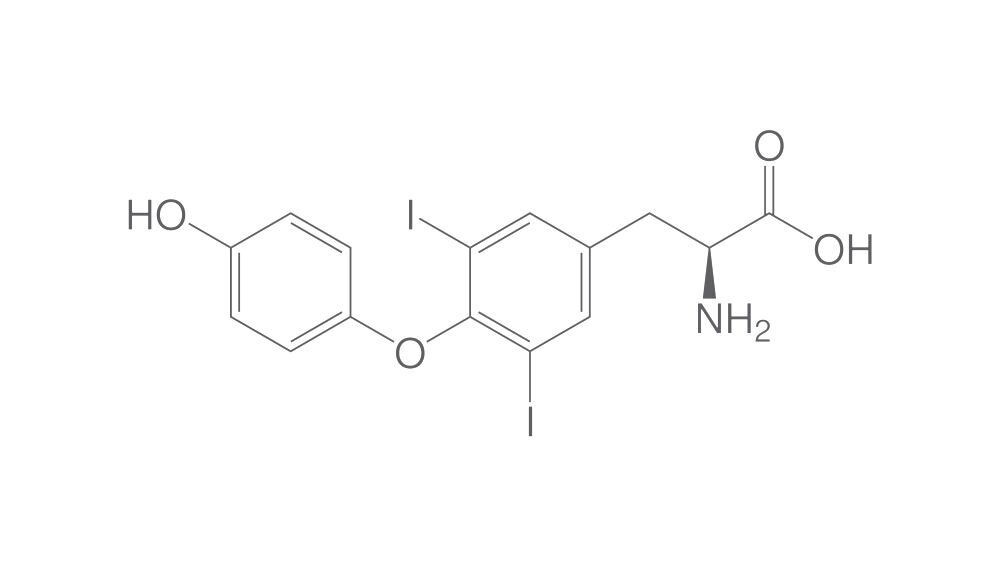


Beschreibung
3,5-Diiodo-L-thyronine is een gejodeerd thyroninederivaat dat wordt gebruikt in endocrinologisch onderzoek, biochemische assays en studies naar schildklierhormoonanalogen. Het wordt geïdentificeerd door CAS-nummer 1041-01-6 en de empirische formule C₁₅H₁₃I₂NO₄, met een molaire massa van 525,08 g/mol en een dichtheid van 2,028 g/cm³. De 3,5-diiodo-substitutie op het L-thyronine-skelet maakt deze verbinding waardevol voor vergelijkend metabolismeonderzoek, receptorbindingsexperimenten en de bereiding van gelabelde of gemodificeerde hormoongerelateerde standaarden. Wetenschappers betrekken dit materiaal van fabrikant Carl ROTH bij het onderzoeken van structuur-activiteitsrelaties tussen schildklierhormoonmetabolieten of bij het opstellen van analysemethoden voor gejodeerde aminozuurderivaten. Betrouwbare moleculaire karakterisering ondersteunt de nauwkeurige bereiding van voorraadoplossingen en een reproduceerbaar experimenteel ontwerp in academische, klinische onderzoeks- en industriële biochemische omgevingen.
Dit artikel hoort bij Clickchemie, bioconjugatie & synthesereagentia, in Biochemicaliën & reagentia.
Belangrijkste kenmerken
- CAS-nummer: 1041-01-6
- Verpakkingsgrootten: 2 g, 5 g, 10 g, 25 g
- Empirische formule: C₁₅H₁₃I₂NO₄
- Molaire massa: 525,08 g/mol
- Dichtheid: 2,028 g/cm³
- Opslagtemperatuur: -20 °C
- Technisch informatieblad:

Compliance & Safety Information
Hazard Statements (H-Phrases)
Recent bekeken
Misschien vind je dit ook leuk
Browse related categories
Category
Sub-category
Click chemistry, bioconjugation & synthesis reagents
Catalogue
Brand
Questions about 3,5-Diiodo-L-thyronine, 2 g
What is this article?
3,5-Diiodo-L-thyronine, 2 g is the article on this page. Luminix Health distributes Carl Roth for laboratory use. It sits in Click chemistry, bioconjugation & synthesis reagents, inside Biochemicals & reagents, in Mikrobiologie.
Click and bioconjugation reagents join two molecules under mild conditions, often an azide to an alkyne, or an NHS ester to an amine. The linker length and the reactive group are the specification. They are small bottles of a reactive compound, and moisture often ruins them.
A biochemical is a molecule of life, sold as a reagent: an amino acid, a sugar, a nucleotide, a lipid, an enzyme, an antibiotic. The difference from a bulk chemical is that the use is a biological one, and the impurities that matter are the ones that change that use. An enzyme is specified by activity, not only by mass. An antibiotic is specified by potency. Papers are on PubMed. Structures are on PubChem. Strains and lines that consume these reagents are at ATCC.
Which category should I open next?
The category is Biochemicals & reagents. The sub-category is Click chemistry, bioconjugation & synthesis reagents. The catalogue is Mikrobiologie.
Shelves beside this one are Amino acids & peptides, Carbohydrates & sugars, Coenzymes, nucleotides & vitamins, Biochemicals (other), Enzymes & substrates, Antibiotics & antimycotics, Lipids, steroids & fatty acids and Detergents & surfactants.
What should I check before I order?
When this page shows a safety data sheet, use that manufacturer file. Hazard text does not belong in the sales description. For a pack size, a grade or a certificate that is not on the page, send a quote request or contact the team.
How does ordering and shipping work?
Luminix Health distributes this article from the heart of Europe. Articles in stock ship within 2–5 business days. Standard delivery is free from €250 excl. VAT. Cold-chain goods and dangerous goods under ADR are never included in that free delivery. The terms are in the Shipping Policy. The full brand index is on shop by brand. Who we are is on about us.
Which other categories should I open?
The seven catalogues are Labware, Lab chemicals, Lab instruments, Lab consumables, Chromatography equipment, Lab safety equipment and Life Science & Microbiology.