

Beschreibung
Agarose HR-PLUS ROTI®Garose, for analytical gels, CAS No. 9012-36-6, EC No. 232-731-8
Our agarose ROTI®Garose is a neutral polysaccharide which is obtained in many purification steps from the cell wall of certain algae, called Rhodophyceae. ROTI®Garose forms very clear gels with all standard running buffers and will result in a sharp and clear separation of your biomolecules. Extremely pure agarose with very low interference binding to staining reagents. ROTI®Garose produces a low background and high contrast appearance after staining.
- For clear and sharp bands
- Gels with high transparency
- Low background
- Suitable for all standard running buffers and high-speed buffer systems
- Compatible with all nucleic acid staining systems
- Non-toxic in cell immobilisation assays
- Of course DNase and RNase free
Chemically, agarose is a galactan which is capable of forming extremely solid gels, even at a low concentration. The pore size of the gels is determined by the concentration of the agarose used. Because there are no ionic groups in the gel, hydrophilic materials without any interaction with the gel matrix will also be separated according to their size. The high hysteresis of the agarose, that is the thermal stability after solidification, ensures that the gels remain reliably stable even during heatproducing running conditions.
- Reliable agarose for routine analyses in the range of 100 to 3000 bp
- Superior separation efficiency and high gel strength, usable in concentrations of up to 3 % agarose
- Very well suited for analysis of PCR amplificates, restriction digests and for blotting
- Low gel background
- Compatible with all standard nucleic acid-staining methods
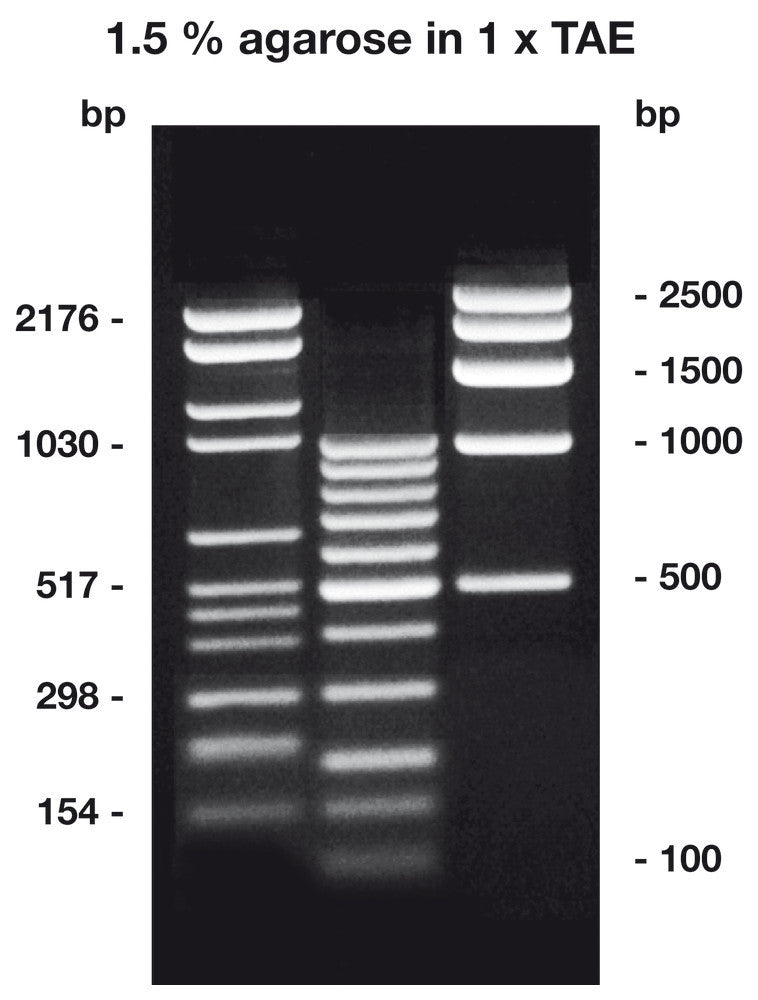
- Separation range in 1 x TAE:1 % proof agarose gel: 1000-3000 bp1,5 % proof agarose gel: 300-2000 bp2,5 % proof agarose gel: 100-1000 bp
| Application | Analysis of fragments between 100 and 3000 bp |