



Beschreibung
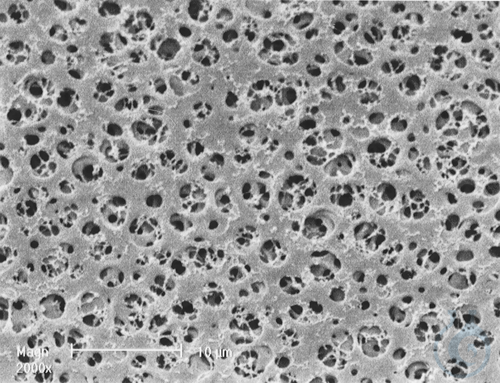
Cellulose acetate (CA) membrane filters with a pore size of 0,45 µm and a diameter of 47 mm combine high flow performance with good thermal resistance and low adsorption. These laboratory membranes support filtration workflows where consistent throughput and limited sample interaction are important. Cellulose acetate is well regarded for aqueous systems and related media that benefit from a low-adsorption surface. Supplied in a pack of 100 pieces from manufacturer Sartorius, the filters suit routine microbiology and general laboratory filtration tasks. The 0,45 µm pore rating is commonly chosen for clarifying solutions and retaining fine particulates under standard operating conditions. Good thermal resistance supports use across typical laboratory temperature ranges, while the low adsorption profile helps preserve sample integrity during processing. Originating from Germany, the discs integrate readily into pressure or vacuum filtration devices used in research and quality-control settings. Their balance of flow rate, thermal stability and low binding makes them a practical choice for everyday membrane filtration.
This article is part of Carbohydrates & sugars, in Biochemicals & reagents.
Key features
- Pack size: 100 pc(s)
- Storage temperature: Room Temperature
- Pore size: 0,45 µm
- Diameter: 47 mm
- Material: Cellulose acetate (CA)
- Sterility: No
Recent bekeken
Misschien vind je dit ook leuk
Browse related categories
Category
Sub-category
Catalogue
Brand
Questions about CA white, sterile, 0.45 m
What is this article?
CA white, sterile, 0.45 m is the article on this page. Luminix Health distributes Sartorius for laboratory use. It sits in Carbohydrates & sugars, inside Biochemicals & reagents, in Mikrobiologie.
A carbohydrate reagent is a sugar or a derivative, specified by identity, anomer where it matters, and purity. Hydrate and anhydrous forms change the mass. A culture-grade sugar and an analytical standard of the same name are different bottles.
A biochemical is a molecule of life, sold as a reagent: an amino acid, a sugar, a nucleotide, a lipid, an enzyme, an antibiotic. The difference from a bulk chemical is that the use is a biological one, and the impurities that matter are the ones that change that use. An enzyme is specified by activity, not only by mass. An antibiotic is specified by potency. Papers are on PubMed. Structures are on PubChem. Strains and lines that consume these reagents are at ATCC.
Which category should I open next?
The category is Biochemicals & reagents. The sub-category is Carbohydrates & sugars. The catalogue is Mikrobiologie.
Shelves beside this one are Amino acids & peptides, Coenzymes, nucleotides & vitamins, Biochemicals (other), Enzymes & substrates, Antibiotics & antimycotics, Lipids, steroids & fatty acids and Detergents & surfactants.
What should I check before I order?
When this page shows a safety data sheet, use that manufacturer file. Hazard text does not belong in the sales description. For a pack size, a grade or a certificate that is not on the page, send a quote request or contact the team.
How does ordering and shipping work?
Luminix Health distributes this article from the heart of Europe. Articles in stock ship within 2–5 business days. Standard delivery is free from €250 excl. VAT. Cold-chain goods and dangerous goods under ADR are never included in that free delivery. The terms are in the Shipping Policy. The full brand index is on shop by brand. Who we are is on about us.
Which other categories should I open?
The seven catalogues are Labware, Lab chemicals, Lab instruments, Lab consumables, Chromatography equipment, Lab safety equipment and Life Science & Microbiology.