



Beschreibung
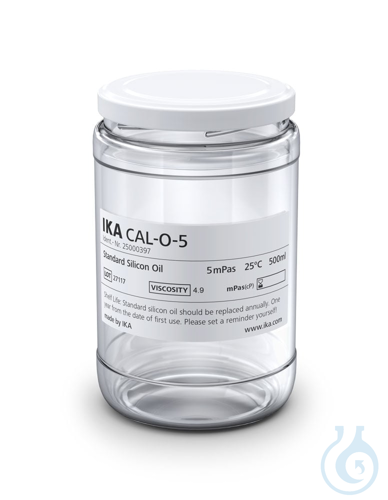
CAL-O-5 is a certified standard silicone oil with a defined viscosity of 5 mPas at 25 °C, supplied in a 500 ml pack. It is intended for verifying the measurement accuracy of ROTAVISC rotational viscometers in laboratory quality control and routine calibration work. The certificate is included with the product, supporting documented checks of instrument performance against a known reference viscosity. Other standard silicone oils with different viscosities or temperature conditions can be ordered to customer specification when required. This calibration fluid from manufacturer IKA provides a practical reference medium for viscosity measurement workflows in research, analytical and industrial laboratories. Net weight is 0,920 kg. The oil is non-sterile and suited to controlled laboratory environments where reliable viscosity standards are needed for instrument verification. Use CAL-O-5 whenever a low-viscosity silicone reference at 25 °C is specified for ROTAVISC accuracy checks.
This article is part of Microscopy stains & staining solutions, in Dyes, stains & indicators.
Key features
- Pack size: 500 ml
- Storage temperature: 5°C - 40°C
- Product type: Certified standard silicone oil
- Viscosity: 5 mPas at 25 °C
- EAN: 4053411048297
Recent bekeken
Misschien vind je dit ook leuk
Browse related categories
Category
Sub-category
Microscopy stains & staining solutions
Catalogue
Labor- und Industriechemikalien
Brand
Questions about CAL-O-5, Standard silicon oil, 5 mPas, 25?, 500 ml
What is this article?
CAL-O-5, Standard silicon oil, 5 mPas, 25?, 500 ml is the article on this page. Luminix Health distributes IKA for laboratory use. It sits in Microscopy stains & staining solutions, inside Dyes, stains & indicators, in Labor- und Industriechemikalien.
A microscopy stain binds a structure so it can be seen: haematoxylin on nuclei, eosin on cytoplasm, Gram reagents on a bacterial wall. A ready solution and a dry dye to be dissolved are different articles. The method names the stain. A substitute dye is a different method.
A dye or a stain binds, or changes colour, so that something invisible becomes visible. An indicator changes at a pH or a redox point. A fluorescent dye absorbs one wavelength and emits another, which is how a microscope or a plate reader picks it out. The excitation and emission, or the transition interval, are the specification. The colour name on the label is not. Structures are on PubChem under IUPAC names. Methods are in the PubMed literature.
Which category should I open next?
The category is Dyes, stains & indicators. The sub-category is Microscopy stains & staining solutions. The catalogue is Labor- und Industriechemikalien.
Shelves beside this one are Fluorescent dyes & labels and Dyes & pigments.
What should I check before I order?
When this page shows a safety data sheet, use that manufacturer file. Hazard text does not belong in the sales description. For a pack size, a grade or a certificate that is not on the page, send a quote request or contact the team.
How does ordering and shipping work?
Luminix Health distributes this article from the heart of Europe. Articles in stock ship within 2–5 business days. Standard delivery is free from €250 excl. VAT. Cold-chain goods and dangerous goods under ADR are never included in that free delivery. The terms are in the Shipping Policy. The full brand index is on shop by brand. Who we are is on about us.
Which other categories should I open?
The seven catalogues are Labware, Lab chemicals, Lab instruments, Lab consumables, Chromatography equipment, Lab safety equipment and Life Science & Microbiology.