


Beschreibung
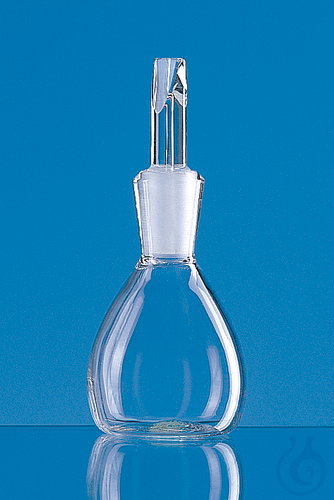
Pycnometer according to Gay-Lussac, 5 ml, not adjusted, Boro 3.3 is a classic laboratory glass vessel used for accurate density determination of liquids. Fabricated from borosilicate glass 3.3, it combines high chemical resistance with good thermal stability for everyday analytical work. The nominal volume of 5 ml (0,005 l) supports precise measurements once the exact capacity has been established by the user, as this model is supplied not adjusted. The traditional Gay-Lussac design incorporates a ground glass stopper with capillary bore that permits bubble-free filling and reliable temperature equilibration. Offered in packs of 2 pieces from manufacturer Brand, the pycnometer suits density determinations in quality-control, research and teaching laboratories. Its compact form and net weight of 0,03 kg allow convenient handling on analytical balances. The robust borosilicate glass 3.3 construction withstands repeated cleaning cycles and exposure to common laboratory reagents, ensuring long service life in chemical, pharmaceutical and materials-testing workflows that rely on standardised density protocols.
This article is part of Density meters & pycnometers, in Density & viscosity measurement.
Key features
- Pack size: 2 pc(s)
- Type: Pycnometer according to Gay-Lussac
- Nominal volume: 5 ml
- Material: Borosilicate glass 3.3
- Adjustment: Not adjusted
- EAN: 4033378242082
Recent bekeken
Misschien vind je dit ook leuk
Questions about Density bottle, Gay-Lussac pattern, 5 ml uncalibrated borosilicate gl. 3.3
What is this article?
Density bottle, Gay-Lussac pattern, 5 ml uncalibrated borosilicate gl. 3.3 is the article on this page. Luminix Health distributes BRAND for laboratory use. It sits in Density meters & pycnometers, inside Density & viscosity measurement, in Präzisionsinstrumente.
A pycnometer is a vessel of known volume that is weighed full. An oscillating density meter infers density from how a tube vibrates when it is filled. Both need temperature control. Air bubbles are the ordinary error.
Density is mass divided by volume. A hydrometer floats at a depth that depends on the density of the liquid. A pycnometer is a vessel of known volume that is weighed full. Viscosity is the resistance to flow. A capillary viscometer times how long a volume takes to fall through a tube. Both measurements need a stated temperature, because liquids change density and viscosity as they warm. The units trace to the BIPM and to NIST.
Which category should I open next?
The category is Density & viscosity measurement. The sub-category is Density meters & pycnometers. The catalogue is Präzisionsinstrumente.
Shelves beside this one are Hydrometers and Viscometers.
What should I check before I order?
When this page shows a safety data sheet, use that manufacturer file. Hazard text does not belong in the sales description. For a pack size, a grade or a certificate that is not on the page, send a quote request or contact the team.
How does ordering and shipping work?
Luminix Health distributes this article from the heart of Europe. Articles in stock ship within 2–5 business days. Standard delivery is free from €250 excl. VAT. Cold-chain goods and dangerous goods under ADR are never included in that free delivery. The terms are in the Shipping Policy. The full brand index is on shop by brand. Who we are is on about us.
Which other categories should I open?
The seven catalogues are Labware, Lab chemicals, Lab instruments, Lab consumables, Chromatography equipment, Lab safety equipment and Life Science & Microbiology.