


Beschreibung
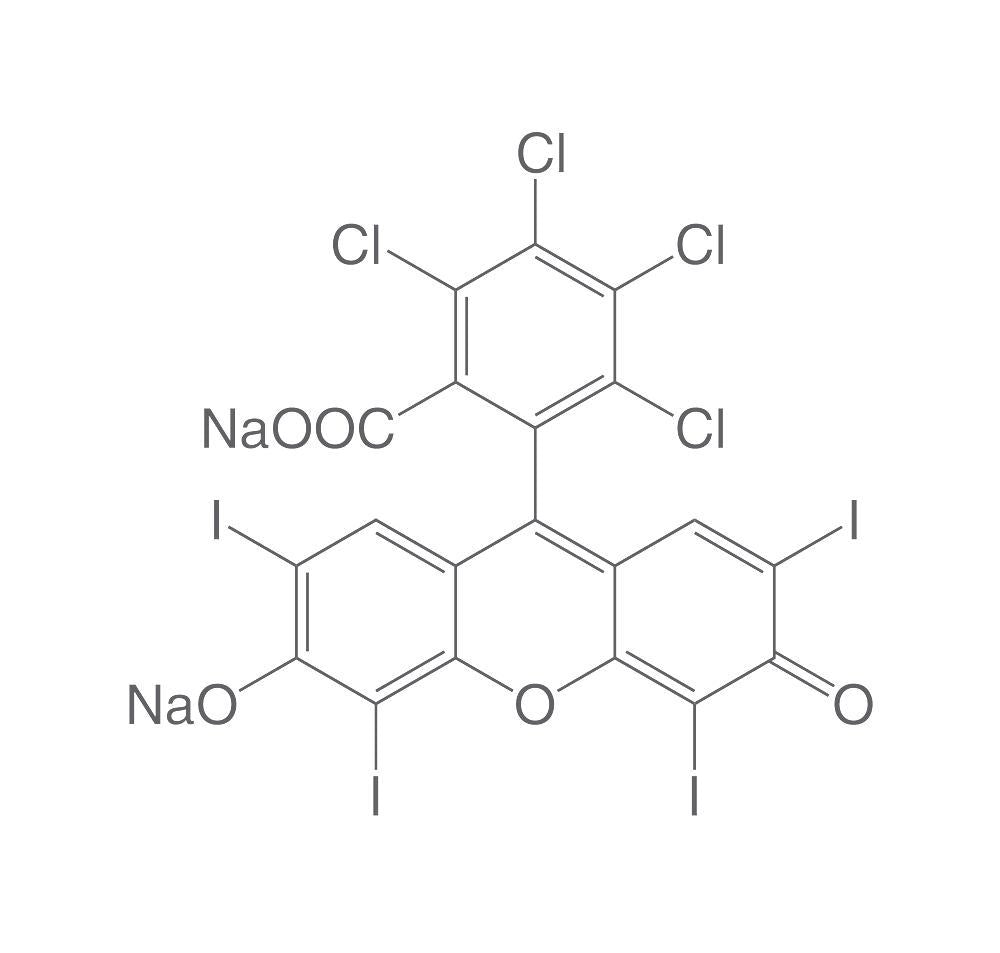
Rose Bengaal B (C.I. 45440) is een microscopiekleurstof die wordt geleverd voor biologische kleurtoepassingen, met CAS-nummer 632-69-9, EG-nr. 211-183-3 en empirische formule C₂₀H₂Cl₄I₄Na₂O₅. De molaire massa is 1017,65 g/mol en de dichtheid is 1 g/cm³, wat een nauwkeurige bereiding van kleurvloeistoffen in de histologie en aanverwant laboratoriumwerk ondersteunt. Rose Bengaal B wordt veel gebruikt waar selectief kleurgedrag vereist is voor microscopisch onderzoek van weefsels en cellulaire structuren. Het materiaal is verkrijgbaar bij fabrikant Carl ROTH, wordt geplaatst onder de kleurstoffen voor biologische toepassingen en laat zich eenvoudig integreren in gevestigde kleuringsprotocollen. Laboratoria kunnen het gebruiken voor de bereiding van voorraadoplossingen, methodeontwikkeling en dagelijkse microscopiekleuringen zonder onnodige herformulering. Duidelijke identiteitsgegevens — inclusief CAS, EG-nummer en formule — vergemakkelijken de documentatie, bestelling en kwaliteitscontrole in gereguleerde of onderzoeksomgevingen voor microscopie.
Dit artikel hoort thuis bij Gedehydrateerde kweekmedia (agar- & bouillonbases), in Kweekmedia & microbiologie. Zie ook Petrischalen.
Belangrijkste kenmerken
- Maximale absorptie: 540-555 nm
- Drogingsverlies (110 °C): ≤10 %
- CAS-nummer: 632-69-9
- Verpakkingsgroottes: 50 g, 5 g, 25 g
- EG-nr.: 211-183-3
- Empirische formule: C₂₀H₂Cl₄I₄Na₂O₅
- Dichtheid: 1 g/cm³
- Technisch informatieblad:

- Veiligheidsinformatieblad:
Recent bekeken
Misschien vind je dit ook leuk
Browse related categories
Category
Sub-category
Dehydrated culture media (agar & broth bases)
Catalogue
Brand
Questions about Rosea Bengala B (C.I. 45440), voor microscopie, 5 g, glas
What is this article?
Rosea Bengala B (C.I. 45440), voor microscopie, 5 g, glas is the article on this page. Luminix Health distributes Carl Roth for laboratory use. It sits in Dehydrated culture media (agar & broth bases), inside Culture media & microbiology, in Mikrobiologie.
A dehydrated medium is a powder the laboratory dissolves, sterilises and pours. The formulation name, the supplements it still needs, and the grams per litre are the specification. Two powders with similar names, one selective and one not, grow different organisms.
A culture medium is the food and the solid or liquid home of a microorganism. Dehydrated media are powders the laboratory dissolves and sterilises. Ready-to-use plates and tubes are already that. A Petri dish is the plate. Selective media let one kind of organism grow and hold another back. The formulation and the supplements, not the colour of the agar, are the specification. Reference strains are at ATCC. Methods are on PubMed. Biosafety practice is the WHO laboratory biosafety topic.
Which category should I open next?
The category is Culture media & microbiology. The sub-category is Dehydrated culture media (agar & broth bases). The catalogue is Mikrobiologie.
Shelves beside this one are Petri dishes, Ready-to-use culture media (plates, tubes, bottles), Microbiology (other), Inoculation loops, spreaders & needles and Microbial identification, hygiene monitoring & rapid tests.
What should I check before I order?
The technical information on this page is the manufacturer's sheet. Read that, not a rewritten specification.
When this page shows a safety data sheet, use that manufacturer file. Hazard text does not belong in the sales description. For a pack size, a grade or a certificate that is not on the page, send a quote request or contact the team.
How does ordering and shipping work?
Luminix Health distributes this article from the heart of Europe. Articles in stock ship within 2–5 business days. Standard delivery is free from €250 excl. VAT. Cold-chain goods and dangerous goods under ADR are never included in that free delivery. The terms are in the Shipping Policy. The full brand index is on shop by brand. Who we are is on about us.
Which other categories should I open?
The seven catalogues are Labware, Lab chemicals, Lab instruments, Lab consumables, Chromatography equipment, Lab safety equipment and Life Science & Microbiology.