



Beschreibung
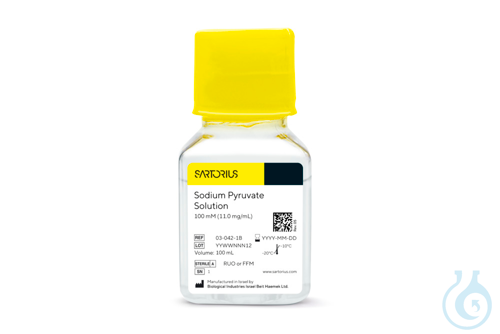
Sodium Pyruvate Solution 100 mM (11,0 mg/ml) is supplied in a convenient 100 ml pack size for laboratory cell-culture and media supplementation work. The solution is recognised as an easily accessible additional carbohydrate energy source, making it a practical additive where an extra energy substrate is required. Offered by manufacturer Sartorius, the ready-to-use liquid format simplifies handling and dosing in routine protocols. Net weight is 0,100 kg per unit, with a corresponding gross weight of 0,120 kg. The product supports standard laboratory workflows that benefit from a defined pyruvate concentration of 100 mM, equivalent to 11,0 mg/ml. Packaged as one piece, it integrates readily into existing media-preparation and culture procedures without further dilution steps when the stated concentration matches experimental needs. This sodium pyruvate solution provides a straightforward energy-source option for research and production laboratories seeking consistent carbohydrate supplementation.
This article is part of Cell culture media & sera, in Cell culture.
Key features
- Pack size: 1 pc
- Storage temperature: -20 °C
- Concentration: 100 mM
- Content: 11,0 mg/ml
- Volume: 100 ml
Recent bekeken
Misschien vind je dit ook leuk
Browse related categories
Category
Sub-category
Catalogue
Brand
Questions about Sodium Pyruvate Solution 100mM
What is this article?
Sodium Pyruvate Solution 100mM is the article on this page. Luminix Health distributes Sartorius for laboratory use. It sits in Cell culture media & sera, inside Cell culture, in Mikrobiologie.
Cell-culture medium is the liquid a cell line grows in. Serum, often fetal bovine, supplies what the basal medium does not. With or without glutamine, with or without phenol red, and the serum origin are different products. Serum is a cold-chain article and is never part of free standard delivery.
Cell culture grows cells outside the body. The medium, often with serum, supplies what the flask does not. A flask or a dish is the vessel, treated so the cells attach or left untreated so they float. Contamination by microbes, or by another cell line, is the ordinary failure. Cold-chain articles in this work, including serum, are never part of free standard delivery. Lines are catalogued by ATCC. Papers are on PubMed. Practice is summarised by the WHO laboratory biosafety topic.
Which category should I open next?
The category is Cell culture. The sub-category is Cell culture media & sera. The catalogue is Mikrobiologie.
Shelves beside this one are Cell culture accessories, Cell culture flasks, Cell culture plates & dishes and Cell strainers, inserts & scrapers.
What should I check before I order?
When this page shows a safety data sheet, use that manufacturer file. Hazard text does not belong in the sales description. For a pack size, a grade or a certificate that is not on the page, send a quote request or contact the team.
How does ordering and shipping work?
Luminix Health distributes this article from the heart of Europe. Articles in stock ship within 2–5 business days. Standard delivery is free from €250 excl. VAT. Cold-chain goods and dangerous goods under ADR are never included in that free delivery. The terms are in the Shipping Policy. The full brand index is on shop by brand. Who we are is on about us.
Which other categories should I open?
The seven catalogues are Labware, Lab chemicals, Lab instruments, Lab consumables, Chromatography equipment, Lab safety equipment and Life Science & Microbiology.