
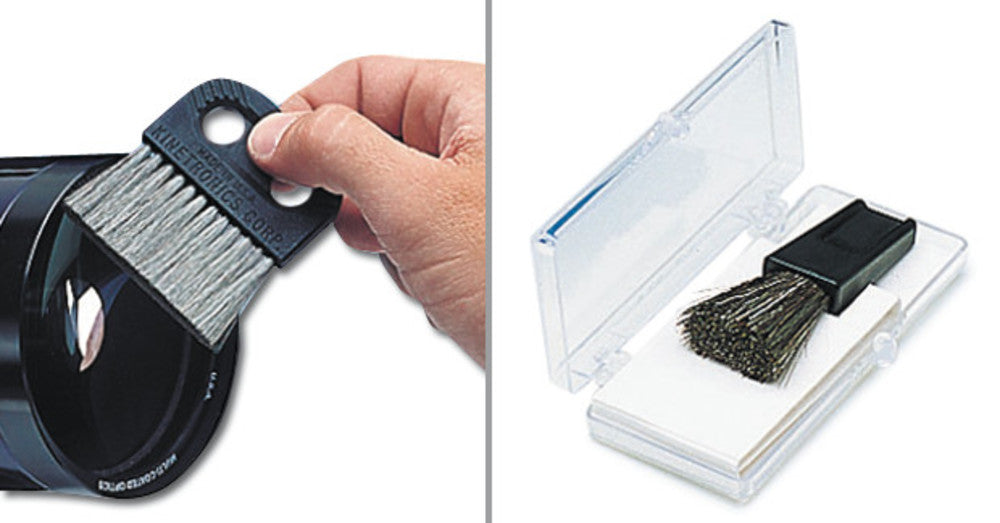


Description
Antistatic brush, width 30 mm is a laboratory cleaning aid intended for controlled removal of dust and loose particles from sensitive work areas and equipment. The brush head combines natural and synthetic fibres and is specified for use up to a maximum of 65 °C, supporting routine cleaning under typical ambient laboratory conditions. A working width of 30 mm gives focused contact for instruments, housings, benches and other surfaces where electrostatic charge can attract debris. Offered as a single piece with a net weight of 0,060 kg, it packs easily into standard cleaning kits and service trays. This antistatic brush from manufacturer Carl ROTH sits in the labware cleaning range alongside other brushes and sponges used for day-to-day care of glassware, plasticware and apparatus. Technicians employ such tools to limit particulate contamination, keep optical and electronic-adjacent zones tidy and maintain orderly sample-handling spaces without aggressive abrasion. The compact format suits both fixed clean-up stations and mobile carts, providing a practical accessory for analytical, teaching and general research laboratories that require reliable, low-impact surface maintenance as part of regular housekeeping routines.
This article is part of Brushes & cleaning tools, in Tools & accessories.
Key features
- Pack size: 1 pc
- Product type: Antistatic brush
- Width: 30 mm
- Fibre material: Natural and synthetic fibres
- Max. temperature: 65 °C
- Weight: 0,060 kg
Recently viewed
You may also like
Browse related categories
Category
Sub-category
Catalogue
Brand
Questions about Antistatic-brush, width 30 mm, natural a. synthetic fibres max. 65 °C
What is this article?
Antistatic-brush, width 30 mm, natural a. synthetic fibres max. 65 °C is the article on this page. Luminix Health distributes Carl Roth for laboratory use. It sits in Brushes & cleaning tools, inside Tools & accessories, in Labware.
A laboratory brush reaches the inside of a burette, a flask or a tube that a cloth cannot enter. The bristle and the shape have to match the bore, or the brush becomes the thing that scratches the volumetric mark.
The small tools of the bench are what the hand actually holds: a spatula for a powder, forceps for an object that must stay clean, a brush for a narrow neck, a desiccator when a dried sample must not take up water again. None of these reads a measurement. They keep the measurement possible. The apparatus around them is listed under ISO laboratory apparatus.
Which category should I open next?
The category is Tools & accessories. The sub-category is Brushes & cleaning tools. The catalogue is Labware.
Shelves beside this one are Spatulas & spoons, Other lab tools & accessories, Lab furniture, trolleys & storage, Tweezers & forceps, Scissors, scalpels & dissecting instruments, Weighing boats, dishes & paper, Desiccators & desiccant, Grease, boiling stones & sealants, Timers, stopwatches & calculators, Stationery, books & lab notebooks, Stirring rods, spreaders & glass tools, Cutting & sealing tools and Gas handling & burners accessories.
What should I check before I order?
The technical information on this page is the manufacturer's sheet. Read that, not a rewritten specification.
When this page shows a safety data sheet, use that manufacturer file. Hazard text does not belong in the sales description. For a pack size, a grade or a certificate that is not on the page, send a quote request or contact the team.
How does ordering and shipping work?
Luminix Health distributes this article from the heart of Europe. Articles in stock ship within 2–5 business days. Standard delivery is free from €250 excl. VAT. Cold-chain goods and dangerous goods under ADR are never included in that free delivery. The terms are in the Shipping Policy. The full brand index is on shop by brand. Who we are is on about us.
Which other categories should I open?
The seven catalogues are Labware, Lab chemicals, Lab instruments, Lab consumables, Chromatography equipment, Lab safety equipment and Life Science & Microbiology.