
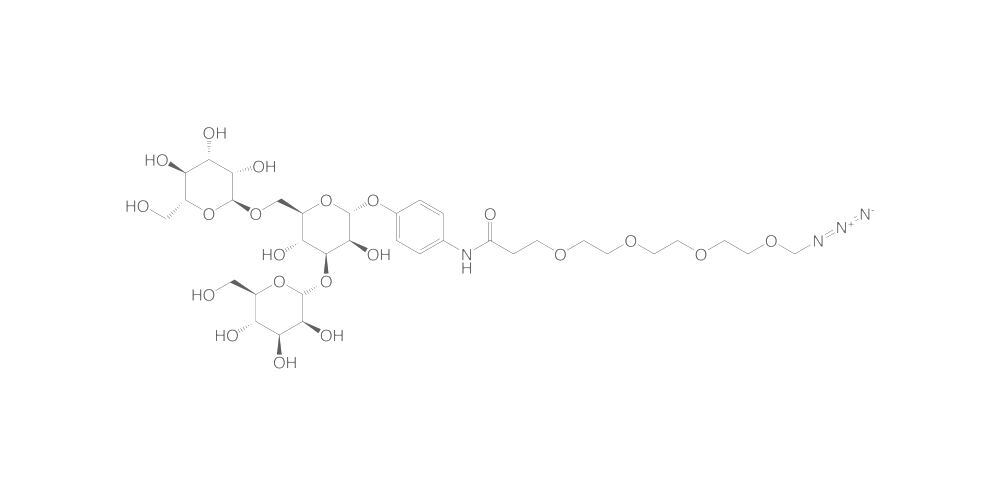



Description
Azido-PEG4-Trimannose is a specialised carbohydrate conjugate for click chemistry and mRNA-related research, offered at a minimum purity of 95 %. With the empirical formula C₃₅H₅₆N₄O₂₁ and a molar mass of 868,33 g/mol, this azide-functionalised PEG4-linked trimannose building block supports bioorthogonal ligation where mannose recognition and azide–alkyne cycloaddition are required. It is Produced by manufacturer baseclick, the reagent fits workflows spanning click chemistry reagent sets and mRNA synthesis support chemistry. The terminal azide enables copper-catalysed or strain-promoted click reactions, while the trimannose moiety provides multivalent carbohydrate presentation for glycan-focused probes and conjugation studies. The compact pack size helps conserve material during protocol optimisation, probe assembly, and related synthetic biology experiments. Use under standard laboratory controls for azide-bearing organic reagents and consult the safety documentation before handling.
This article is part of Carbohydrates & sugars, in Biochemicals & reagents.
Key features
- Appearance: white amorphous solid
- Purity (HPLC): ≥95 %
- Pack sizes: 5 mg, 10 mg
- Purity: min. 95 %
- Empirical formula: C₃₅H₅₆N₄O₂₁
- Molar mass: 868,33 g/mol
- Technical Information Sheet:

- Safety Data Sheet:
Recently viewed
You may also like
Browse related categories
Category
Sub-category
Catalogue
Brand
Questions about Azido-PEG4-Trimannose, min. 95 %, 5 mg, plastic
What is this article?
Azido-PEG4-Trimannose, min. 95 %, 5 mg, plastic is the article on this page. Luminix Health distributes baseclick for laboratory use. It sits in Carbohydrates & sugars, inside Biochemicals & reagents, in Microbiology lab supplies.
A carbohydrate reagent is a sugar or a derivative, specified by identity, anomer where it matters, and purity. Hydrate and anhydrous forms change the mass. A culture-grade sugar and an analytical standard of the same name are different bottles.
A biochemical is a molecule of life, sold as a reagent: an amino acid, a sugar, a nucleotide, a lipid, an enzyme, an antibiotic. The difference from a bulk chemical is that the use is a biological one, and the impurities that matter are the ones that change that use. An enzyme is specified by activity, not only by mass. An antibiotic is specified by potency. Papers are on PubMed. Structures are on PubChem. Strains and lines that consume these reagents are at ATCC.
Which category should I open next?
The category is Biochemicals & reagents. The sub-category is Carbohydrates & sugars. The catalogue is Microbiology lab supplies.
Shelves beside this one are Amino acids & peptides, Coenzymes, nucleotides & vitamins, Biochemicals (other), Enzymes & substrates, Antibiotics & antimycotics, Lipids, steroids & fatty acids and Detergents & surfactants.
What should I check before I order?
When this page shows a safety data sheet, use that manufacturer file. Hazard text does not belong in the sales description. For a pack size, a grade or a certificate that is not on the page, send a quote request or contact the team.
How does ordering and shipping work?
Luminix Health distributes this article from the heart of Europe. Articles in stock ship within 2–5 business days. Standard delivery is free from €250 excl. VAT. Cold-chain goods and dangerous goods under ADR are never included in that free delivery. The terms are in the Shipping Policy. The full brand index is on shop by brand. Who we are is on about us.
Which other categories should I open?
The seven catalogues are Labware, Lab chemicals, Lab instruments, Lab consumables, Chromatography equipment, Lab safety equipment and Life Science & Microbiology.