



Description
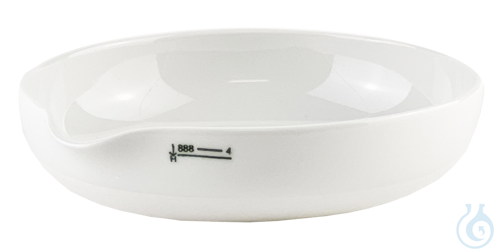
Evaporating dishes made of porcelain, flat form, approx. 100 mm Ø are laboratory vessels used for solvent removal and concentration of solutions in analytical and preparative work. These dishes feature porcelain construction in a flat form with an approximate diameter of 100 mm, providing a broad surface that supports even evaporation. The pack size is 1 pc, suited to individual bench use or replacement in existing sets. Manufactured by Hecht, the porcelain material aligns with standard laboratory requirements for chemical handling during heating and drying steps. Typical applications include sample preparation, residue isolation, crystallization support, and gentle concentration of aqueous or organic mixtures on hot plates or in drying equipment. The flat profile ensures stable positioning while the 100 mm scale offers practical capacity for routine volumes without excessive bulk. Such porcelain evaporating dishes integrate into workflows in research, quality-control, and teaching laboratories where reliable open vessels are needed for thermal processing of liquids. Their simple geometry facilitates cleaning and repeated use across successive evaporation cycles under controlled laboratory conditions.
This article is part of Evaporating dishes, in Dishes, crucibles & porcelain.
Key features
- Pack size: 1 pc
- Product type: Evaporating dish
- Material: Porcelain
- Form: Flat
- Diameter: approx. 100 mm
Recently viewed
You may also like
Browse related categories
Category
Sub-category
Catalogue
Brand
Questions about Evaporating dishes of porcelain flat shape ca. 100 mm Ø
What is this article?
Evaporating dishes of porcelain flat shape ca. 100 mm Ø is the article on this page. Luminix Health distributes Hecht for laboratory use. It sits in Evaporating dishes, inside Dishes, crucibles & porcelain, in Labware.
An evaporating dish is a shallow porcelain or glass dish used to drive off a liquid over heat. The flat form gives surface area. Porcelain takes a higher heat than borosilicate. It is not a crucible and it is not a volumetric vessel.
A dish is an open vessel for drying, evaporating or holding a solid. Porcelain and glazed ceramic take a higher temperature than borosilicate glass, which is why a crucible, not a beaker, goes into a furnace. A watch glass covers, or holds a small amount for drying. A mortar is for grinding. The temperature and the chemical, not the shape alone, choose the material. Laboratory ware of this family is listed under ISO laboratory ware.
Which category should I open next?
The category is Dishes, crucibles & porcelain. The sub-category is Evaporating dishes. The catalogue is Labware.
Shelves beside this one are Crucibles, Trays, bowls & tubs, Mortars & pestles, Watch glasses & crystallising dishes and Dishes (other).
What should I check before I order?
When this page shows a safety data sheet, use that manufacturer file. Hazard text does not belong in the sales description. For a pack size, a grade or a certificate that is not on the page, send a quote request or contact the team.
How does ordering and shipping work?
Luminix Health distributes this article from the heart of Europe. Articles in stock ship within 2–5 business days. Standard delivery is free from €250 excl. VAT. Cold-chain goods and dangerous goods under ADR are never included in that free delivery. The terms are in the Shipping Policy. The full brand index is on shop by brand. Who we are is on about us.
Which other categories should I open?
The seven catalogues are Labware, Lab chemicals, Lab instruments, Lab consumables, Chromatography equipment, Lab safety equipment and Life Science & Microbiology.