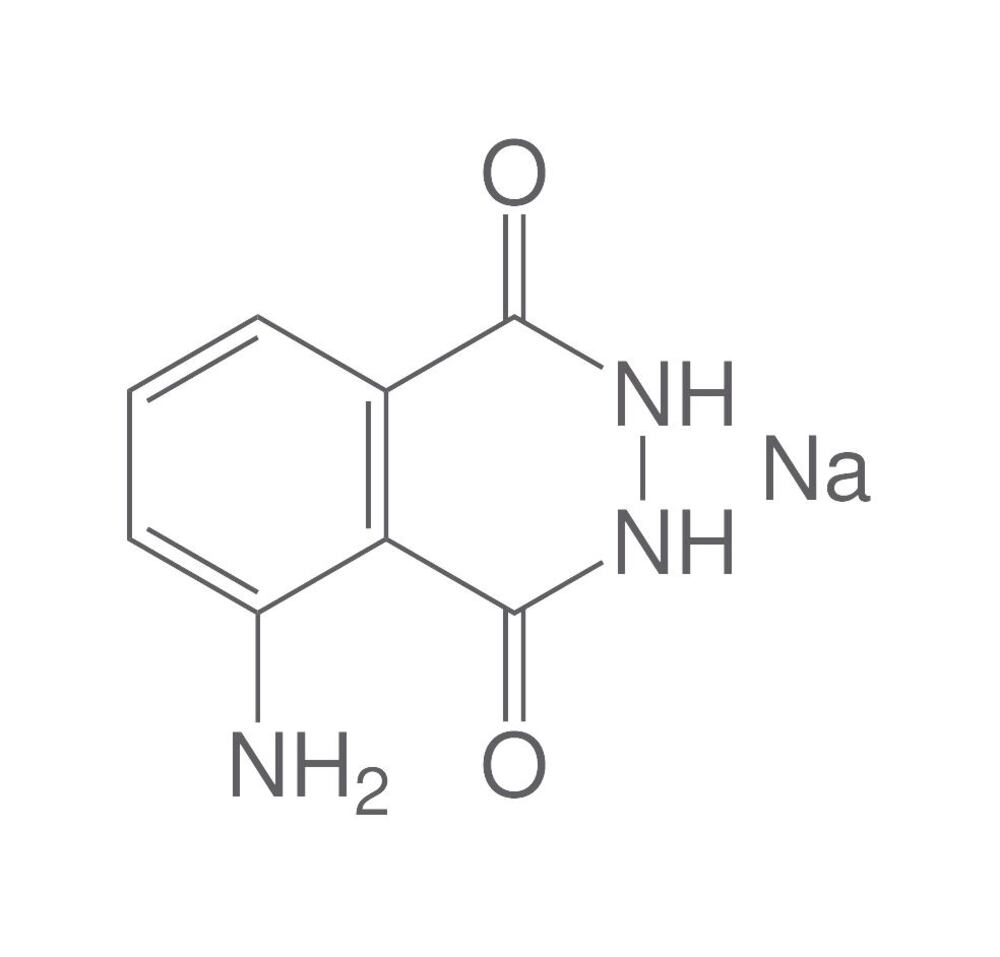


Description
Luminol sodium salt is a chemiluminescent biochemical reagent with CAS number 20666-12-0 and empirical formula C₈H₆N₃O₂Na. Its molar mass is 199,14 g/mol, supporting precise stoichiometric work in analytical and life-science laboratories. The ionic salt improves handling and dissolution compared with the free acid in many aqueous buffer systems, making it suitable for method development, teaching laboratories, and routine analytical workflows. Researchers value luminol-based reagents for their strong light-emitting response under alkaline oxidative conditions, enabling visual or instrumental readout with high contrast. This material fits biochemical catalogues focused on detection chemistry and specialty organic salts. Clear identification via CAS and molecular formula supports documentation, inventory control, and reproducible preparation of working solutions across research and quality-control environments.
This article is part of Enzymes & substrates, in Biochemicals & reagents.
Key features
- Colour: white to yellow to light green
- Form: powder to crystalline powder
- Water content (KF): ≤30 %
- Purity (HPLC): ≥98 %
- IR-spectrum: complies
- CAS number: 20666-12-0
- Pack sizes: 10 g, 25 g, 50 g, 100 g
- Empirical formula: C₈H₆N₃O₂Na
- Molar mass: 199,14 g/mol
- Storage temperature: +2 to +8 °C
- Technical Information Sheet:

- Safety Data Sheet:
Compliance & Safety Information
 Warning
Hazard Statements (H-Phrases)
Recently viewed
You may also like
Browse related categories
Category
Sub-category
Catalogue
Brand
Questions about Luminol sodium salt, 10 g
What is this article?
Luminol sodium salt, 10 g is the article on this page. Luminix Health distributes Carl Roth for laboratory use. It sits in Enzymes & substrates, inside Biochemicals & reagents, in Microbiology lab supplies.
An enzyme is sold by activity, in units defined by a stated reaction, not only by milligrams. Source and specific activity are the specification. A substrate is the molecule that enzyme converts, often a chromogenic one so the reaction can be seen. Units from two suppliers are comparable only when the definition matches.
A biochemical is a molecule of life, sold as a reagent: an amino acid, a sugar, a nucleotide, a lipid, an enzyme, an antibiotic. The difference from a bulk chemical is that the use is a biological one, and the impurities that matter are the ones that change that use. An enzyme is specified by activity, not only by mass. An antibiotic is specified by potency. Papers are on PubMed. Structures are on PubChem. Strains and lines that consume these reagents are at ATCC.
Which category should I open next?
The category is Biochemicals & reagents. The sub-category is Enzymes & substrates. The catalogue is Microbiology lab supplies.
Shelves beside this one are Amino acids & peptides, Carbohydrates & sugars, Coenzymes, nucleotides & vitamins, Biochemicals (other), Antibiotics & antimycotics, Lipids, steroids & fatty acids and Detergents & surfactants.
What should I check before I order?
When this page shows a safety data sheet, use that manufacturer file. Hazard text does not belong in the sales description. For a pack size, a grade or a certificate that is not on the page, send a quote request or contact the team.
How does ordering and shipping work?
Luminix Health distributes this article from the heart of Europe. Delivery across Europe, two to five days when in stock. Standard delivery is free from €250 excl. VAT. Cold-chain goods and dangerous goods under ADR are never included in that free delivery. The terms are in the Shipping Policy. The full brand index is on shop by brand. Who we are is on about us.
Which other categories should I open?
The seven catalogues are Labware, Lab chemicals, Lab instruments, Lab consumables, Chromatography equipment, Lab safety equipment and Life Science & Microbiology.