


Description
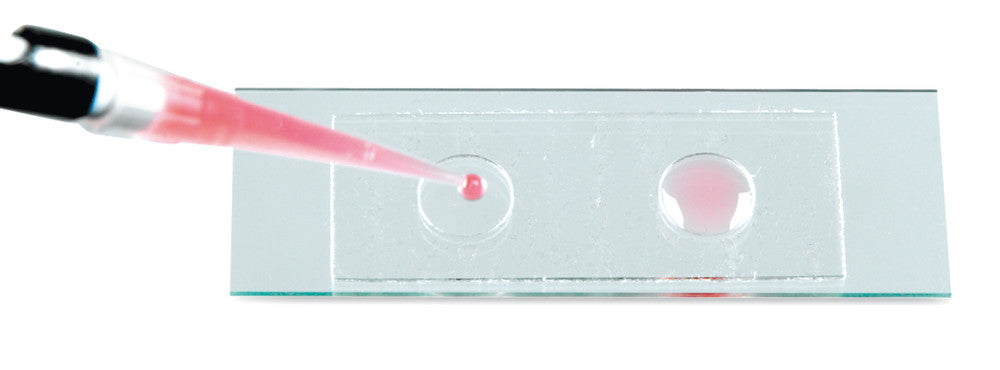
Marking films for microscope slides with two recesses of diameter 0,25 mm are dedicated microscopy accessories for clear, reproducible specimen orientation and field marking on standard slides. The films support histology, cytology, and general light-microscopy workflows where defined circular recesses help locate or frame regions of interest under the objective. Each pack contains 25 pc(s) and has a total weight of 0,017 kg, so stocks remain compact for teaching labs, core facilities, and routine diagnostic benches. These marking films from manufacturer ROTH SELECTION sit within microscopy accessories and broader labware ranges used alongside slides, coverslips, and staining protocols. The dual-recess layout offers two marked zones per film, which is useful when comparing fields or documenting paired observations on one slide. Diameter 0,25 mm suits fine-scale marking tasks that must remain compatible with typical slide real estate. Laboratories can standardise slide preparation and documentation by using a consistent film format across multiple users and instruments, simplifying training and sample hand-over between microscopy stations.
This article is part of Microscope slides & cover glasses, in Microscopy & histology.
Key features
- Pack size: 25 pc(s)
- Product type: Marking films for microscope slides
- Recesses: 2
- Recess diameter: 0,25 mm
- Weight: 0,017 kg
- Application area: Microscopy and histology
Recently viewed
You may also like
Questions about Marking films for microscope slides, 2 recesses, D 0,25 mm, 25 unit(s)
What is this article?
Marking films for microscope slides, 2 recesses, D 0,25 mm, 25 unit(s) is the article on this page. Luminix Health distributes Carl Roth for laboratory use. It sits in Microscope slides & cover glasses, inside Microscopy & histology, in Lab instruments.
A slide is the glass a specimen sits on. A cover glass is the thin sheet over it, of a thickness the objective was designed for. A cover glass of the wrong thickness softens the image. Charged and plain slides hold sections differently.
A light microscope forms an image with glass lenses and transmitted or reflected light. A stereo microscope is the lower-magnification instrument for dissecting and for looking at a surface. Fluorescence needs a light source and filters matched to the dye. Histology is the preparation that makes a tissue readable: fixation, a cassette, a section, a stain. The objective's magnification and numerical aperture decide the resolution. The slide and the cover glass decide whether the section sits in the focal plane. Stains and dyes as substances are identified on PubChem. Papers on the methods are on PubMed.
Which category should I open next?
The category is Microscopy & histology. The sub-category is Microscope slides & cover glasses. The catalogue is Lab instruments.
Shelves beside this one are Microscope objectives, eyepieces & optics, Histology cassettes & moulds, Counting chambers & haemocytometers, Stereo microscopes, Light & fluorescence microscopes, Histology reagents & consumables, Microscopy accessories, Cold light sources & lighting and Digital & USB microscopes.
What should I check before I order?
The technical information on this page is the manufacturer's sheet. Read that, not a rewritten specification.
When this page shows a safety data sheet, use that manufacturer file. Hazard text does not belong in the sales description. For a pack size, a grade or a certificate that is not on the page, send a quote request or contact the team.
How does ordering and shipping work?
Luminix Health distributes this article from the heart of Europe. Delivery across Europe, two to five days when in stock. Standard delivery is free from €250 excl. VAT. Cold-chain goods and dangerous goods under ADR are never included in that free delivery. The terms are in the Shipping Policy. The full brand index is on shop by brand. Who we are is on about us.
Which other categories should I open?
The seven catalogues are Labware, Lab chemicals, Lab instruments, Lab consumables, Chromatography equipment, Lab safety equipment and Life Science & Microbiology.