
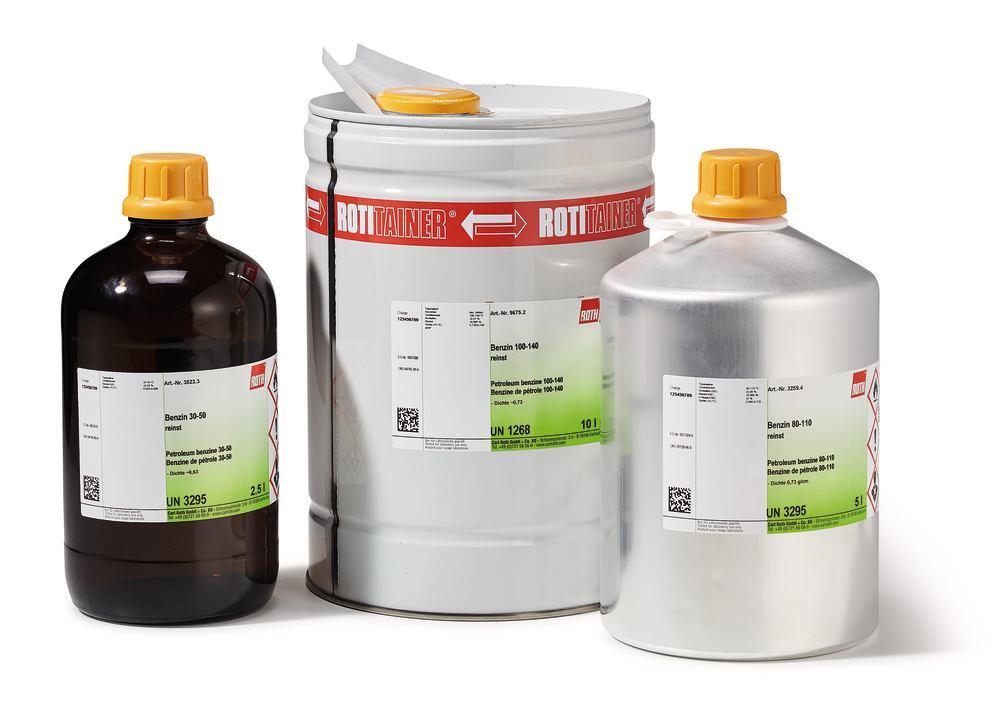


Description
Petroleum benzine 60-70 is an extra pure hydrocarbon solvent fraction intended for laboratory and technical use. It is defined by a boiling range of 65 to 70 °C, a density of 0,675 g/cm³ and a flash point of −26 °C, and is identified under CAS number 64742-49-0 and EG nr. 925-292-5 (UN 1208). The controlled boiling interval supports reproducible evaporation behaviour and consistent handling in fume-hood operations. Physical data from manufacturer Carl ROTH allow straightforward integration into existing SOPs and risk assessments. The clear glass bottle supports visual inspection of the contents and convenient dispensing for routine bench work. Choose this petroleum benzine when an extra pure 60–70 fraction with documented density, flash point and boiling range is needed for chemical, quality-control or research applications.
This article is part of Chromatography standards (GC, HPLC, pesticides), in Analytical standards & reference materials.
Key features
- Boiling range: 60-70 °C
- Aromatic compounds (GC): ≤0,01 %
- Density (15 °C): 0,670-0,680
- CAS number: 64742-49-0
- Pack sizes: 1 l, 10 l, 200 l, 20 l, 2.5 l, 5 l, 25 l
- Density: 0,675 g/cm³
- Flash point: −26 °C
- Boiling point: 65 to 70 °C
- Technical Information Sheet:

- Safety Data Sheet:
Compliance & Safety Information
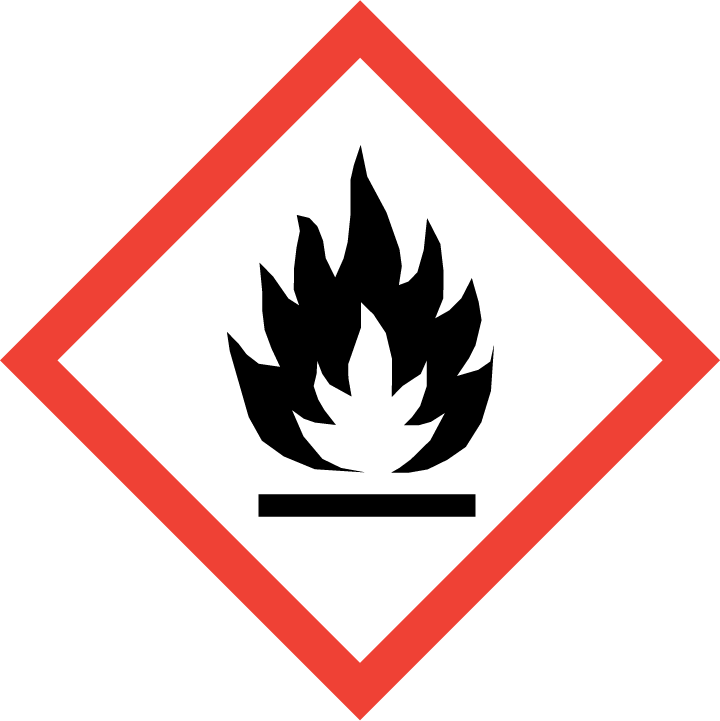


 Danger
Hazard Statements (H-Phrases)
Precautionary Statements (P-Phrases)
Recently viewed
You may also like
Questions about Petroleum benzine 60-70, extra pure, 1 l, glass
What is this article?
Petroleum benzine 60-70, extra pure, 1 l, glass is the article on this page. Luminix Health distributes Carl Roth for laboratory use. It sits in Technical & synthesis grade solvents, inside Solvents, in Lab chemicals.
Technical and synthesis grades are for cleaning, for a coarse extraction and for chemistry that does not end in a chromatogram. They cost less because more impurity is allowed. They are the wrong bottle to make a mobile phase or a volumetric standard.
A solvent dissolves. The grade says which impurities are low enough for the method. Analytical grade is the ordinary pure solvent. HPLC and LC-MS grades limit the absorbance and the ions that would become peaks or background. A dry solvent has had water removed. A deuterated solvent is for NMR, where the hydrogen signal would otherwise drown the sample. Technical grade is for cleaning and for synthesis that does not need a chromatogram. Identity is on PubChem. Names follow IUPAC. Hazards follow ECHA, the CLP Regulation and REACH.
Which category should I open next?
The category is Solvents. The sub-category is Technical & synthesis grade solvents. The catalogue is Lab chemicals.
Shelves beside this one are Analytical grade solvents (p.a.), HPLC & LC-MS grade solvents, Dry & deuterated solvents (NMR, synthesis) and Green & alternative solvents.
What should I check before I order?
When this page shows a safety data sheet, use that manufacturer file. Hazard text does not belong in the sales description. For a pack size, a grade or a certificate that is not on the page, send a quote request or contact the team.
How does ordering and shipping work?
Luminix Health distributes this article from the heart of Europe. Articles in stock ship within 2–5 business days. Standard delivery is free from €250 excl. VAT. Cold-chain goods and dangerous goods under ADR are never included in that free delivery. The terms are in the Shipping Policy. The full brand index is on shop by brand. Who we are is on about us.
Which other categories should I open?
The seven catalogues are Labware, Lab chemicals, Lab instruments, Lab consumables, Chromatography equipment, Lab safety equipment and Life Science & Microbiology.