
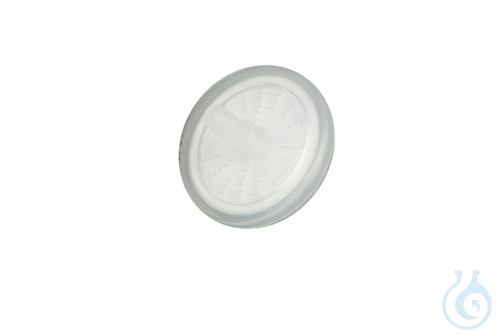


Description
qpore® syringe filter with a sterile, hydrophobic PTFE membrane (0,22 µm, Ø 33 mm) is designed for filtration tasks that demand high chemical resistance. The polytetrafluoroethylene membrane is biologically and chemically inert and supports high flow rates while keeping dead volume low. Stable across pH 1–14 and free from DNA, DNase, RNase and pyrogens, it helps protect sensitive sample integrity during preparation and clarification of aggressive or non-aqueous media. Female and male Luer-Lock connections ensure secure syringe attachment, and clear labelling of membrane type and pore size reduces mix-ups at the bench. Supplied as 100 individually sterile packed units from manufacturer neolab - Labor, these filters suit routine laboratory workflows where chemical inertness, sterility and reliable retention at 0,22 µm are required. The 33 mm membrane format balances filtration area with practical handling for sample volumes typical in analytical and life-science laboratories.
This article is part of Syringe filters, in Filtration.
Key features
- Pack size: 100 pc(s), individually sterile packed
- Membrane material: PTFE (polytetrafluoroethylene)
- Pore size: 0,22 µm
- Membrane diameter: 33 mm
- Surface character: Sterile, hydrophobic
- EAN: 4058072171964
Recently viewed
You may also like
Browse related categories
Category
Sub-category
Catalogue
Brand
Questions about qpore® Spritzenvorsatzfilter, PTFE, steril, hydrophob, 0,22 µm, Ø 33 mm
What is this article?
qpore® Spritzenvorsatzfilter, PTFE, steril, hydrophob, 0,22 µm, Ø 33 mm is the article on this page. Luminix Health distributes neolab for laboratory use. It sits in Syringe filters, inside Filtration, in Lab consumables.
A syringe filter is a membrane in a plastic housing on a Luer fitting. Pore size, membrane polymer and diameter are the three choices. 0.2 µm is the sterilising and the HPLC-particle cut. 0.45 µm is the coarser clarification. Aqueous and solvent-resistant membranes are different polymers.
Filtration holds back what is larger than the pores and lets the rest through. Paper is the ordinary laboratory filter. A membrane has a stated pore size and a polymer that must survive the solvent. A syringe filter is that membrane in a housing on a syringe. Glass fibre takes a higher dirt load. Ultrafiltration holds back macromolecules and passes salts. The pore size, the chemical compatibility and the volume are the three choices. Laboratory apparatus around filtration is indexed under ISO laboratory apparatus.
Which category should I open next?
The category is Filtration. The sub-category is Syringe filters. The catalogue is Lab consumables.
Shelves beside this one are Filter paper, Sintered glass filter plates & discs, Filter cartridges & capsules, Membrane filters, Glass & quartz fibre filters, Bottle-top & vacuum filtration units, Ultrafiltration & concentrators, Filtration accessories, Extraction thimbles and Dialysis tubing & devices.
What should I check before I order?
When this page shows a safety data sheet, use that manufacturer file. Hazard text does not belong in the sales description. For a pack size, a grade or a certificate that is not on the page, send a quote request or contact the team.
How does ordering and shipping work?
Luminix Health distributes this article from the heart of Europe. Articles in stock ship within 2–5 business days. Standard delivery is free from €250 excl. VAT. Cold-chain goods and dangerous goods under ADR are never included in that free delivery. The terms are in the Shipping Policy. The full brand index is on shop by brand. Who we are is on about us.
Which other categories should I open?
The seven catalogues are Labware, Lab chemicals, Lab instruments, Lab consumables, Chromatography equipment, Lab safety equipment and Life Science & Microbiology.