


Description
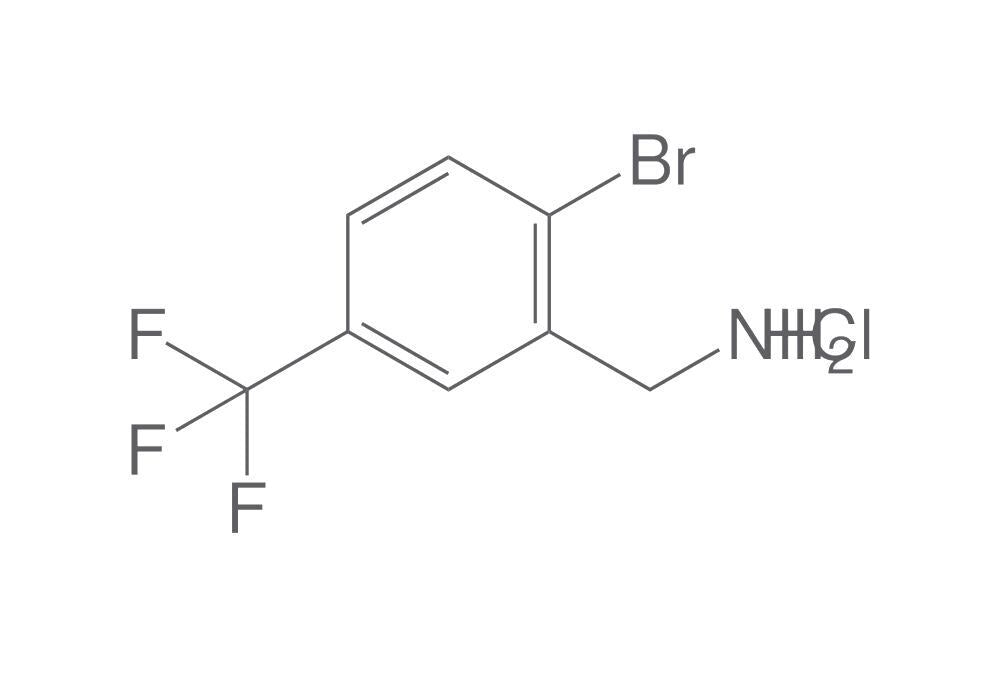
Le chlorhydrate de 2-bromo-5-(trifluorométhyl)benzylamine est un sel de benzylamine substitué conçu pour être utilisé comme intermédiaire de synthèse en chimie organique et médicinale. Le composé est enregistré sous le numéro CAS 1214331-01-7, possède la formule brute C₈H₇BrF₃NHCl et une masse molaire de 290,51 g/mol. Son noyau aromatique porte à la fois un atome de brome et un groupe trifluorométhyle ainsi qu'une amine primaire sous forme de chlorhydrate, permettant des réactions sélectives de couplage croisé, de substitution nucléophile et de formation de liaisons amide. Ces benzylamines trifluorométhylées halogénées sont appréciées en chimie exploratoire pour introduire des motifs lipophiles et électro-attracteurs dans les molécules cibles. La forme sel de chlorhydrate facilite le pesage et la manipulation dans les flux de travail de synthèse courants. Ce réactif est destiné à des applications de recherche professionnelle dans des laboratoires chimiques et biochimiques nécessitant des blocs de construction aromatiques définis pour des synthèses multi-étapes et des programmes d'optimisation de structure.
Cet article appartient à la catégorie Photomètres & spectrophotomètres, dans Spectroscopie & photométrie.
Caractéristiques principales
- Dosage : ≥ 95 %
- Couleur : signalée
- Forme : signalée
- Numéro CAS : 1214331-01-7
- Conditionnements : 5 g, 10 g
- Formule brute : C₈H₇BrF₃NHCl
- Masse molaire : 290,51 g/mol
- Fiche technique :

- Fiche de données de sécurité :
Compliance & Safety Information
 Attention
Hazard Statements (H-Phrases)
Récemment consulté
Vous aimerez peut-être aussi
Questions about Chlorhydrate de 2-bromo-5-(trifluorométhyl)benzylamine, 5 g
What is this article?
Chlorhydrate de 2-bromo-5-(trifluorométhyl)benzylamine, 5 g is the article on this page. Luminix Health distributes Carl Roth for laboratory use. It sits in Photometers & spectrophotometers, inside Spectroscopy & photometry, in Instruments de laboratoire.
A photometer reads absorbance at one or a few wavelengths. A spectrophotometer scans or selects many. Both send light through a cuvette or a well. The wavelength range, UV or visible, and the bandwidth decide what can be measured. A visible-only instrument cannot read a nucleic acid at 260 nm.
A photometer or spectrophotometer sends light through a sample and reads how much was absorbed. In the range where the Beer–Lambert relation holds, absorbance tracks concentration. A refractometer reads how a liquid bends light, which tracks dissolved solids. A polarimeter reads the rotation of polarised light, the classical measurement for sugars. The lamp, the wavelength and the cuvette path length are the three things that have to be right before the number means anything. The optical quantities trace to NIST and the BIPM.
Which category should I open next?
The category is Spectroscopy & photometry. The sub-category is Photometers & spectrophotometers. The catalogue is Instruments de laboratoire.
Shelves beside this one are Refractometers & polarimeters and Lamps, cuvette holders & accessories.
What should I check before I order?
When this page shows a safety data sheet, use that manufacturer file. Hazard text does not belong in the sales description. For a pack size, a grade or a certificate that is not on the page, send a quote request or contact the team.
How does ordering and shipping work?
Luminix Health distributes this article from the heart of Europe. Articles in stock ship within 2–5 business days. Standard delivery is free from €250 excl. VAT. Cold-chain goods and dangerous goods under ADR are never included in that free delivery. The terms are in the Shipping Policy. The full brand index is on shop by brand. Who we are is on about us.
Which other categories should I open?
The seven catalogues are Labware, Lab chemicals, Lab instruments, Lab consumables, Chromatography equipment, Lab safety equipment and Life Science & Microbiology.