
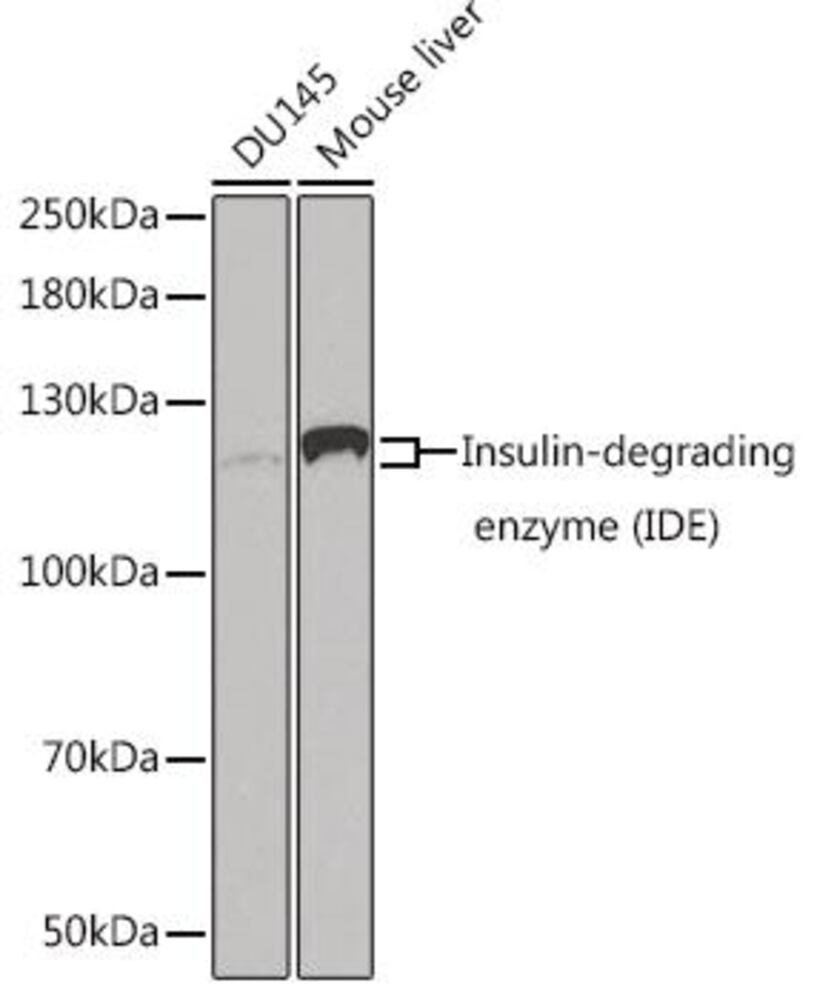


Description
L'anticorps anti-enzyme de dégradation de l'insuline / IDE est un réactif d'immunodétection fourni en conditionnement de 100 µl pour le buvardage en laboratoire et les dosages protéiques associés. Développé contre l'enzyme de dégradation de l'insuline (IDE), il est destiné aux flux de travail de Western blot et ELISA, ainsi qu'aux étapes de blocage et d'immunodétection utilisées dans les applications de recherche. Le produit présente une densité de 1 g/cm³ et un poids net de 0,006 kg, facilitant sa manipulation et la gestion des stocks. Disponible auprès du fabricant antibodies.com, cet anticorps est adapté aux laboratoires de biologie moléculaire et d'immunoessais qui privilégient un volume unitaire compact pour le développement ou le criblage de routine. Son classement par catégorie couvre les applications, le buvardage, le Western blot, l'ELISA, ainsi que le blocage et l'immunodétection, favorisant une organisation claire du catalogue et de l'espace de travail. La quantité de 100 µl permet de limiter le gaspillage lorsque seuls de petits volumes sont nécessaires par expérience. Les données physiques fournies par le fabricant, telles que la densité et le poids, peuvent être intégrées aux systèmes d'information de laboratoire sans ajout de déclarations de qualité ou de certification non justifiées. Utilisez ce réactif conformément aux pratiques établies en matière d'immunoessais et aux exigences spécifiques du système de détection IDE utilisé.
Cet article appartient aux catégories Enzymes & substrats, et Produits biochimiques & réactifs.
Caractéristiques principales
- Conditionnement : 100 µl
- Densité : 1 g/cm³
- Température de stockage : +4 °C
- Cible : Enzyme de dégradation de l'insuline / IDE
- Poids : 0,006 kg
- Domaine d'application : Western blot & ELISA
- Fiche d'information technique :

- Fiche de données de sécurité :
Compliance & Safety Information
 Avertissement
Hazard Statements (H-Phrases)
Récemment consulté
Vous aimerez peut-être aussi
Browse related categories
Category
Sub-category
Catalogue
Brand
Questions about A-Enzyme de dégradation de l'insuline / IDE Anticorps, 100 µl
What is this article?
A-Enzyme de dégradation de l'insuline / IDE Anticorps, 100 µl is the article on this page. Luminix Health distributes antibodies.com for laboratory use. It sits in Enzymes & substrates, inside Biochemicals & reagents, in Microbiologie.
An enzyme is sold by activity, in units defined by a stated reaction, not only by milligrams. Source and specific activity are the specification. A substrate is the molecule that enzyme converts, often a chromogenic one so the reaction can be seen. Units from two suppliers are comparable only when the definition matches.
A biochemical is a molecule of life, sold as a reagent: an amino acid, a sugar, a nucleotide, a lipid, an enzyme, an antibiotic. The difference from a bulk chemical is that the use is a biological one, and the impurities that matter are the ones that change that use. An enzyme is specified by activity, not only by mass. An antibiotic is specified by potency. Papers are on PubMed. Structures are on PubChem. Strains and lines that consume these reagents are at ATCC.
Which category should I open next?
The category is Biochemicals & reagents. The sub-category is Enzymes & substrates. The catalogue is Microbiologie.
Shelves beside this one are Amino acids & peptides, Carbohydrates & sugars, Coenzymes, nucleotides & vitamins, Biochemicals (other), Antibiotics & antimycotics, Lipids, steroids & fatty acids and Detergents & surfactants.
What should I check before I order?
The technical information on this page is the manufacturer's sheet. Read that, not a rewritten specification.
When this page shows a safety data sheet, use that manufacturer file. Hazard text does not belong in the sales description. For a pack size, a grade or a certificate that is not on the page, send a quote request or contact the team.
How does ordering and shipping work?
Luminix Health distributes this article from the heart of Europe. Articles in stock ship within 2–5 business days. Standard delivery is free from €250 excl. VAT. Cold-chain goods and dangerous goods under ADR are never included in that free delivery. The terms are in the Shipping Policy. The full brand index is on shop by brand. Who we are is on about us.
Which other categories should I open?
The seven catalogues are Labware, Lab chemicals, Lab instruments, Lab consumables, Chromatography equipment, Lab safety equipment and Life Science & Microbiology.