


Description
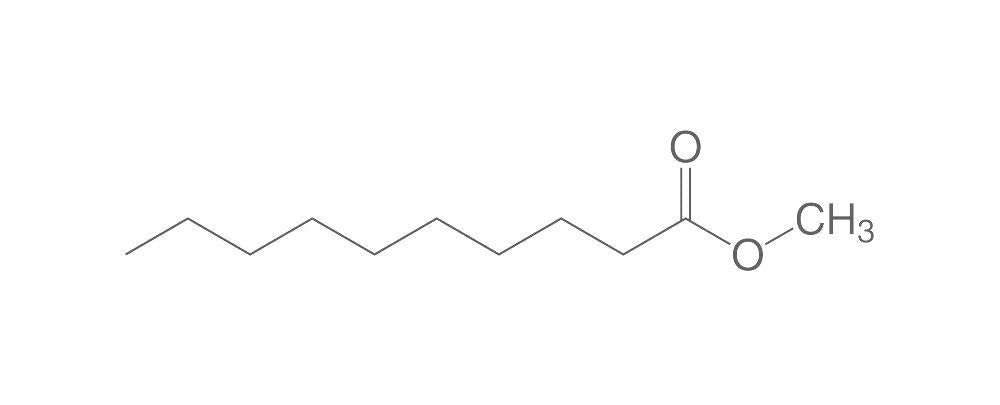
L'ester méthylique d'acide caprique est un ester de qualité synthèse avec une pureté minimale de 98 %, un numéro CAS 110-42-9 et une formule brute C₁₁H₂₂O₂. Sa masse molaire est de 186,29 g/mol et sa densité de 0,873 g/cm³, tandis que son point d'éclair est de 110,5 °C et son point d'ébullition de 224 °C. Le produit est fourni en flacon de 100 ml pour la synthèse en laboratoire et les travaux chimiques connexes. Le numéro CE 203-766-6 et le numéro ONU 3082 accompagnent les données physiques du fabricant Carl ROTH, facilitant ainsi une identification et une manipulation claires. Cet ester méthylique d'acide caprique pur à 98 % min. est adapté aux étapes préparatoires nécessitant un ester défini avec une masse molaire et une densité connues pour un dosage précis. Le conditionnement en flacon de 100 ml offre un volume pratique pour une utilisation synthétique répétée sans encombrement excessif. Le point d'ébullition documenté de 224 °C et le point d'éclair de 110,5 °C aident à planifier les mesures de chauffage et de sécurité en laboratoire. Avec sa formule C₁₁H₂₂O₂, son numéro CAS 110-42-9 et sa désignation pour synthèse, cet ester de type décanoate de méthyle est un réactif bien spécifié pour la synthèse organique et les applications générales en laboratoire nécessitant un ester méthylique d'acide gras de haute pureté.
Cet article appartient aux catégories Lipides, stéroïdes et acides gras et Produits biochimiques et réactifs.
Caractéristiques principales
- Aspect : liquide limpide, presque incolore
- Dosage (CG) : >97 %
- Numéro CAS : 110-42-9
- Conditionnement : flacon de 100 ml
- N° CE : 203-766-6
- Pureté : min. 98 %, pour synthèse
- Masse molaire : 186,29 g/mol
- Densité : 0,873 g/cm³
- Fiche technique :

- Fiche de données de sécurité :
Compliance & Safety Information
 Avertissement
Hazard Statements (H-Phrases)
Precautionary Statements (P-Phrases)
Récemment consulté
Vous aimerez peut-être aussi
Questions about Ester méthylique de l'acide caprique, min. 98 %, pour synthèse, 100 ml, verre
What is this article?
Ester méthylique de l'acide caprique, min. 98 %, pour synthèse, 100 ml, verre is the article on this page. Luminix Health distributes Carl Roth for laboratory use. It sits in Lipids, steroids & fatty acids, inside Biochemicals & reagents, in Microbiologie.
A lipid, a steroid or a fatty acid is specified by chain length, saturation and purity. Esters and free acids are different compounds. Many are supplied in a small amount under inert gas because they oxidise. The physical form, oil or powder, follows from the structure.
A biochemical is a molecule of life, sold as a reagent: an amino acid, a sugar, a nucleotide, a lipid, an enzyme, an antibiotic. The difference from a bulk chemical is that the use is a biological one, and the impurities that matter are the ones that change that use. An enzyme is specified by activity, not only by mass. An antibiotic is specified by potency. Papers are on PubMed. Structures are on PubChem. Strains and lines that consume these reagents are at ATCC.
Which category should I open next?
The category is Biochemicals & reagents. The sub-category is Lipids, steroids & fatty acids. The catalogue is Microbiologie.
Shelves beside this one are Amino acids & peptides, Carbohydrates & sugars, Coenzymes, nucleotides & vitamins, Biochemicals (other), Enzymes & substrates, Antibiotics & antimycotics and Detergents & surfactants.
What should I check before I order?
When this page shows a safety data sheet, use that manufacturer file. Hazard text does not belong in the sales description. For a pack size, a grade or a certificate that is not on the page, send a quote request or contact the team.
How does ordering and shipping work?
Luminix Health distributes this article from the heart of Europe. Articles in stock ship within 2–5 business days. Standard delivery is free from €250 excl. VAT. Cold-chain goods and dangerous goods under ADR are never included in that free delivery. The terms are in the Shipping Policy. The full brand index is on shop by brand. Who we are is on about us.
Which other categories should I open?
The seven catalogues are Labware, Lab chemicals, Lab instruments, Lab consumables, Chromatography equipment, Lab safety equipment and Life Science & Microbiology.