


Description
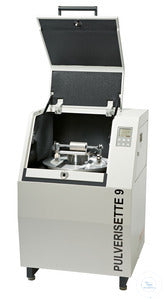
PULVERISETTE 9 vibrating disc mill 200-240 V 1~ is a laboratory mill engineered for extremely rapid comminution of hard, medium-hard and brittle samples to analytical fineness, either dry or in suspension. Maximum feed size is 12 mm depending on material, batch volume reaches 250 ml and final fineness lies between 10 and 20 µm, with rotor speeds up to 1500 rpm. Grinding is effected by horizontal circular oscillations of the grinding set on a vibrating plate; the ring-and-puck assembly generates intense pressure, impact and friction forces. A specialised motor with torque-optimised frequency converter matches power delivery to the sample and grinding set while satisfying international safety standards. Second-precise control of speed, grinding duration and pause times, programmable cycles, multilingual menu guidance, ergonomic set insertion, heat-insulated handles, anti-twist clamping, secure hood lock and full sound insulation complete the design. Suitable for mining, metallurgy, ceramics, agriculture, environmental analysis and IR/XRF sample preparation, the mill is supplied without grinding sets by manufacturer Fritsch; sets in five materials and three sizes (50–250 ml) are ordered separately. Net weight 267,00 kg.
This article is part of Mills, grinders & homogenisers, in Test sieves & mills.
Key features
- Pack size: 1 pc
- Voltage: 200-240 V 1~
- Max. feed size: 12 mm
- Max. batch volume: 250 ml
- Final fineness: 10–20 µm
- Rotor speed: up to 1500 rpm
Récemment consulté
Vous aimerez peut-être aussi
Questions about PULVERISETTE 9 Vibrating Cup Mill 200-240 V/1~
What is this article?
PULVERISETTE 9 Vibrating Cup Mill 200-240 V/1~ is the article on this page. Luminix Health distributes Fritsch for laboratory use. It sits in Mills, grinders & homogenisers, inside Test sieves & mills, in Instruments de laboratoire.
A mill, grinder or homogeniser reduces particle size or breaks a tissue before an extraction. The rotor and the sieve insert decide the result. A knife mill and a bead mill are different machines. The sample has to tolerate the heat the motor puts into it.
A test sieve sorts particles by whether they pass an opening. Wire mesh and perforated plate are two ways of making that opening, and the nominal size is not a suggestion. A sieve shaker repeats the motion so the result does not depend on how hard someone shook by hand. A mill or grinder makes the particles smaller before they are sieved. The certificate of the sieve, and the opening size, are what an audit asks for. Measurement practice around mass and dimension sits with the BIPM, EURAMET and BELAC.
Which category should I open next?
The category is Test sieves & mills. The sub-category is Mills, grinders & homogenisers. The catalogue is Instruments de laboratoire.
Shelves beside this one are Test sieves (wire mesh), Test sieves (perforated plate), Sieve shakers and Sieve accessories (lids, pans, rings).
What should I check before I order?
When this page shows a safety data sheet, use that manufacturer file. Hazard text does not belong in the sales description. For a pack size, a grade or a certificate that is not on the page, send a quote request or contact the team.
How does ordering and shipping work?
Luminix Health distributes this article from the heart of Europe. Articles in stock ship within 2–5 business days. Standard delivery is free from €250 excl. VAT. Cold-chain goods and dangerous goods under ADR are never included in that free delivery. The terms are in the Shipping Policy. The full brand index is on shop by brand. Who we are is on about us.
Which other categories should I open?
The seven catalogues are Labware, Lab chemicals, Lab instruments, Lab consumables, Chromatography equipment, Lab safety equipment and Life Science & Microbiology.