



Description
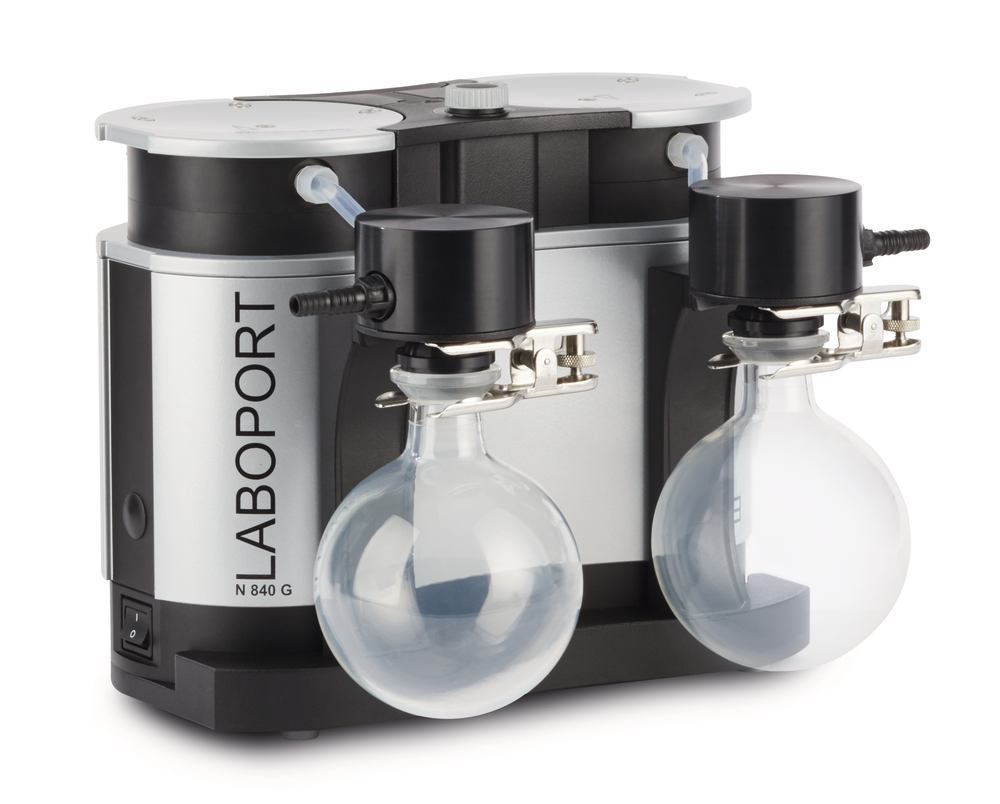
Système de vide SR 840 G, débit max. 34 l/min, avec plaque de base, séparateur côté aspiration et côté refoulement
Disponible en différentes versions, elles sont donc sur mesure pour répondre aux exigences individuelles du laboratoire. Le cœur du système est la pompe à vide à membrane LABOPORT® (série N 800 G) : compacte, résistante aux produits chimiques et puissante. Encore plus respectueuse de l'environnement grâce à de nouveaux composants système tels que le séparateur, le condenseur haute performance et/ou le régulateur de vide innovant.
- Régulation de vitesse intégrée pour un vide précis
- Clapet de dégazage intégré pour une haute résistance aux vapeurs et aux condensats
- La surface interne en contact avec les médias est conforme ATEX selon « II 3/-G Ex h IIB+H2 T3 Gc atmosphère interne uniquement » ; pour les applications impliquant la manipulation de solvants hautement inflammables dans des systèmes fermés. Non approuvé pour les zones ATEX
Équipé de deux séparateurs en verre revêtu (côté aspiration et côté refoulement). Pour piéger et retenir les particules et les gouttelettes de liquide/condensats du flux. Empêche leur atteinte de la pompe à vide côté aspiration et les libère dans l'air ambiant côté refoulement.
| Type | SR 840 G |
| Système | SR 840 G |
| Version | séparateur |
| Capacité d'aspiration (l/min) | 34,0 |
| Vide final (abs.) | 6 mbar |
| Vide final abs. avec dégazage | 17 mbar |
| Surpression | 0,1 bar |
| Raccordement | pour tuyau intérieur Ø 8-9,5 mm |
| Température ambiante | +5 - +40 °C |
| Matériaux en contact avec les médias | tête de pompe : PTFE membranes : revêtement PTFE vannes : FFPM raccords de tuyau : PVDF/FPM |
| L x P x H | 299 x 274 x 250 mm |
| Poids | 13,1 kg |
| Alimentation secteur | 100-240 V, 50/60 Hz |
| ROTH pour l'avenir | oui |
Récemment consulté
Vous aimerez peut-être aussi
Browse related categories
Category
Sub-category
Catalogue
Brand
Questions about Système de vide SR 840 G, débit max. 34 l/min, 1 unité(s)
What is this article?
Système de vide SR 840 G, débit max. 34 l/min, 1 unité(s) is the article on this page. Luminix Health distributes KNF for laboratory use. It sits in Laboratory glass thermometers, inside Temperature measurement, in Instruments de laboratoire.
A liquid-in-glass thermometer is a calibrated column, often with a stated immersion depth, total or partial. The range and the division decide the reading. A partial-immersion thermometer read at the wrong depth is wrong by design.
A thermometer reports a temperature. A liquid-in-glass thermometer is a calibrated column. A digital thermometer is a sensor and a display, and the sensor, not the display, is what is calibrated. An infrared thermometer reads a surface and depends on emissivity. A data logger stores the reading over time. Without a stated uncertainty and a calibration point, the number is only an indication. The scale is maintained by the BIPM and compared by EURAMET. Accreditation is BELAC.
Which category should I open next?
The category is Temperature measurement. The sub-category is Laboratory glass thermometers. The catalogue is Instruments de laboratoire.
Shelves beside this one are Temperature probes & sensors, Hygrometers & humidity meters, Data loggers, Temperature measurement accessories, Digital thermometers and Infrared thermometers.
What should I check before I order?
The technical information on this page is the manufacturer's sheet. Read that, not a rewritten specification.
When this page shows a safety data sheet, use that manufacturer file. Hazard text does not belong in the sales description. For a pack size, a grade or a certificate that is not on the page, send a quote request or contact the team.
How does ordering and shipping work?
Luminix Health distributes this article from the heart of Europe. Articles in stock ship within 2–5 business days. Standard delivery is free from €250 excl. VAT. Cold-chain goods and dangerous goods under ADR are never included in that free delivery. The terms are in the Shipping Policy. The full brand index is on shop by brand. Who we are is on about us.
Which other categories should I open?
The seven catalogues are Labware, Lab chemicals, Lab instruments, Lab consumables, Chromatography equipment, Lab safety equipment and Life Science & Microbiology.