
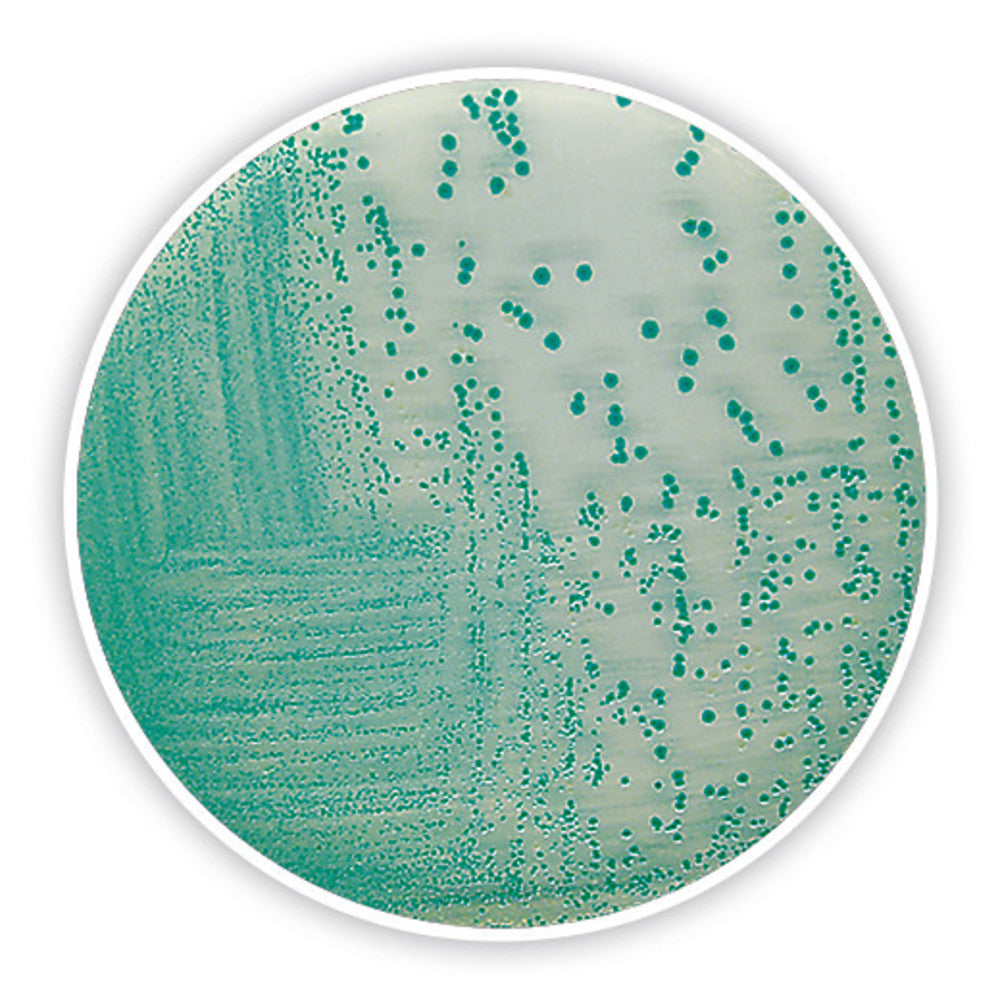


Description
TBX chromogenic Agar est un milieu nutritif déshydraté pour la microbiologie, spécifié en référence à ISO 16649-2 et ISO 16649-3 et aligné sur les attentes d'ISO 11133 pour la qualité des milieux de culture. Il est destiné au travail de laboratoire sur les coliformes et Escherichia coli, où des plaques TBX chromogènes sont préparées à partir de la formulation sèche. Le produit est Dans les laboratoires de sciences de la vie et de microbiologie des aliments ou de l'eau, les milieux TBX sont utilisés dans des schémas normalisés de dénombrement et de détection pour E. coli positif à la β-glucuronidase et les organismes apparentés, selon les méthodes ISO citées. Le milieu sec est reconstitué, stérilisé ou traité thermiquement selon les exigences de la méthode, puis coulé en plaques avant utilisation. Les catégories comprennent les milieux nutritifs déshydratés pour la microbiologie et les milieux pour coliformes et E. coli. Cette préparation provient du fabricant Carl ROTH Stockez et manipulez selon les conditions indiquées et les données de sécurité. Utilisez dans des flux de travail validés fondés sur l'ISO et les bonnes pratiques de laboratoire afin d'obtenir des plaques adaptées à la différenciation chromogène dans les environnements d'essais de routine et de référence.
Cet article fait partie de Enzymes & substrats, dans Produits biochimiques & réactifs.
Caractéristiques
- Casein peptone: 20 g/l
- Bile salts: 1.5 g/l
- x-β-D-Glucuronide: 0.075 g/l
- Agar: 15 g/l
- Valeur de pH: 7.2 ±0.2
- Conditionnements: 500 g, 100 g
- Température de stockage: +15 to +25 °C
- Type de produit: TBX chromogenic Agar
- Normes: ISO 16649-2 et -3, ISO 11133
- Fiche technique:

- Fiche de données de sécurité:
Récemment consulté
Vous aimerez peut-être aussi
Questions about TBX chromogenic Agar, ISO 16649-2 et -3, pour la microbiologie, 500 g, plastique
What is this article?
TBX chromogenic Agar, ISO 16649-2 et -3, pour la microbiologie, 500 g, plastique is the article on this page. Luminix Health distributes Carl Roth for laboratory use. It sits in Enzymes & substrats, inside Produits biochimiques & réactifs, in Milieux microbiologiques.
An enzyme is sold by activity, in units defined by a stated reaction, not only by milligrams. Source and specific activity are the specification. A substrate is the molecule that enzyme converts, often a chromogenic one so the reaction can be seen. Units from two suppliers are comparable only when the definition matches.
A biochemical is a molecule of life, sold as a reagent: an amino acid, a sugar, a nucleotide, a lipid, an enzyme, an antibiotic. The difference from a bulk chemical is that the use is a biological one, and the impurities that matter are the ones that change that use. An enzyme is specified by activity, not only by mass. An antibiotic is specified by potency. Papers are on PubMed. Structures are on PubChem. Strains and lines that consume these reagents are at ATCC.
Which category should I open next?
The category is Produits biochimiques & réactifs. The sub-category is Enzymes & substrats. The catalogue is Milieux microbiologiques.
Shelves beside this one are Acides aminés & peptides, Glucides & sucres, Coenzymes, nucléotides & vitamines, Produits biochimiques (autres), Antibiotiques & antimycotiques, Lipides, stéroïdes & acides gras and Détergents & tensioactifs.
What should I check before I order?
The technical information on this page is the manufacturer's sheet. Read that, not a rewritten specification.
When this page shows a safety data sheet, use that manufacturer file. Hazard text does not belong in the sales description. For a pack size, a grade or a certificate that is not on the page, send a quote request or contact the team.
How does ordering and shipping work?
Luminix Health distributes this article from the heart of Europe. Articles in stock ship within 2–5 business days. Standard delivery is free from €250 excl. VAT. Cold-chain goods and dangerous goods under ADR are never included in that free delivery. The terms are in the Shipping Policy. The full brand index is on shop by brand. Who we are is on about us.
Which other categories should I open?
The seven catalogues are Labware, Lab chemicals, Lab instruments, Lab consumables, Chromatography equipment, Lab safety equipment and Life Science & Microbiology.