
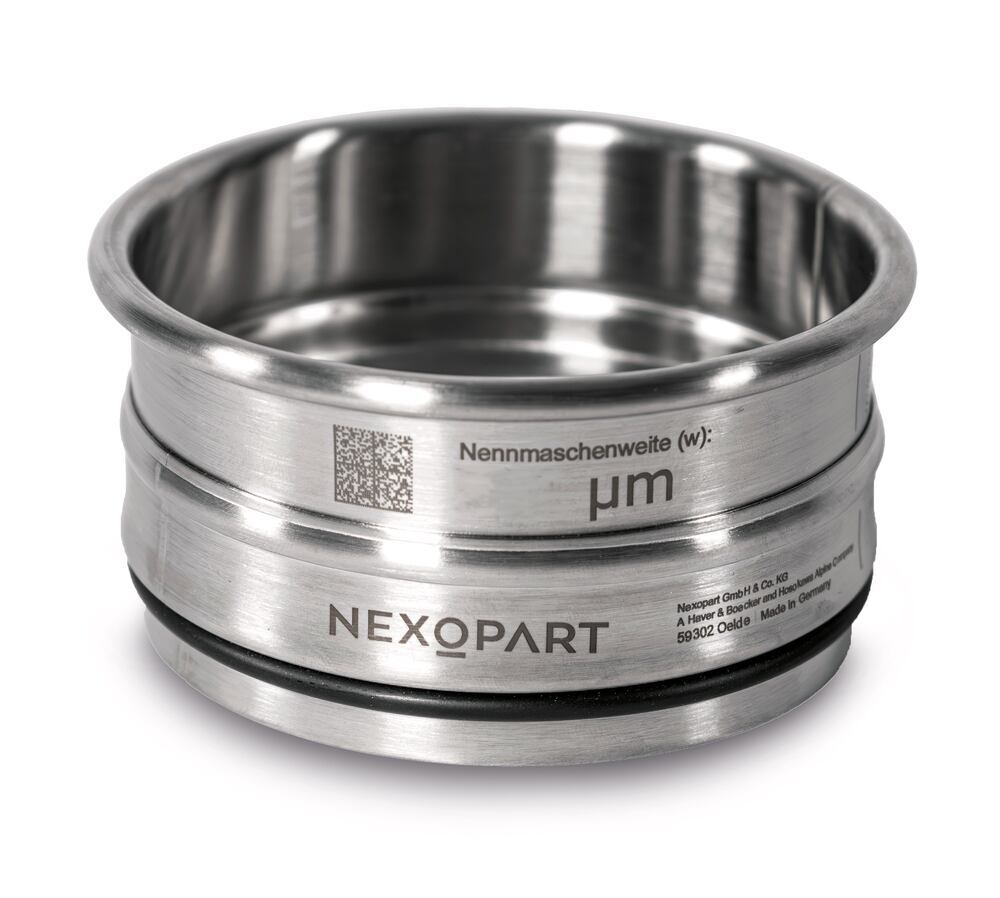



Description
Le tamis d'essai Ø 150 mm avec une ouverture de maille de 0,050 mm est un tamis d'analyse en laboratoire conçu pour la séparation et la classification de particules fines. La combinaison d'un diamètre de 150 mm et d'une ouverture de maille de 0,050 mm permet un tamisage précis de poudres fines, de granulés et d'autres matériaux particulaires dans des conditions de laboratoire normalisées. Fourni à l'unité, il s'adapte aux pratiques habituelles de manipulation, d'empilage et de stockage des tamis d'essai utilisées pour la caractérisation des particules. L'ouverture de 0,050 mm offre une coupure clairement définie pour les étapes de fractionnement où cette taille de maille est requise par la méthode. Produit par NEXOPART, ce tamis est destiné aux applications de filtration et de séparation dans le cadre de séquences de tamisage analytique et de procédures de préparation d'échantillons. Le marquage distinct du diamètre et de la taille de maille aide à garantir le choix du bon tamis et la comparabilité des analyses successives. Ce tamis d'essai Ø 150 mm avec maille de 0,050 mm est adapté à la granulométrie de routine, au criblage et aux travaux de séparation connexes dans les laboratoires de recherche, de contrôle qualité industriel et d'enseignement.
Cet article appartient à la catégorie Tamis d'essai (toile métallique), dans Tamis d'essai & broyeurs.
Caractéristiques principales
- Conditionnement : 1 pièce(s)
- Type de produit : Tamis d'essai
- Diamètre : Ø 150 mm
- Taille de maille : 0,050 mm
- Poids : 0,460 kg
Récemment consulté
Vous aimerez peut-être aussi
Browse related categories
Category
Sub-category
Catalogue
Brand
Questions about Tamis de contrôle Ø 150 mm, ouverture de maille 0,050 mm, 1 unité(s)
What is this article?
Tamis de contrôle Ø 150 mm, ouverture de maille 0,050 mm, 1 unité(s) is the article on this page. Luminix Health distributes NEXOPART for laboratory use. It sits in Test sieves (wire mesh), inside Test sieves & mills, in Instruments de laboratoire.
A wire-mesh test sieve sorts particles through a woven opening of a stated nominal size. The frame diameter and the mesh are the specification. A sieve without a certificate is a screen, not a measurement.
A test sieve sorts particles by whether they pass an opening. Wire mesh and perforated plate are two ways of making that opening, and the nominal size is not a suggestion. A sieve shaker repeats the motion so the result does not depend on how hard someone shook by hand. A mill or grinder makes the particles smaller before they are sieved. The certificate of the sieve, and the opening size, are what an audit asks for. Measurement practice around mass and dimension sits with the BIPM, EURAMET and BELAC.
Which category should I open next?
The category is Test sieves & mills. The sub-category is Test sieves (wire mesh). The catalogue is Instruments de laboratoire.
Shelves beside this one are Test sieves (perforated plate), Mills, grinders & homogenisers, Sieve shakers and Sieve accessories (lids, pans, rings).
What should I check before I order?
The technical information on this page is the manufacturer's sheet. Read that, not a rewritten specification.
When this page shows a safety data sheet, use that manufacturer file. Hazard text does not belong in the sales description. For a pack size, a grade or a certificate that is not on the page, send a quote request or contact the team.
How does ordering and shipping work?
Luminix Health distributes this article from the heart of Europe. Articles in stock ship within 2–5 business days. Standard delivery is free from €250 excl. VAT. Cold-chain goods and dangerous goods under ADR are never included in that free delivery. The terms are in the Shipping Policy. The full brand index is on shop by brand. Who we are is on about us.
Which other categories should I open?
The seven catalogues are Labware, Lab chemicals, Lab instruments, Lab consumables, Chromatography equipment, Lab safety equipment and Life Science & Microbiology.