


Description
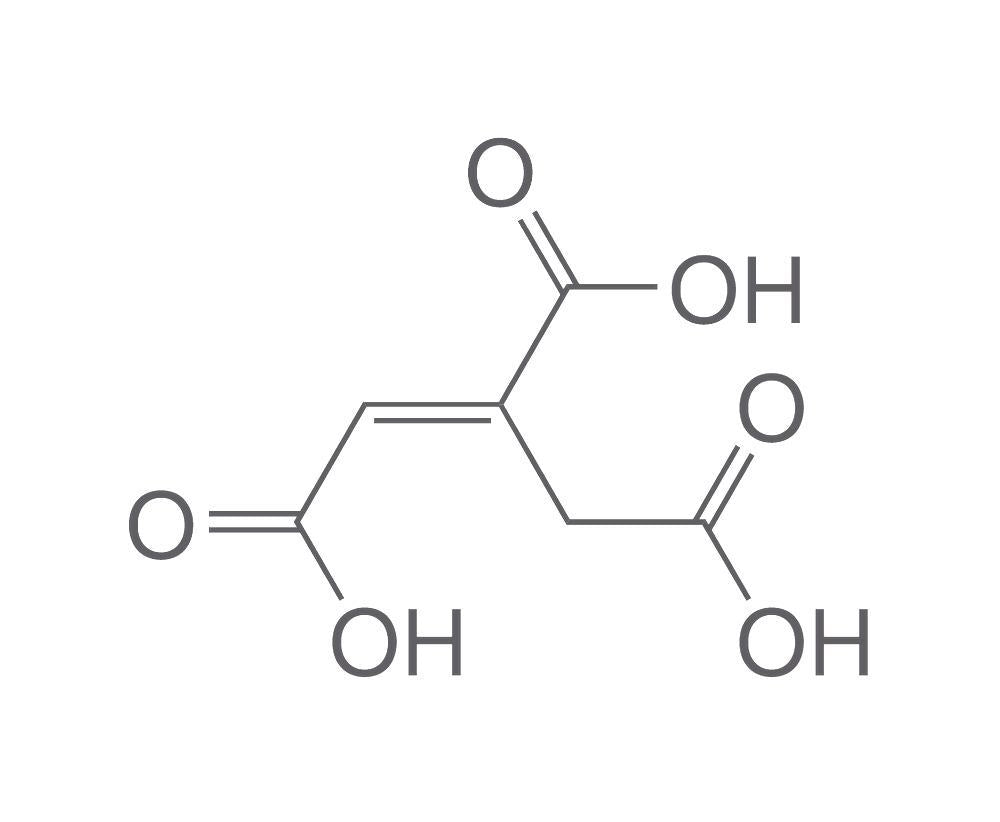
L’acide trans-aconitique est un acide tricarboxylique insaturé proposé avec une pureté minimale de 98,0 % pour un usage en laboratoire. Il est identifié par le numéro CAS 4023-65-8 et le numéro CE 223-688-6, avec la formule brute C₆H₆O₆ et une masse molaire de 174,11 g/mol. Les données physiques comprennent une masse volumique de 0,56 g/cm³ et un point d'ébullition de 542,6 °C, ce qui aide les laboratoires à évaluer la manipulation et le comportement thermique. En tant qu'isomère géométrique de l'acide aconitique, la forme trans est pertinente pour la synthèse organique, les études des voies métaboliques et les travaux analytiques impliquant des intermédiaires liés au cycle de Krebs. Les chercheurs en chimie organique et en biochimie peuvent utiliser cette qualité lorsqu'une pureté définie et une identité claire de l'acide trans-aconitique sont requises. La masse molaire documentée, la densité et les numéros d'enregistrement facilitent une pesée précise, la préparation de solutions et la conformité à la documentation qualité interne du laboratoire de recherche.
Cet article appartient aux catégories Blocs de construction organiques et réactifs de synthèse, dans Produits chimiques organiques et réactifs de synthèse.
Caractéristiques principales
- Pureté (HPLC) : ≥98,0 %
- Eau (KF) : ≤1,0 %
- Cendres sulfuriques : ≤0,5 %
- Numéro CAS : 4023-65-8
- Conditionnements : 10 g, 25 g
- Numéro CE : 223-688-6
- Pureté : min. 98,0 %
- Masse molaire : 174,11 g/mol
- Masse volumique : 0,56 g/cm³
- Fiche technique :

- Fiche de données de sécurité :
Récemment consulté
Vous aimerez peut-être aussi
Browse related categories
Category
Organic chemicals & synthesis reagents
Sub-category
Organic building blocks & synthesis reagents
Catalogue
Brand
Questions about Acide trans-aconitique, min. 98,0 %, 10 g, plastique
What is this article?
Acide trans-aconitique, min. 98,0 %, 10 g, plastique is the article on this page. Luminix Health distributes Carl Roth for laboratory use. It sits in Organic building blocks & synthesis reagents, inside Organic chemicals & synthesis reagents, in Produits chimiques.
A building block is an organic molecule bought to become part of a larger one. The structure, the CAS number and the purity decide it. A 95 percent reagent and a 99.9 percent reagent of the same name leave different impurities in the product. The functional groups are the reason it was chosen.
An organic chemical is built on carbon. In this category it is a building block or a reagent for making another molecule: a starting material, a coupling agent, a polymer, a PEG. Purity is a specification of which impurities remain. The structure, the CAS number and the grade decide whether two bottles are the same substance. Structures and properties are on PubChem. Nomenclature is IUPAC. Classification follows ECHA and the CLP Regulation.
Which category should I open next?
The category is Organic chemicals & synthesis reagents. The sub-category is Organic building blocks & synthesis reagents. The catalogue is Produits chimiques.
Shelves beside this one are Polymers, PEGs & silicones and Click chemistry, bioconjugation & synthesis reagents.
What should I check before I order?
When this page shows a safety data sheet, use that manufacturer file. Hazard text does not belong in the sales description. For a pack size, a grade or a certificate that is not on the page, send a quote request or contact the team.
How does ordering and shipping work?
Luminix Health distributes this article from the heart of Europe. Articles in stock ship within 2–5 business days. Standard delivery is free from €250 excl. VAT. Cold-chain goods and dangerous goods under ADR are never included in that free delivery. The terms are in the Shipping Policy. The full brand index is on shop by brand. Who we are is on about us.
Which other categories should I open?
The seven catalogues are Labware, Lab chemicals, Lab instruments, Lab consumables, Chromatography equipment, Lab safety equipment and Life Science & Microbiology.