
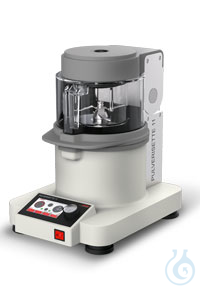


Description
Le broyeur à couteaux PULVERISETTE 11 est un broyeur de laboratoire multifonctionnel pour le broyage et l'homogénéisation rapides et doux d'échantillons humides, huileux, gras, mous, mi-durs et fibreux jusqu'à une qualité industrielle. Il convient bien aux workflows alimentaires, agricoles et forestiers, pharmaceutiques et biologiques, acceptant une taille d'alimentation maximale de 40 mm et des volumes d'échantillon jusqu'à 1300 ml, avec une finesse finale dépendante du matériau inférieure à 300 µm. Fonctionnant à 10000 rpm, l'unité compacte du fabricant Fritsch est fournie avec un récipient de broyage autoclavable de 1.4 l en polycarbonate transparent et résistant aux rayures, un couvercle standard en silicone et un couteau standard en acier inoxydable. Un couvercle réducteur pratique en PP réduit le volume de la chambre à 0.54 l pour un travail plus propre en petits lots, tandis que des bols optionnels en acier inoxydable 316L et des couteaux dentelés étendent la flexibilité d'application. Des recettes programmables et enregistrables et un fonctionnement silencieux soutiennent l'usage de routine au laboratoire. Les dimensions hors tout sont de 32 x 43 x 48 cm et le poids net est de 17.6 kg. Cette version est spécifiée pour une alimentation secteur 100–120 V, 50–60 Hz et arrive prête pour un déploiement immédiat avec le bol, le couvercle et le couteau standard.
Cet article fait partie de Broyeurs, moulins & homogénéisateurs, dans Tamis d'essai & broyeurs.
Caractéristiques
- Conditionnement: 1 pièce
- Taille d'alimentation max.: 40 mm
- Max. sample volume: 1,300 ml
- Finesse finale: < 300 µm
- Speed: 10,000 rpm
- Récipient de broyage: 1.4 l autoclavable
- Fiche technique:

Récemment consulté
Vous aimerez peut-être aussi
Questions about PULVERISETTE 11 broyeur à couteaux 100 - 120 V, 50 - 60 Hz
What is this article?
PULVERISETTE 11 broyeur à couteaux 100 - 120 V, 50 - 60 Hz is the article on this page. Luminix Health distributes Fritsch for laboratory use. It sits in Broyeurs, moulins & homogénéisateurs, inside Tamis d'essai & broyeurs, in Instruments de laboratoire.
A mill, grinder or homogeniser reduces particle size or breaks a tissue before an extraction. The rotor and the sieve insert decide the result. A knife mill and a bead mill are different machines. The sample has to tolerate the heat the motor puts into it.
A test sieve sorts particles by whether they pass an opening. Wire mesh and perforated plate are two ways of making that opening, and the nominal size is not a suggestion. A sieve shaker repeats the motion so the result does not depend on how hard someone shook by hand. A mill or grinder makes the particles smaller before they are sieved. The certificate of the sieve, and the opening size, are what an audit asks for. Measurement practice around mass and dimension sits with the BIPM, EURAMET and BELAC.
Which category should I open next?
The category is Tamis d'essai & broyeurs. The sub-category is Broyeurs, moulins & homogénéisateurs. The catalogue is Instruments de laboratoire.
Shelves beside this one are Tamis d'essai (toile métallique), Tamis d'essai (tôle perforée), Tamiseurs vibrants and Accessoires de tamis (couvercles, fonds, anneaux).
What should I check before I order?
When this page shows a safety data sheet, use that manufacturer file. Hazard text does not belong in the sales description. For a pack size, a grade or a certificate that is not on the page, send a quote request or contact the team.
How does ordering and shipping work?
Luminix Health distributes this article from the heart of Europe. Articles in stock ship within 2–5 business days. Standard delivery is free from €250 excl. VAT. Cold-chain goods and dangerous goods under ADR are never included in that free delivery. The terms are in the Shipping Policy. The full brand index is on shop by brand. Who we are is on about us.
Which other categories should I open?
The seven catalogues are Labware, Lab chemicals, Lab instruments, Lab consumables, Chromatography equipment, Lab safety equipment and Life Science & Microbiology.