


Description
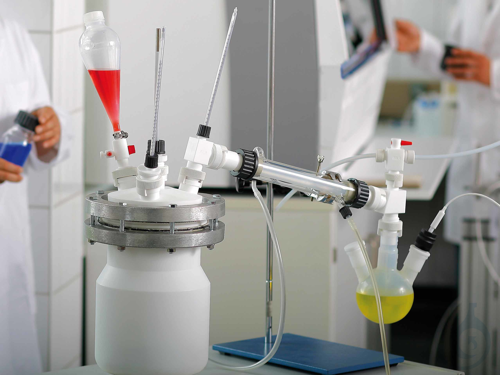
L'appareil de distillation à bride plate BOLA en construction PTFE de 1000 ml est destiné à la distillation de milieux fortement alcalins ou acides ainsi que de solvants très agressifs. La conception SAFE LAB utilise une configuration à bride plane avec des composants en polytetrafluoroethylene (PTFE) chimiquement résistant, permettant un fonctionnement fiable lorsque la verrerie classique peut être limitée par l'attaque chimique. Les dimensions totales sont de 550 × 700 mm (H × L), offrant une enveloppe de travail plus grande autour de la capacité de 1000 ml pour une montée en échelle ou des distillations de laboratoire à plus haut débit. Le poids net est de 4.76 kg pour l'unité complète en une pièce. Proposé par le fabricant Bohlender dans la gamme BOLA, l'appareil soutient le travail préparatif et orienté procédé avec des bases fortes, des acides forts et des systèmes de solvants très agressifs qui exigent la compatibilité PTFE et des raccordements sûrs à bride plate. Il convient aux laboratoires qui ont besoin d'un matériel de distillation durable et chimiquement inerte, avec un montage et une maintenance simples. La taille de conditionnement est une pièce, prête pour l'installation dans des montages de distillation compatibles PTFE nécessitant un volume de charge de 1000 ml.
Cet article fait partie de Récipients de réaction & récipients à double enveloppe, dans Béchers & fioles.
Caractéristiques
- Conditionnement: 1 pièce
- Type de produit: Appareil de distillation à bride plate
- Matériau: Polytetrafluoroethylene (PTFE)
- Capacité: 1000 ml
- Exécution: SAFE LAB
- Dimensions hors tout (H × L): 550 × 700 mm
Récemment consulté
Vous aimerez peut-être aussi
Browse related categories
Category
Sub-category
Récipients de réaction & récipients à double enveloppe
Catalogue
Brand
Questions about Appareils de distillation BOLA, 1000 ml en PTFE - avec système SAFE LAB composé de
What is this article?
Appareils de distillation BOLA, 1000 ml en PTFE - avec système SAFE LAB composé de is the article on this page. Luminix Health distributes Bohlender for laboratory use. It sits in Récipients de réaction & récipients à double enveloppe, inside Béchers & fioles, in Matériel de laboratoire.
A reaction vessel is the flask a synthesis actually runs in, sometimes jacketed so a fluid can heat or cool the wall. The joints, the working volume and the jacket connections are the specification. It is not a storage bottle.
A beaker is an open working vessel: easy to pour, poor as a measure. An Erlenmeyer flask has a flat base and a conical wall so a liquid can be swirled without climbing out. A round-bottom flask is for heating under a condenser, because the heat meets a curved wall and the joint at the neck connects to the rest of the glassware. Borosilicate is the glass that survives the temperature change. These forms are listed under ISO laboratory glassware.
Which category should I open next?
The category is Béchers & fioles. The sub-category is Récipients de réaction & récipients à double enveloppe. The catalogue is Matériel de laboratoire.
Shelves beside this one are Ballons à fond rond, Béchers, Fioles Erlenmeyer, Fioles à fond plat, Fioles (autres) and Accessoires pour béchers & fioles.
What should I check before I order?
When this page shows a safety data sheet, use that manufacturer file. Hazard text does not belong in the sales description. For a pack size, a grade or a certificate that is not on the page, send a quote request or contact the team.
How does ordering and shipping work?
Luminix Health distributes this article from the heart of Europe. Articles in stock ship within 2–5 business days. Standard delivery is free from €250 excl. VAT. Cold-chain goods and dangerous goods under ADR are never included in that free delivery. The terms are in the Shipping Policy. The full brand index is on shop by brand. Who we are is on about us.
Which other categories should I open?
The seven catalogues are Labware, Lab chemicals, Lab instruments, Lab consumables, Chromatography equipment, Lab safety equipment and Life Science & Microbiology.