
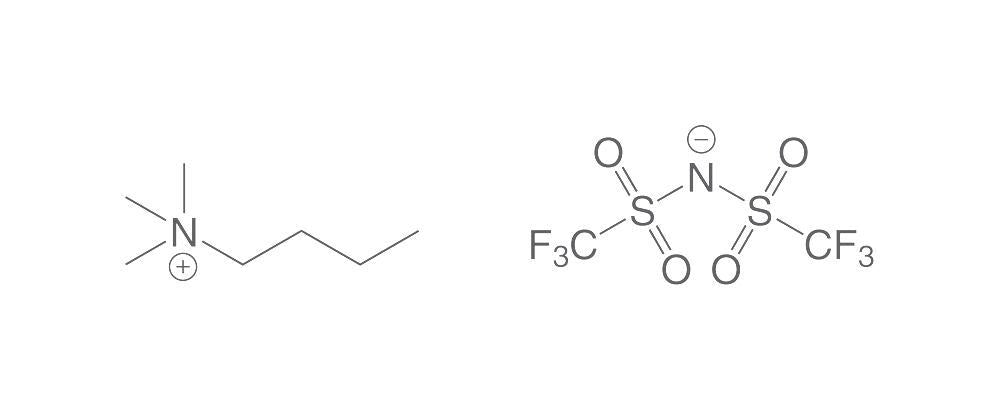


Description
Le butyl-triméthyl-ammonium-bis-(trifluorométhylsulfonyl)-imide (N1114 BTA) est un réactif de type liquide ionique proposé avec une pureté minimale de 99 % pour des applications chimiques et solvants avancées. Il porte le numéro CAS 258273-75-5 et la formule brute C₉H₁₈F₆N₂O₄S₂, avec une masse molaire de 396,36 g/mol et une densité de 1,398 g/cm³. Ces valeurs physico-chimiques définies favorisent un dosage précis et le développement de méthodes dans les environnements de recherche axés sur les solvants alternatifs verts et les milieux spécialisés. Sa taille est pratique pour le criblage, les essais de formulation et les travaux de synthèse à petite échelle. Disponible auprès du fabricant Carl ROTH, ce produit N1114 BTA répond aux besoins des laboratoires dans le segment des solvants et des alternatives vertes, où les sels de bis(trifluorométhylsulfonyl)imide de haute pureté sont sélectionnés pour leur composition bien caractérisée. À manipuler conformément à la documentation de sécurité associée et aux bonnes pratiques de laboratoire. La combinaison de la pureté indiquée, de la masse molaire et de la densité permet une intégration claire dans les protocoles expérimentaux sans affirmations de performance supplémentaires au-delà des données du fabricant.
Cet article appartient à la catégorie Photomètres & spectrophotomètres, dans Spectroscopie & photométrie.
Caractéristiques principales
- Aspect : liquide jaunâtre
- Teneur : ≥99 %
- Eau (KF) : ≤0,01 %
- Halogènes : ≤0,01 %
- Numéro CAS : 258273-75-5
- Conditionnements : 25 g, 100 g
- Pureté : min. 99 %
- Formule brute : C₉H₁₈F₆N₂O₄S₂
- Masse molaire : 396,36 g/mol
- Densité : 1,398 g/cm³
- Fiche technique :

- Fiche de données de sécurité :
Compliance & Safety Information

 Danger
Hazard Statements (H-Phrases)
Precautionary Statements (P-Phrases)
Récemment consulté
Vous aimerez peut-être aussi
Questions about Bis(trifluorométhylsulfonyl)imide de butyltriméthylammonium (N1114 BTA), 25 g
What is this article?
Bis(trifluorométhylsulfonyl)imide de butyltriméthylammonium (N1114 BTA), 25 g is the article on this page. Luminix Health distributes Carl Roth for laboratory use. It sits in Photometers & spectrophotometers, inside Spectroscopy & photometry, in Instruments de précision.
A photometer reads absorbance at one or a few wavelengths. A spectrophotometer scans or selects many. Both send light through a cuvette or a well. The wavelength range, UV or visible, and the bandwidth decide what can be measured. A visible-only instrument cannot read a nucleic acid at 260 nm.
A photometer or spectrophotometer sends light through a sample and reads how much was absorbed. In the range where the Beer–Lambert relation holds, absorbance tracks concentration. A refractometer reads how a liquid bends light, which tracks dissolved solids. A polarimeter reads the rotation of polarised light, the classical measurement for sugars. The lamp, the wavelength and the cuvette path length are the three things that have to be right before the number means anything. The optical quantities trace to NIST and the BIPM.
Which category should I open next?
The category is Spectroscopy & photometry. The sub-category is Photometers & spectrophotometers. The catalogue is Instruments de précision.
Shelves beside this one are Refractometers & polarimeters and Lamps, cuvette holders & accessories.
What should I check before I order?
The technical information on this page is the manufacturer's sheet. Read that, not a rewritten specification.
When this page shows a safety data sheet, use that manufacturer file. Hazard text does not belong in the sales description. For a pack size, a grade or a certificate that is not on the page, send a quote request or contact the team.
How does ordering and shipping work?
Luminix Health distributes this article from the heart of Europe. Articles in stock ship within 2–5 business days. Standard delivery is free from €250 excl. VAT. Cold-chain goods and dangerous goods under ADR are never included in that free delivery. The terms are in the Shipping Policy. The full brand index is on shop by brand. Who we are is on about us.
Which other categories should I open?
The seven catalogues are Labware, Lab chemicals, Lab instruments, Lab consumables, Chromatography equipment, Lab safety equipment and Life Science & Microbiology.