
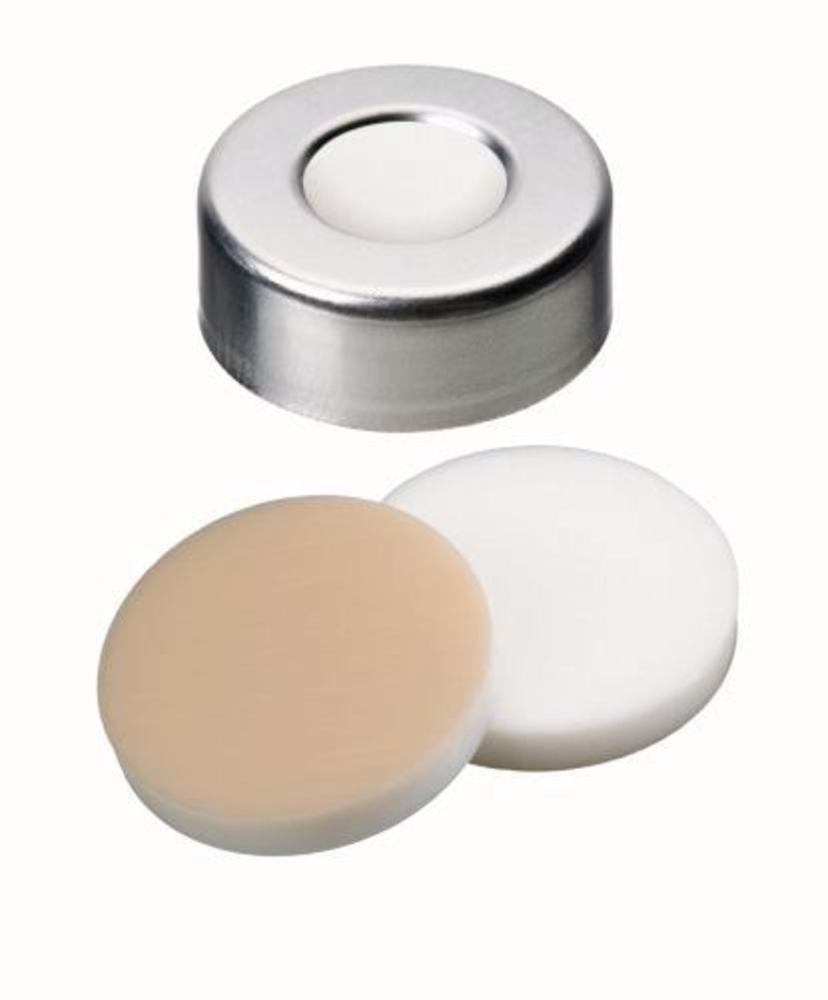


Description
Les capsules à sertir avec trou, Al, ND20 sont des joints à sertir en aluminium pour flacons de laboratoire à finition de col ND20. Cette version est équipée d'un septum Silicone/PTFE AGILENT HT de 3.25 mm d'épaisseur dans une disposition 45°, adaptée aux flacons d'échantillonneur automatique et aux flacons d'échantillon en analyse instrumentale. Un trou central dans la capsule en aluminium maintient le septum accessible pour la pénétration de l'aiguille lors de l'introduction de l'échantillon. Le pack comprend 100 pièces et soutient le travail d'étanchéité au quotidien en chromatographie et dans les environnements de laboratoire associés. Disponibles du fabricant ROTH SELECTION, les capsules s'alignent sur les systèmes standard de flacons ND20 à sertir utilisés sur de nombreuses plateformes analytiques. La désignation Silicone/PTFE AGILENT HT identifie la garniture de septum spécifique fournie avec cet article. La construction en aluminium fournit la coque mécanique pour une fermeture à sertir conventionnelle sur la verrerie correspondante. Le poids du pack est de 0.171 kg. Ces capsules à sertir ND20 avec trou font partie d'une sélection ciblée d'accessoires pour flacons destinée aux laboratoires qui standardisent les joints à sertir en aluminium et la spécification de septum indiquée pour la manipulation d'échantillons de routine.
Cet article fait partie de Bouchons de vials & septa, dans Vials, bouchons & septa.
Caractéristiques
- Conditionnement: 100 pièces
- Type de produit: Capsules à sertir avec trou
- Matériau: Aluminium (Al)
- Finition du col: ND20
- Septum: Silicone/PTFE AGILENT HT
- Épaisseur de septum: 3.25 mm
Récemment consulté
Vous aimerez peut-être aussi
Browse related categories
Category
Sub-category
Catalogue
Brand
Questions about Capsules à sertir avec trou, Al, ND20, Septum Silic./PTFE AGILENT HT,3,25mm 45°
What is this article?
Capsules à sertir avec trou, Al, ND20, Septum Silic./PTFE AGILENT HT,3,25mm 45° is the article on this page. Luminix Health distributes Carl Roth for laboratory use. It sits in Bouchons de vials & septa, inside Vials, bouchons & septa, in Chromatographie.
A vial cap and a septum have to match the vial neck: crimp, screw or snap, and the diameter. The septum material, PTFE/silicone or rubber, decides chemical resistance and how many times a needle can pierce it. A septum that sheds into the solvent becomes ghost peaks.
An autosampler vial is the small closed bottle a chromatograph picks up. The neck is crimp, screw or snap, and the cap and the septum have to be that neck. The septum is the part the needle pierces. A soft septum reseals. A septum that is wrong for the solvent swells or sheds particles into the sample. Inserts reduce the volume when the sample is scarce. The separation they feed is described with IUPAC names and PubChem data.
Which category should I open next?
The category is Vials, bouchons & septa. The sub-category is Bouchons de vials & septa. The catalogue is Chromatographie.
Shelves beside this one are Accessoires de chromatographie, Flacons pour passeur d'échantillons, Sertisseuses & décapsuleurs and Inserts pour vials.
What should I check before I order?
The technical information on this page is the manufacturer's sheet. Read that, not a rewritten specification.
When this page shows a safety data sheet, use that manufacturer file. Hazard text does not belong in the sales description. For a pack size, a grade or a certificate that is not on the page, send a quote request or contact the team.
How does ordering and shipping work?
Luminix Health distributes this article from the heart of Europe. Articles in stock ship within 2–5 business days. Standard delivery is free from €250 excl. VAT. Cold-chain goods and dangerous goods under ADR are never included in that free delivery. The terms are in the Shipping Policy. The full brand index is on shop by brand. Who we are is on about us.
Which other categories should I open?
The seven catalogues are Labware, Lab chemicals, Lab instruments, Lab consumables, Chromatography equipment, Lab safety equipment and Life Science & Microbiology.