
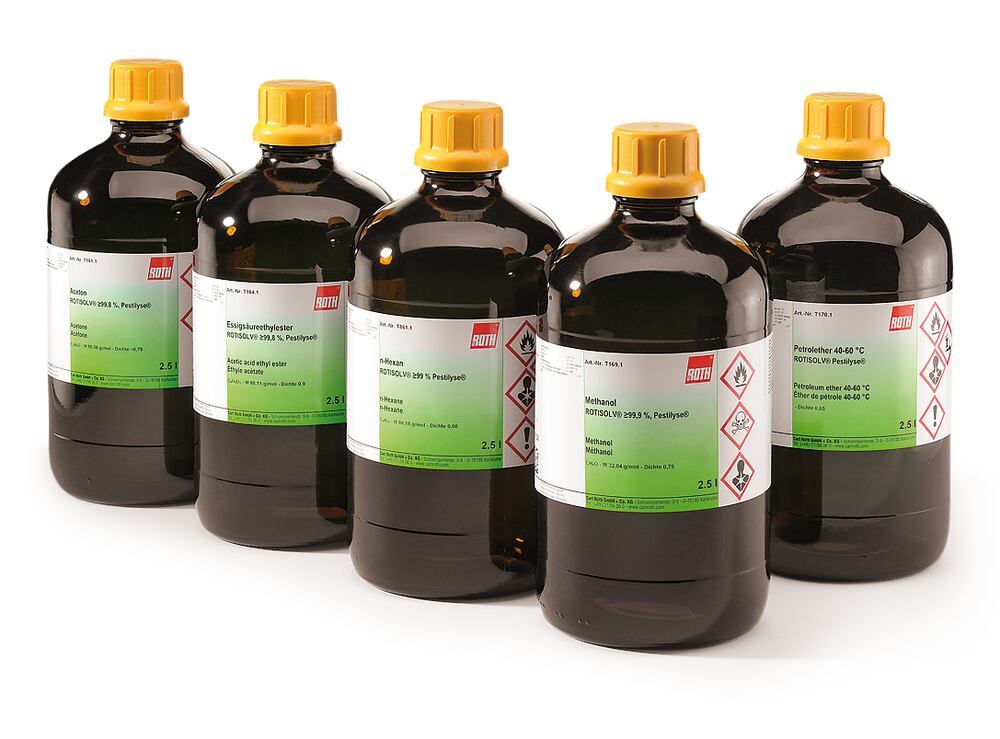


Description
Diethyl ether ROTISOLV® Pestilyse® is a high-purity solvent grade with a minimum assay of 99,8 %, stabilised with ethanol for laboratory and chromatographic use. It carries CAS number 60-29-7 and empirical formula C₄H₁₀O, with a molar mass of 74,12 g/mol and a density of 0,71 g/cm³. The boiling point lies between 34,58 and 34,59 °C, and the flash point is −40 °C, reflecting the highly volatile character typical of diethyl ether in GC solvent workflows. Supplied as 2,5 l in glass, this ROTISOLV® quality from manufacturer Carl ROTH is positioned for gas chromatography and related analytical applications that demand low-residue solvent performance. Supporting identifiers include EG number 200-467-2 and UN number 1155. The combination of Pestilyse® specification, ethanol stabilisation, and defined physical constants makes it a practical choice for GC sample preparation and solvent systems in analytical laboratories.
This article is part of GC liners, septa, syringes & accessories, in GC columns & accessories.
Key features
- Assay (GC): ≥99,8 %
- Water (KF): ≤0,1 %
- Acidity: ≤0,0005 meq/g
- Evaporation residue: ≤0,0005 %
- GC/ECD (individual signal as lindane): ≤5 ng/l
- GC/PND (individual signal as ethylparathion): ≤10 ng/l
- CAS number: 60-29-7
- Pack size: 2,5 l glass
- EG nr.: 200-467-2
- Purity: min. 99,8 %
- Grade: ROTISOLV® Pestilyse®, stabilised with ethanol
- Molar mass: 74,12 g/mol
- Technical Information Sheet:

- Safety Data Sheet:
Compliance & Safety Information

 Danger
Hazard Statements (H-Phrases)
Precautionary Statements (P-Phrases)
Récemment consulté
Vous aimerez peut-être aussi
Browse related categories
Category
Sub-category
GC liners, septa, syringes & accessories
Catalogue
Brand
Questions about Diethyl ether, ROTISOLV®, min. 99,8 %, Pestilyse®, 2.5 l, glass
What is this article?
Diethyl ether, ROTISOLV®, min. 99,8 %, Pestilyse®, 2.5 l, glass is the article on this page. Luminix Health distributes Carl Roth for laboratory use. It sits in GC liners, septa, syringes & accessories, inside GC columns & accessories, in Chromatographie.
A GC liner is the glass sleeve of the injector, and it collects the non-volatile residue. Its geometry, straight, gooseneck, with or without wool, belongs to a method. Septa and syringes are the other parts that leak. A liner for one injector model does not fit another.
A GC capillary column is a long open tube with a stationary phase coated on the wall. The sample is a vapour, carried by gas. The phase, the film thickness, the length and the internal diameter decide which compounds separate and how long it takes. A liner is the glass sleeve in the injector. It is a consumable: it collects the non-volatile dirt. The septum and the syringe are the other parts that leak or shed. Compound identity sits on PubChem under IUPAC names.
Which category should I open next?
The category is GC columns & accessories. The sub-category is GC liners, septa, syringes & accessories. The catalogue is Chromatographie.
Shelves beside this one are GC capillary columns.
What should I check before I order?
The technical information on this page is the manufacturer's sheet. Read that, not a rewritten specification.
When this page shows a safety data sheet, use that manufacturer file. Hazard text does not belong in the sales description. For a pack size, a grade or a certificate that is not on the page, send a quote request or contact the team.
How does ordering and shipping work?
Luminix Health distributes this article from the heart of Europe. Articles in stock ship within 2–5 business days. Standard delivery is free from €250 excl. VAT. Cold-chain goods and dangerous goods under ADR are never included in that free delivery. The terms are in the Shipping Policy. The full brand index is on shop by brand. Who we are is on about us.
Which other categories should I open?
The seven catalogues are Labware, Lab chemicals, Lab instruments, Lab consumables, Chromatography equipment, Lab safety equipment and Life Science & Microbiology.