
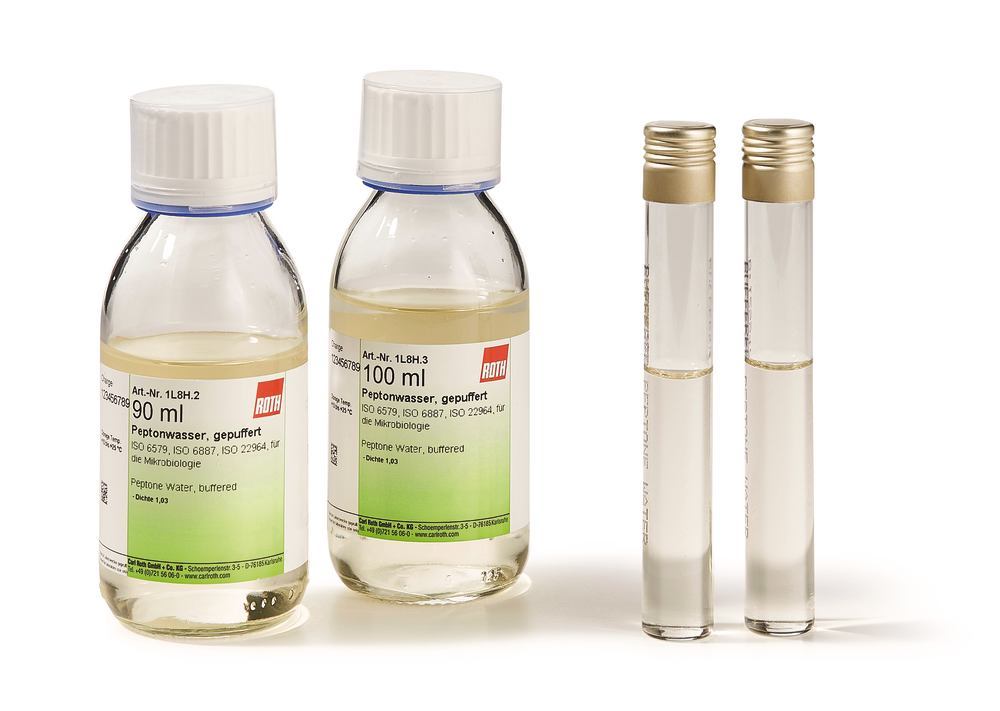


Description
Eau peptonée tamponnée, ISO 6579, ISO 6887, ISO 22964, prête à l'emploi, pour microbiologie, Densité (D) 1,037 g/cm³, Point d'ébullition (pb) 100 °C, Temp. de stockage +15 à +25 °C
L'eau peptonée tamponnée est un milieu non sélectif recommandé comme milieu de pré-enrichissement par la norme EN ISO 6579 dans les échantillons alimentaires contenant des contaminants suspectés tels que Salmonella et dans la norme ISO 22964 dans le lait et les produits laitiers pour Enterobacter sakazakii.
Ce bouillon est riche en nutriments et produit des taux de réanimation élevés pour les bactéries sub létalement lésées et une croissance intense. Les changements de pH peuvent endommager la croissance bactérienne. L'eau peptonée tamponnée maintient un pH élevé pendant la période d'enrichissement grâce au système tampon phosphate et permet la réparation des cellules lésées sensibles à un pH bas. La peptone de caséine pancréatique fournit l'azote, les vitamines, les minéraux et les acides aminés essentiels à la croissance. Le pyruvate de sodium peut être ajouté comme source d'énergie supplémentaire, mais peut également avoir des effets protecteurs contre le peroxyde d'hydrogène qui aide à la réanimation des organismes stressés. Le chlorure de sodium fournit les électrolytes essentiels pour le transport et l'équilibre osmotique.
| Vérification de | Escherichia coli Salmonella enterica Salmonella typhimurium Staphylococcus aureus |
| Application | Dilution générale Enrichissement général |
| Certifié selon | ISO 6579 ISO 6887 ISO 22964 |
Récemment consulté
Vous aimerez peut-être aussi
Browse related categories
Category
Sub-category
Dehydrated culture media (agar & broth bases)
Catalogue
Brand
Questions about Eau peptonée tamponnée, ISO 6579, ISO 6887, ISO 22964, 180 ml, verre
What is this article?
Eau peptonée tamponnée, ISO 6579, ISO 6887, ISO 22964, 180 ml, verre is the article on this page. Luminix Health distributes Carl Roth for laboratory use. It sits in Dehydrated culture media (agar & broth bases), inside Culture media & microbiology, in Microbiologie.
A dehydrated medium is a powder the laboratory dissolves, sterilises and pours. The formulation name, the supplements it still needs, and the grams per litre are the specification. Two powders with similar names, one selective and one not, grow different organisms.
A culture medium is the food and the solid or liquid home of a microorganism. Dehydrated media are powders the laboratory dissolves and sterilises. Ready-to-use plates and tubes are already that. A Petri dish is the plate. Selective media let one kind of organism grow and hold another back. The formulation and the supplements, not the colour of the agar, are the specification. Reference strains are at ATCC. Methods are on PubMed. Biosafety practice is the WHO laboratory biosafety topic.
Which category should I open next?
The category is Culture media & microbiology. The sub-category is Dehydrated culture media (agar & broth bases). The catalogue is Microbiologie.
Shelves beside this one are Petri dishes, Ready-to-use culture media (plates, tubes, bottles), Microbiology (other), Inoculation loops, spreaders & needles and Microbial identification, hygiene monitoring & rapid tests.
What should I check before I order?
The technical information on this page is the manufacturer's sheet. Read that, not a rewritten specification.
When this page shows a safety data sheet, use that manufacturer file. Hazard text does not belong in the sales description. For a pack size, a grade or a certificate that is not on the page, send a quote request or contact the team.
How does ordering and shipping work?
Luminix Health distributes this article from the heart of Europe. Articles in stock ship within 2–5 business days. Standard delivery is free from €250 excl. VAT. Cold-chain goods and dangerous goods under ADR are never included in that free delivery. The terms are in the Shipping Policy. The full brand index is on shop by brand. Who we are is on about us.
Which other categories should I open?
The seven catalogues are Labware, Lab chemicals, Lab instruments, Lab consumables, Chromatography equipment, Lab safety equipment and Life Science & Microbiology.