


Description
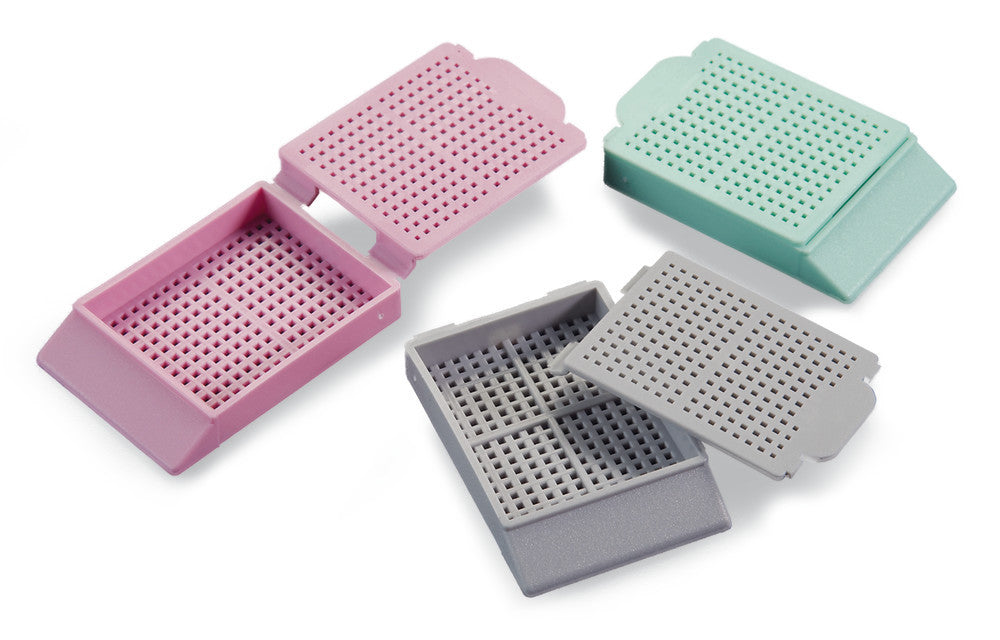
Les cassettes d'inclusion pour biopsies sont des consommables de laboratoire d'histologie spécialisés, fabriqués à partir d'un polymère spécial et fournis en gris pour une identification visuelle claire des spécimens. Elles sont destinées à contenir les échantillons de biopsie lors des procédures d'inclusion dans les laboratoires de microscopie et de pathologie. Chaque paquet contient 500 unités, offrant aux laboratoires une quantité de travail pratique pour les flux de travail d'histologie de routine. La construction en polymère spécial est adaptée à une utilisation standard des cassettes d'inclusion aux côtés des moules et des systèmes de stockage en laboratoire. Le code couleur gris facilite l'organisation des échantillons par cas, type de tissu ou étape de processus sur la paillasse. Ces cassettes d'inclusion du fabricant SIMPORT appartiennent à la gamme de consommables pour la microscopie, l'histologie et l'instrumentation, plus spécifiquement au groupe couvrant les cassettes d'inclusion, les moules et le stockage. Avec un poids de paquet de 1,900 kg, l'unité est facile à manipuler en inventaire et à la réception des marchandises. Les cassettes répondent aux besoins quotidiens d'inclusion de biopsies et de manipulation de spécimens dans des environnements de laboratoire professionnels sans complexité ajoutée.
Cet article appartient à la collection Cassettes d'inclusion et moules, dans Microscopie & histologie.
Caractéristiques principales
- Conditionnement : 500 unité(s)
- Type : Cassettes d'inclusion
- Matériau : Polymère spécial
- Couleur : Gris
- Poids : 1,900 kg
- Fiche technique :

Récemment consulté
Vous aimerez peut-être aussi
Browse related categories
Category
Sub-category
Catalogue
Brand
Questions about Cassettes d'inclusion, pour biopsies, polymère spécial, gris, 500 unité(s)
What is this article?
Cassettes d'inclusion, pour biopsies, polymère spécial, gris, 500 unité(s) is the article on this page. Luminix Health distributes SIMPORT for laboratory use. It sits in Histology cassettes & moulds, inside Microscopy & histology, in Instruments de précision.
A histology cassette holds a tissue through processing, and a mould forms the paraffin block. The cassette's holes have to let solvents through and still keep the specimen. A fine biopsy and a large organ are different cassettes.
A light microscope forms an image with glass lenses and transmitted or reflected light. A stereo microscope is the lower-magnification instrument for dissecting and for looking at a surface. Fluorescence needs a light source and filters matched to the dye. Histology is the preparation that makes a tissue readable: fixation, a cassette, a section, a stain. The objective's magnification and numerical aperture decide the resolution. The slide and the cover glass decide whether the section sits in the focal plane. Stains and dyes as substances are identified on PubChem. Papers on the methods are on PubMed.
Which category should I open next?
The category is Microscopy & histology. The sub-category is Histology cassettes & moulds. The catalogue is Instruments de précision.
Shelves beside this one are Microscope slides & cover glasses, Microscope objectives, eyepieces & optics, Counting chambers & haemocytometers, Stereo microscopes, Light & fluorescence microscopes, Histology reagents & consumables, Microscopy accessories, Cold light sources & lighting and Digital & USB microscopes.
What should I check before I order?
The technical information on this page is the manufacturer's sheet. Read that, not a rewritten specification.
When this page shows a safety data sheet, use that manufacturer file. Hazard text does not belong in the sales description. For a pack size, a grade or a certificate that is not on the page, send a quote request or contact the team.
How does ordering and shipping work?
Luminix Health distributes this article from the heart of Europe. Articles in stock ship within 2–5 business days. Standard delivery is free from €250 excl. VAT. Cold-chain goods and dangerous goods under ADR are never included in that free delivery. The terms are in the Shipping Policy. The full brand index is on shop by brand. Who we are is on about us.
Which other categories should I open?
The seven catalogues are Labware, Lab chemicals, Lab instruments, Lab consumables, Chromatography equipment, Lab safety equipment and Life Science & Microbiology.