


Description
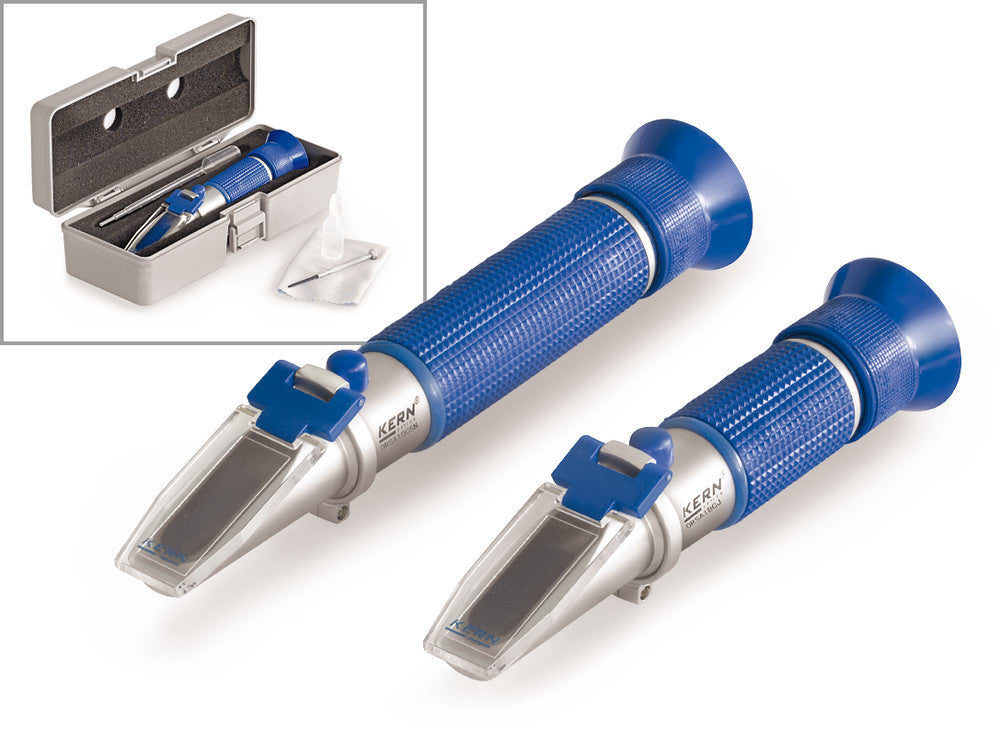
Handheld refractometer ORA 90BE (without ATC) is an analogue device for Brix measurement over an extended range of 0–90% Brix. It is intended for refractive-index determination and related physical-property checks where a wide concentration span is required and automatic temperature compensation is not specified. The handheld optical design supports rapid sample evaluation in laboratory, production or teaching environments that favour a clear scale readout and manual operation. Delivered as one unit with a weight of 0,95 kg, the ORA 90BE forms part of the KERN analogue refractometer line and addresses applications from dilute solutions through to highly concentrated sugar-containing matrices. Users apply a small sample volume to the prism and read the Brix value directly, making the instrument suitable for routine screening and comparative work. This single-piece offering serves laboratories seeking a robust, non-digital refractometer for everyday concentration assessment across a broad Brix window without ATC functionality.
This article is part of Refractometers & polarimeters, in Spectroscopy & photometry.
Key features
- Pack size: 1 pc
- Instrument type: Analogue handheld refractometer
- Model: ORA 90BE
- Measuring range: 0–90% Brix
- Temperature compensation: Without ATC
- EAN: 4045761160156
- Technical Information Sheet:

Récemment consulté
Vous aimerez peut-être aussi
Browse related categories
Category
Sub-category
Catalogue
Brand
Questions about Handh. refractometer, ORA 90BE (w/o ATC), Analogue, 0-90% Brix, 1 unit(s)
What is this article?
Handh. refractometer, ORA 90BE (w/o ATC), Analogue, 0-90% Brix, 1 unit(s) is the article on this page. Luminix Health distributes KERN for laboratory use. It sits in Refractometers & polarimeters, inside Spectroscopy & photometry, in Instruments de précision.
A refractometer reads the refractive index of a liquid, often expressed as Brix for sugar. A polarimeter reads the rotation of polarised light. Both depend on temperature. A handheld refractometer and a thermostated benchtop instrument are different accuracies.
A photometer or spectrophotometer sends light through a sample and reads how much was absorbed. In the range where the Beer–Lambert relation holds, absorbance tracks concentration. A refractometer reads how a liquid bends light, which tracks dissolved solids. A polarimeter reads the rotation of polarised light, the classical measurement for sugars. The lamp, the wavelength and the cuvette path length are the three things that have to be right before the number means anything. The optical quantities trace to NIST and the BIPM.
Which category should I open next?
The category is Spectroscopy & photometry. The sub-category is Refractometers & polarimeters. The catalogue is Instruments de précision.
Shelves beside this one are Photometers & spectrophotometers and Lamps, cuvette holders & accessories.
What should I check before I order?
The technical information on this page is the manufacturer's sheet. Read that, not a rewritten specification.
When this page shows a safety data sheet, use that manufacturer file. Hazard text does not belong in the sales description. For a pack size, a grade or a certificate that is not on the page, send a quote request or contact the team.
How does ordering and shipping work?
Luminix Health distributes this article from the heart of Europe. Articles in stock ship within 2–5 business days. Standard delivery is free from €250 excl. VAT. Cold-chain goods and dangerous goods under ADR are never included in that free delivery. The terms are in the Shipping Policy. The full brand index is on shop by brand. Who we are is on about us.
Which other categories should I open?
The seven catalogues are Labware, Lab chemicals, Lab instruments, Lab consumables, Chromatography equipment, Lab safety equipment and Life Science & Microbiology.