



Description
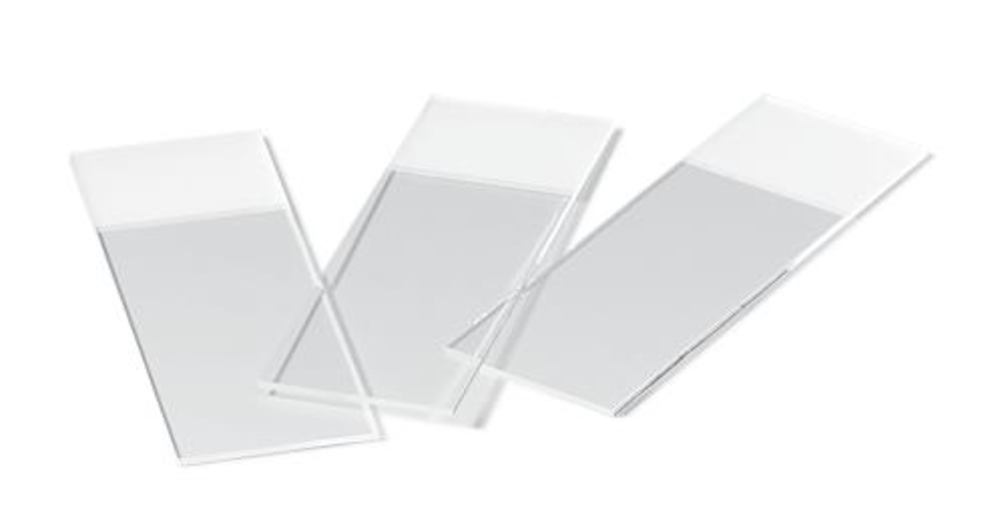
Les lames de microscope standard en verre sodocalcique avec bords polis à 45° et zone d'écriture dépolie constituent une base fiable pour les flux de travail courants en microscopie optique et en histologie. Chaque lame a une épaisseur de 1 mm, offrant une plate-forme stable pour monter des échantillons, appliquer des colorations et fixer des lamelles lors de l'examen. Le bord dépoli permet un étiquetage clair des échantillons sans interférer avec le champ optique, tandis que la finition polie à 45° réduit le risque de bords tranchants lors de la manipulation. Fournies en paquets de 50 pièces et pesant 0,250 kg par unité, ces lames conviennent aux laboratoires d'enseignement, aux bancs de pathologie diagnostique et aux stations de microscopie de recherche nécessitant une qualité de verre constante. Fabriquées par Epredia, leur construction en verre sodocalcique est destinée aux applications standard en fond clair et en lumière transmise simple. Elles s'intègrent facilement dans les séquences de préparation de lames quotidiennes, des préparations humides aux préparations permanentes, et s'associent aux formats de lamelles courants utilisés dans les environnements cliniques et universitaires. La combinaison d'une épaisseur définie, d'une zone de marquage dépolie et de bords polis en fait un choix pratique pour les travaux nécessitant un débit élevé, où la géométrie reproductible et un étiquetage simple sont essentiels.
Cet article appartient à la catégorie Lames de microscope et lamelles, dans Microscopie et histologie.
Caractéristiques principales
- Conditionnement : 50 pc(s)
- Type de produit : Lames de microscope standard
- Matériau : Verre sodocalcique
- Finition des bords : Polis à 45°/bord dépoli
- Épaisseur : 1 mm
- Poids : 0,250 kg
- Fiche technique :

Récemment consulté
Vous aimerez peut-être aussi
Questions about Lames de microscope, verre sodocalcique, bords meulés à 45°/bande dépolie, épaisseur 1 mm
What is this article?
Lames de microscope, verre sodocalcique, bords meulés à 45°/bande dépolie, épaisseur 1 mm is the article on this page. Luminix Health distributes Epredia for laboratory use. It sits in Microscope slides & cover glasses, inside Microscopy & histology, in Instruments de laboratoire.
A slide is the glass a specimen sits on. A cover glass is the thin sheet over it, of a thickness the objective was designed for. A cover glass of the wrong thickness softens the image. Charged and plain slides hold sections differently.
A light microscope forms an image with glass lenses and transmitted or reflected light. A stereo microscope is the lower-magnification instrument for dissecting and for looking at a surface. Fluorescence needs a light source and filters matched to the dye. Histology is the preparation that makes a tissue readable: fixation, a cassette, a section, a stain. The objective's magnification and numerical aperture decide the resolution. The slide and the cover glass decide whether the section sits in the focal plane. Stains and dyes as substances are identified on PubChem. Papers on the methods are on PubMed.
Which category should I open next?
The category is Microscopy & histology. The sub-category is Microscope slides & cover glasses. The catalogue is Instruments de laboratoire.
Shelves beside this one are Microscope objectives, eyepieces & optics, Histology cassettes & moulds, Counting chambers & haemocytometers, Stereo microscopes, Light & fluorescence microscopes, Histology reagents & consumables, Microscopy accessories, Cold light sources & lighting and Digital & USB microscopes.
What should I check before I order?
The technical information on this page is the manufacturer's sheet. Read that, not a rewritten specification.
When this page shows a safety data sheet, use that manufacturer file. Hazard text does not belong in the sales description. For a pack size, a grade or a certificate that is not on the page, send a quote request or contact the team.
How does ordering and shipping work?
Luminix Health distributes this article from the heart of Europe. Articles in stock ship within 2–5 business days. Standard delivery is free from €250 excl. VAT. Cold-chain goods and dangerous goods under ADR are never included in that free delivery. The terms are in the Shipping Policy. The full brand index is on shop by brand. Who we are is on about us.
Which other categories should I open?
The seven catalogues are Labware, Lab chemicals, Lab instruments, Lab consumables, Chromatography equipment, Lab safety equipment and Life Science & Microbiology.