
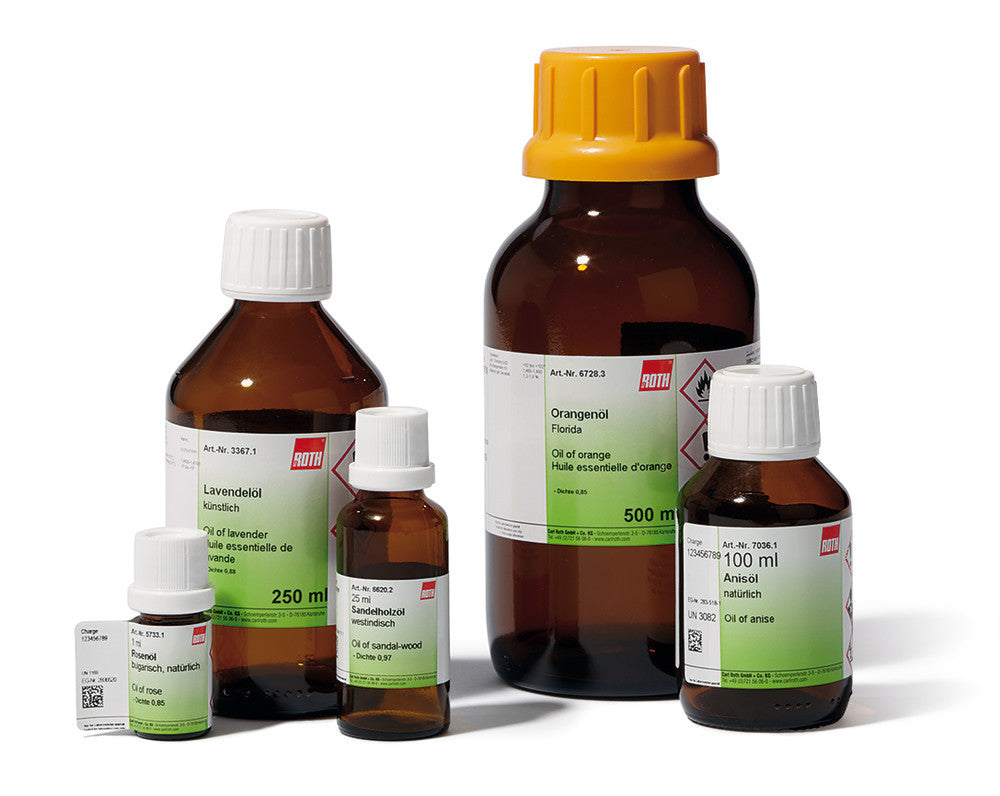


Description
L'huile de cajeput est une huile essentielle naturelle proposée pour un usage en laboratoire et en recherche. Identifiée par le numéro CAS 85480-37-1 et le numéro CE 287-316-4, elle présente une densité de 0,92 g/cm³, un point d'éclair de 54,6 °C et une plage d'ébullition de 157 à 210 °C. Ces données physiques permettent une manipulation contrôlée dans les flux de travail d'analyse, de formulation et de produits naturels où un profil d'huile essentielle défini est requis. Le produit appartient à la catégorie des produits naturels et huiles essentielles et convient aux applications nécessitant une huile de cajeput naturelle plutôt qu'un substitut synthétique. Fournie par le fabricant Carl ROTH en verre, elle est pratique pour le développement de méthodes, les travaux de référence et la préparation courante en laboratoire. La densité, le point d'éclair et la plage d'ébullition doivent être pris en compte lors de la planification des étapes de stockage, de transfert et de chauffage. Cette qualité est destinée aux environnements de laboratoire professionnels ayant besoin d'une huile naturelle clairement spécifiée avec des paramètres physico-chimiques transparents pour la documentation et la conception de procédés.
Cet article appartient à la catégorie Huiles essentielles & parfums, dans Produits naturels & huiles essentielles.
Caractéristiques principales
- Aspect : huile limpide, incolore à jaune
- Densité (20 °C) : 0,910-0,925 g/cm³
- Indice de réfraction (20 °C) : 1,462-1,472
- Pouvoir rotatoire (20 °C) : -5° à 0°
- 1,8-Cinéole : 50- 70 %
- α-Terpinéol : 5-15 %
- Numéro CAS : 85480-37-1
- Conditionnements : 100 ml, 500 ml
- N° CE : 287-316-4
- Densité : 0,92 g/cm³
- Point d'éclair : 54,6 °C
- Point d'ébullition : 157 à 210 °C
- Fiche technique :

- Fiche de données de sécurité :
Compliance & Safety Information


 Danger
Hazard Statements (H-Phrases)
Precautionary Statements (P-Phrases)
Récemment consulté
Vous aimerez peut-être aussi
Questions about Huile de cajeput, naturelle, 100 ml, verre
What is this article?
Huile de cajeput, naturelle, 100 ml, verre is the article on this page. Luminix Health distributes Carl Roth for laboratory use. It sits in Essential oils & fragrances, inside Natural products & essential oils, in Produits chimiques.
An essential oil is the volatile fraction distilled or pressed from a named plant part. The species, the chemotype and a stated component, when the seller gives one, are the specification. A fragrance compound is a formulated mixture. The two should not be treated as the same bottle.
A natural product is a molecule extracted from a plant, an animal or a microorganism, or a mixture of those molecules. An essential oil is the volatile fraction. The useful specification is the source species, the plant part and, where it exists, the stated content of a marker compound. Two oils with the same common name are not the same article. Marker compounds are identified on PubChem and named by IUPAC.
Which category should I open next?
The category is Natural products & essential oils. The sub-category is Essential oils & fragrances. The catalogue is Produits chimiques.
Shelves beside this one are Natural products & phytochemicals.
What should I check before I order?
When this page shows a safety data sheet, use that manufacturer file. Hazard text does not belong in the sales description. For a pack size, a grade or a certificate that is not on the page, send a quote request or contact the team.
How does ordering and shipping work?
Luminix Health distributes this article from the heart of Europe. Articles in stock ship within 2–5 business days. Standard delivery is free from €250 excl. VAT. Cold-chain goods and dangerous goods under ADR are never included in that free delivery. The terms are in the Shipping Policy. The full brand index is on shop by brand. Who we are is on about us.
Which other categories should I open?
The seven catalogues are Labware, Lab chemicals, Lab instruments, Lab consumables, Chromatography equipment, Lab safety equipment and Life Science & Microbiology.