
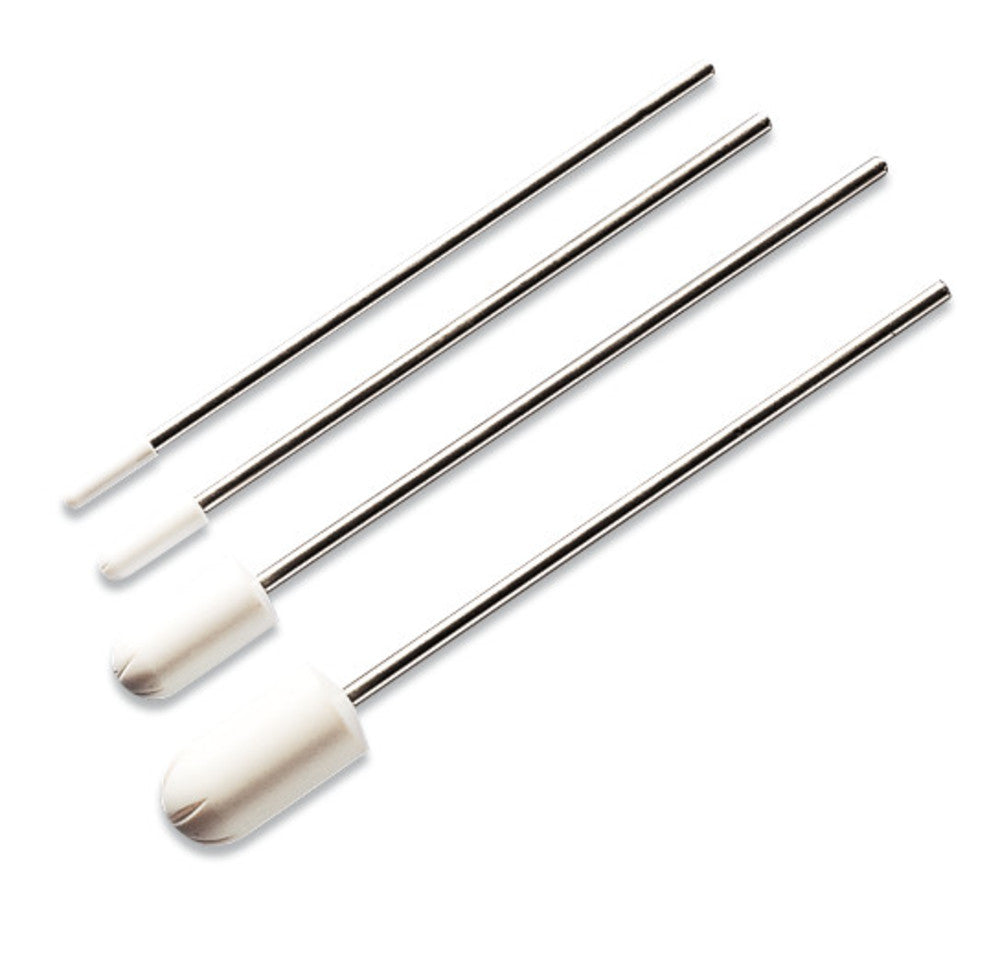


Description
Pestle for homogeniser TT58.1 provides the grinding element for mid-range sample volumes in tissue and cell homogenisation. Its head is manufactured from PTFE and is fixed to a stainless steel rod, delivering a chemically resistant working face with a stable metallic shaft for manual operation. The pestle is dimensioned for the 5 ml homogeniser TT58.1 and belongs to the standard accessory range used in microbiology, molecular biology and cell-culture laboratories. PTFE minimises sample adhesion during disruption of soft tissues and cell aggregates, while the stainless steel rod transmits force evenly along the vessel wall. Packed as a single unit weighing 0,070 kg, it is straightforward to stock alongside matching glass homogenisers. Typical applications include preparation of homogeneous suspensions prior to nucleic-acid work, protein extraction or plating steps where a defined 5 ml format is preferred. This pestle from manufacturer Carl ROTH is selected when laboratories already operate the TT58.1 homogeniser and require a PTFE-headed tool with stainless steel rod construction. Explicit pairing to the 5 ml system simplifies ordering and keeps mechanical fit consistent across batches.
This article is part of Homogenisers & dispersers, in Stirring, shaking & mixing.
Key features
- Pack size: 1 pc
- Product type: Pestle
- Compatible with: homogeniser TT58.1
- Head material: PTFE
- Rod material: stainless steel
- Working volume: 5 ml
Récemment consulté
Vous aimerez peut-être aussi
Browse related categories
Category
Sub-category
Catalogue
Brand
Questions about Pestle for homogeniser TT58.1, Head made of PTFE, rod stainl. st., 5 ml
What is this article?
Pestle for homogeniser TT58.1, Head made of PTFE, rod stainl. st., 5 ml is the article on this page. Luminix Health distributes Carl Roth for laboratory use. It sits in Homogenisers & dispersers, inside Stirring, shaking & mixing, in Instruments de précision.
A homogeniser or disperser uses a rotor inside a stator to tear a sample and disperse it. Tip diameter and speed decide the particle size. A generator for 2 mL and a generator for 1 L are different tools on, sometimes, the same drive.
Stirring keeps a mixture uniform or helps a solid dissolve. A magnetic stirrer spins a bar inside a closed vessel. An overhead stirrer drives a shaft when the liquid is viscous or the volume is large. A vortex mixer agitates a tube. A shaker moves a whole rack or a plate. The shape of the impeller and the speed decide whether the liquid turns over or merely spins. The vessels being stirred are indexed under ISO laboratory glassware.
Which category should I open next?
The category is Stirring, shaking & mixing. The sub-category is Homogenisers & dispersers. The catalogue is Instruments de précision.
Shelves beside this one are Magnetic stirring bars, Stirring shafts, propellers & impellers, Magnetic stirrers, Stirring & mixing accessories, Shakers, rockers & rotators, Overhead stirrers and Vortex mixers.
What should I check before I order?
The technical information on this page is the manufacturer's sheet. Read that, not a rewritten specification.
When this page shows a safety data sheet, use that manufacturer file. Hazard text does not belong in the sales description. For a pack size, a grade or a certificate that is not on the page, send a quote request or contact the team.
How does ordering and shipping work?
Luminix Health distributes this article from the heart of Europe. Articles in stock ship within 2–5 business days. Standard delivery is free from €250 excl. VAT. Cold-chain goods and dangerous goods under ADR are never included in that free delivery. The terms are in the Shipping Policy. The full brand index is on shop by brand. Who we are is on about us.
Which other categories should I open?
The seven catalogues are Labware, Lab chemicals, Lab instruments, Lab consumables, Chromatography equipment, Lab safety equipment and Life Science & Microbiology.