
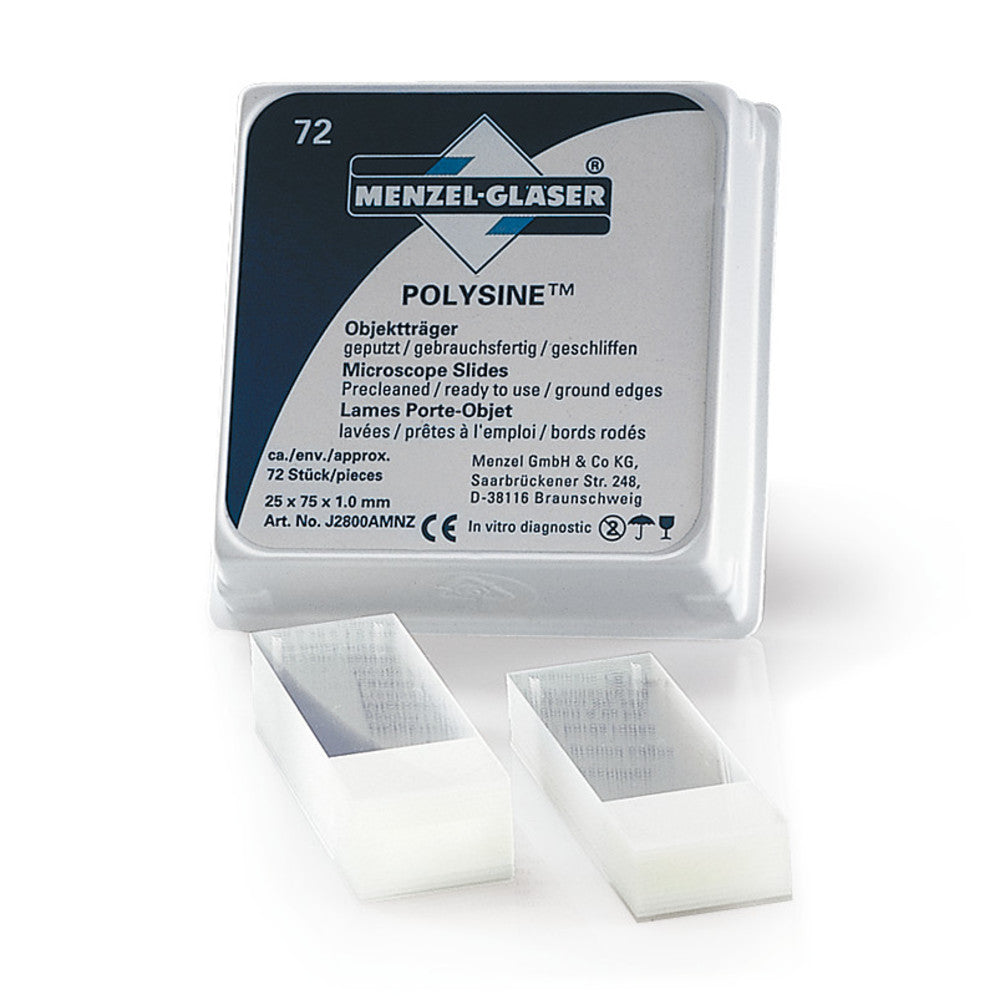



Description
Lames Polysine®, verre sodocalcique, bords coupés 90°, épaisseur 1 mm
Avec adhésifs spéciaux pour la fixation de cellules et de tissus. L'application complexe et coûteuse d'adhésifs ou de revêtements protéiques n'est pas nécessaire. Les préparations sont d'abord attirées par voie électrostatique, puis liées biochimiquement. L'adhésif permanent confère à la lame une excellente adhérence cellulaire et tissulaire. Les lames Polysine® sont insensibles aux effets enzymatiques ou à la chaleur.
- Coupes congelées à frais
- Inclusions en paraffine (2-5 µm, fixées à l'alcool, au formol, au Bouin ou coupes non réticulées)
- Processus de coloration prolongés
- Hybridation in situ de l'ADN prolongée et méthodes immunocytochimiques
- Préparations par cytocentrifugation
| Version | Avec bord dépoli |
| Longueur | 75 mm |
| Largeur | 25 mm |
| Épaisseur | 1 mm |
| Finition des bords | Meulés 90° |
Récemment consulté
Vous aimerez peut-être aussi
Questions about Lames Polysine®, verre sodocalcique, bords coupés 90°, ép. 1 mm, 72 unité(s)
What is this article?
Lames Polysine®, verre sodocalcique, bords coupés 90°, ép. 1 mm, 72 unité(s) is the article on this page. Luminix Health distributes Epredia for laboratory use. It sits in Microscope slides & cover glasses, inside Microscopy & histology, in Instruments de laboratoire.
A slide is the glass a specimen sits on. A cover glass is the thin sheet over it, of a thickness the objective was designed for. A cover glass of the wrong thickness softens the image. Charged and plain slides hold sections differently.
A light microscope forms an image with glass lenses and transmitted or reflected light. A stereo microscope is the lower-magnification instrument for dissecting and for looking at a surface. Fluorescence needs a light source and filters matched to the dye. Histology is the preparation that makes a tissue readable: fixation, a cassette, a section, a stain. The objective's magnification and numerical aperture decide the resolution. The slide and the cover glass decide whether the section sits in the focal plane. Stains and dyes as substances are identified on PubChem. Papers on the methods are on PubMed.
Which category should I open next?
The category is Microscopy & histology. The sub-category is Microscope slides & cover glasses. The catalogue is Instruments de laboratoire.
Shelves beside this one are Microscope objectives, eyepieces & optics, Histology cassettes & moulds, Counting chambers & haemocytometers, Stereo microscopes, Light & fluorescence microscopes, Histology reagents & consumables, Microscopy accessories, Cold light sources & lighting and Digital & USB microscopes.
What should I check before I order?
The technical information on this page is the manufacturer's sheet. Read that, not a rewritten specification.
When this page shows a safety data sheet, use that manufacturer file. Hazard text does not belong in the sales description. For a pack size, a grade or a certificate that is not on the page, send a quote request or contact the team.
How does ordering and shipping work?
Luminix Health distributes this article from the heart of Europe. Articles in stock ship within 2–5 business days. Standard delivery is free from €250 excl. VAT. Cold-chain goods and dangerous goods under ADR are never included in that free delivery. The terms are in the Shipping Policy. The full brand index is on shop by brand. Who we are is on about us.
Which other categories should I open?
The seven catalogues are Labware, Lab chemicals, Lab instruments, Lab consumables, Chromatography equipment, Lab safety equipment and Life Science & Microbiology.