
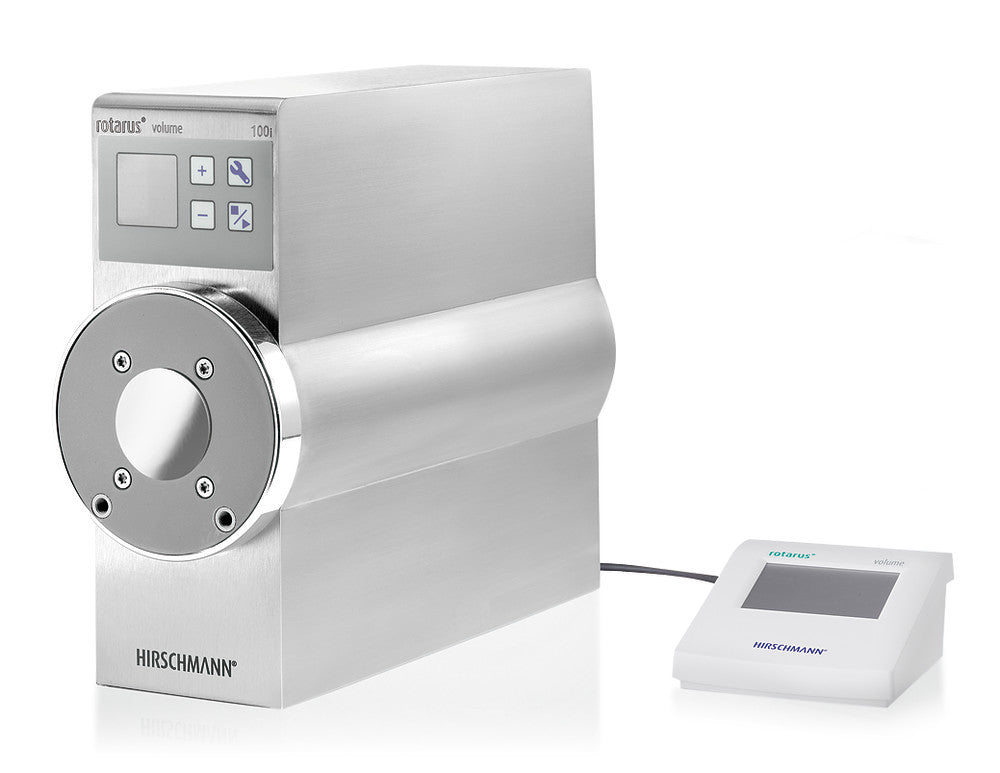


Description
rotarus® standard 50i, Système d'entraînement de pompe
Pompe péristaltique efficace et précise, permettant un large éventail d'applications grâce à l'utilisation de différentes têtes de pompe et tuyaux. Particulièrement adaptée à une utilisation dans les secteurs de la production pharmaceutique et alimentaire grâce à son boîtier en acier inoxydable.
- Panneau de commande directement sur le boîtier de la pompe pour une saisie simple et rapide des fonctions de base
- Têtes de pompe à changement rapide
- Sens de rotation réversible (sens horaire/anti-horaire)
- Régulation de la vitesse en fonction de la charge
- Adaptée au fonctionnement en continu
- Empilable
| Comparaison des modèles de pompe : | |||
| Modèle rotarus® | standard | flow | volume |
| Panneau de commande sur le boîtier | x | x | x |
| Panneau de commande externe avec écran tactile | - | x | x |
| Mémoire pour 20 méthodes | - | x | x |
| Fonction de calibrage | - | x | x |
| Pompage par vitesse | x | x | x |
| Pompage par débit | - | x | x |
| Pompage par volume cible (dosage) | - | - | x |
| Détection automatique de tête de pompe | - | x | x |
| Détection automatique de tuyau | - | x | x |
| Surveillance de la durée de vie du tuyau | - | x | x |
| Détection automatique de fuite et blocage de tuyau | - | x | x |
Pour les faibles débits ou les fluides à haute viscosité.
| Version | standard |
| Type | rotarus® 50i |
| Type de pompe | 50i |
| Débit | 0,0005-1200 ml/min |
| Pas | 0,1 tr/min |
| Vitesse | 0,2-100 tr/min |
| Consommation électrique | 60 W |
| Puissance moteur | 50 W |
| Port | USB et RS 232 |
| Affichage | numérique |
| Indice de protection (IP) | 65 |
| L x l x H | 220 x 100 x 100 mm |
Récemment consulté
Vous aimerez peut-être aussi
Browse related categories
Category
Sub-category
Catalogue
Brand
Questions about rotarus® standard 50i, système d'entraînement de pompe, 1 unité
What is this article?
rotarus® standard 50i, système d'entraînement de pompe, 1 unité is the article on this page. Luminix Health distributes Hirschmann for laboratory use. It sits in Peristaltic & dosing pumps, inside Pumps, vacuum & evaporation, in Instruments de laboratoire.
A peristaltic pump moves liquid by rollers squeezing a tube, so the liquid never touches the mechanism. Flow depends on the tube bore and the speed. A dosing pump aims at a set volume. The tube is the consumable, and the chemical has to be one that tube survives.
A vacuum pump lowers the pressure above a liquid so it boils at a lower temperature. That is the point of a rotary evaporator: solvent leaves a sample without cooking it. A diaphragm pump or a rotary-vane pump is chosen by the vacuum it reaches and by whether solvent vapour will destroy it. A peristaltic pump moves liquid by squeezing a tube, so the liquid touches only the tube. A barrel pump transfers a larger volume from a drum. The glassware on the evaporator is indexed under ISO laboratory glassware. Solvent identity is on PubChem.
Which category should I open next?
The category is Pumps, vacuum & evaporation. The sub-category is Peristaltic & dosing pumps. The catalogue is Instruments de laboratoire.
Shelves beside this one are Vacuum pumps, Rotary evaporators, Vacuum & pump accessories, Drum, barrel & transfer pumps and Pumps (other) & accessories.
What should I check before I order?
The technical information on this page is the manufacturer's sheet. Read that, not a rewritten specification.
When this page shows a safety data sheet, use that manufacturer file. Hazard text does not belong in the sales description. For a pack size, a grade or a certificate that is not on the page, send a quote request or contact the team.
How does ordering and shipping work?
Luminix Health distributes this article from the heart of Europe. Articles in stock ship within 2–5 business days. Standard delivery is free from €250 excl. VAT. Cold-chain goods and dangerous goods under ADR are never included in that free delivery. The terms are in the Shipping Policy. The full brand index is on shop by brand. Who we are is on about us.
Which other categories should I open?
The seven catalogues are Labware, Lab chemicals, Lab instruments, Lab consumables, Chromatography equipment, Lab safety equipment and Life Science & Microbiology.