


Description
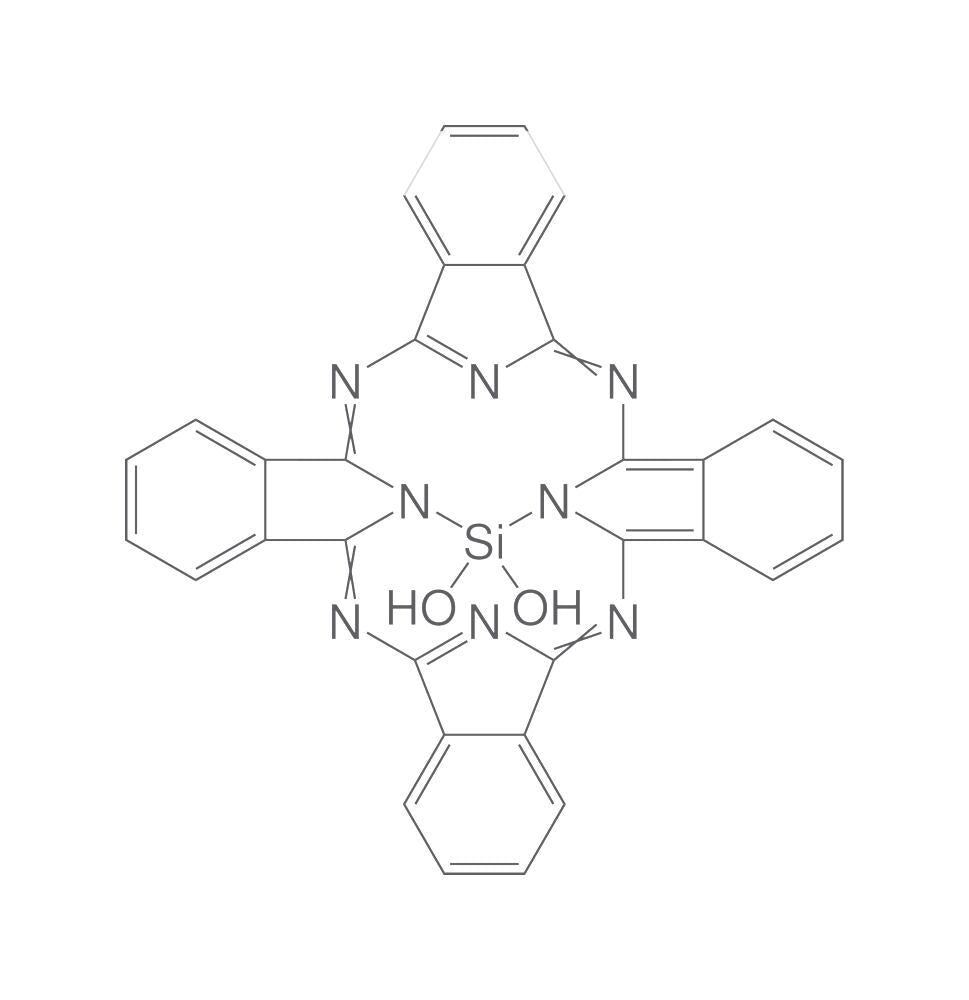
La dihydroxyphtalocyanine de silicium est un réactif de phtalocyanine organosilicique proposé avec une pureté minimale de 95 % pour les travaux de laboratoire et de biochimie. Elle est identifiée par le numéro CAS 19333-15-4, possède la formule brute C₃₂H₁₈N₈O₂Si et une masse molaire de 574,62 g/mol. Sa composition moléculaire définie permet son utilisation partout où une structure de phtalocyanine de silicium substituée par des groupements dihydroxyle est requise, notamment pour la synthèse exploratoire, les études sur les matériaux et le développement de méthodes dans les laboratoires de chimie et de biochimie. Des données d'identification cohérentes aident les chercheurs à documenter clairement les réactifs dans leurs cahiers de laboratoire et leurs protocoles. Cette qualité est disponible auprès du fabricant Carl ROTH et s'adapte aux pratiques de manipulation courantes des réactifs organiques spécialisés. Le conditionnement compact est adapté aux collections de référence, aux réactions pilotes et aux projets nécessitant une consommation contrôlée d'un intermédiaire de phtalocyanine à plus haute valeur ajoutée sans stock excédentaire.
Cet article appartient aux catégories Colorants et marqueurs fluorescents et Colorants, teintures et indicateurs.
Caractéristiques principales
- Numéro CAS : 19333-15-4
- Conditionnements : 100 mg, 250 mg, 500 mg, 1 g, 2 g
- Pureté : min. 95 %
- Formule brute : C₃₂H₁₈N₈O₂Si
- Fiche d'information technique :

Compliance & Safety Information
 Avertissement
Hazard Statements (H-Phrases)
Récemment consulté
Vous aimerez peut-être aussi
Browse related categories
Category
Sub-category
Catalogue
Produits chimiques de laboratoire et industriels
Brand
Questions about Phtalocyanine de dihydroxysilicium, min. 95 %, 100 mg
What is this article?
Phtalocyanine de dihydroxysilicium, min. 95 %, 100 mg is the article on this page. Luminix Health distributes Carl Roth for laboratory use. It sits in Fluorescent dyes & labels, inside Dyes, stains & indicators, in Produits chimiques de laboratoire et industriels.
A fluorescent dye absorbs at one wavelength and emits at a longer one. As a label it is attached to a protein, a nucleic acid or a cell. Excitation and emission maxima, and the reactive group if it must conjugate, are the specification. The colour name does not tell you the wavelengths.
A dye or a stain binds, or changes colour, so that something invisible becomes visible. An indicator changes at a pH or a redox point. A fluorescent dye absorbs one wavelength and emits another, which is how a microscope or a plate reader picks it out. The excitation and emission, or the transition interval, are the specification. The colour name on the label is not. Structures are on PubChem under IUPAC names. Methods are in the PubMed literature.
Which category should I open next?
The category is Dyes, stains & indicators. The sub-category is Fluorescent dyes & labels. The catalogue is Produits chimiques de laboratoire et industriels.
Shelves beside this one are Microscopy stains & staining solutions and Dyes & pigments.
What should I check before I order?
When this page shows a safety data sheet, use that manufacturer file. Hazard text does not belong in the sales description. For a pack size, a grade or a certificate that is not on the page, send a quote request or contact the team.
How does ordering and shipping work?
Luminix Health distributes this article from the heart of Europe. Articles in stock ship within 2–5 business days. Standard delivery is free from €250 excl. VAT. Cold-chain goods and dangerous goods under ADR are never included in that free delivery. The terms are in the Shipping Policy. The full brand index is on shop by brand. Who we are is on about us.
Which other categories should I open?
The seven catalogues are Labware, Lab chemicals, Lab instruments, Lab consumables, Chromatography equipment, Lab safety equipment and Life Science & Microbiology.