
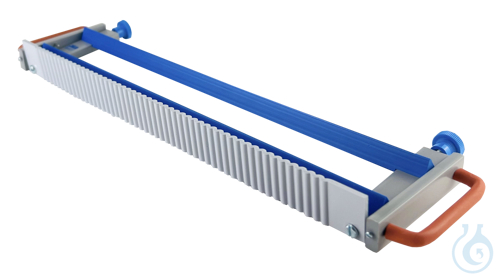



Description
Staining bridge made of PVC without staining tray provides a dedicated support structure for microscope slides during staining operations in the laboratory. Manufactured entirely from polyvinyl chloride (PVC), the bridge offers a lightweight yet sturdy platform that keeps slides elevated and organised while reagents are applied. This version is supplied without a tray, allowing users to pair it with existing containers or separate staining baths according to their preferred workflow. Available as one piece from manufacturer Hecht, it addresses the needs of histology, cytology and general microscopy laboratories that require modular plastic accessories. The PVC material delivers practical durability for repeated contact with common staining solutions. Technicians can position multiple slides securely across the bridge, facilitating simultaneous processing and consistent results. Its straightforward design integrates easily into staining stations in clinical, research or educational settings. By focusing solely on the bridge element, the product supports flexible laboratory layouts where tray systems are already in place or customised separately. This makes it a useful addition to collections of essential laboratory materials used in sample preparation and microscopic examination routines.
This article is part of Trays, bowls & tubs, in Dishes, crucibles & porcelain.
Key features
- Pack size: 1 pc
- Product type: Staining bridge without tray
- Material: Polyvinyl chloride (PVC)
- Includes: Bridge only
- Construction: PVC
Récemment consulté
Vous aimerez peut-être aussi
Questions about Pont de coloration en PVC sans plateau
What is this article?
Pont de coloration en PVC sans plateau is the article on this page. Luminix Health distributes Hecht for laboratory use. It sits in Plateaux, bols & bacs, inside Coupelles, creusets & porcelaine, in Matériel de laboratoire.
A laboratory tray, bowl or tub is an open vessel for holding, staining, drying or carrying many small items at once. Polypropylene trays resist a knock and many aqueous liquids. Porcelain takes heat. The useful numbers are the bottom size and the depth, because that is the working area.
A dish is an open vessel for drying, evaporating or holding a solid. Porcelain and glazed ceramic take a higher temperature than borosilicate glass, which is why a crucible, not a beaker, goes into a furnace. A watch glass covers, or holds a small amount for drying. A mortar is for grinding. The temperature and the chemical, not the shape alone, choose the material. Laboratory ware of this family is listed under ISO laboratory ware.
Which category should I open next?
The category is Coupelles, creusets & porcelaine. The sub-category is Plateaux, bols & bacs. The catalogue is Matériel de laboratoire.
Shelves beside this one are Creusets, Mortiers & pilons, Verres de montre & coupelles de cristallisation, Capsules à évaporation and Coupelles (autres).
What should I check before I order?
When this page shows a safety data sheet, use that manufacturer file. Hazard text does not belong in the sales description. For a pack size, a grade or a certificate that is not on the page, send a quote request or contact the team.
How does ordering and shipping work?
Luminix Health distributes this article from the heart of Europe. Articles in stock ship within 2–5 business days. Standard delivery is free from €250 excl. VAT. Cold-chain goods and dangerous goods under ADR are never included in that free delivery. The terms are in the Shipping Policy. The full brand index is on shop by brand. Who we are is on about us.
Which other categories should I open?
The seven catalogues are Labware, Lab chemicals, Lab instruments, Lab consumables, Chromatography equipment, Lab safety equipment and Life Science & Microbiology.