
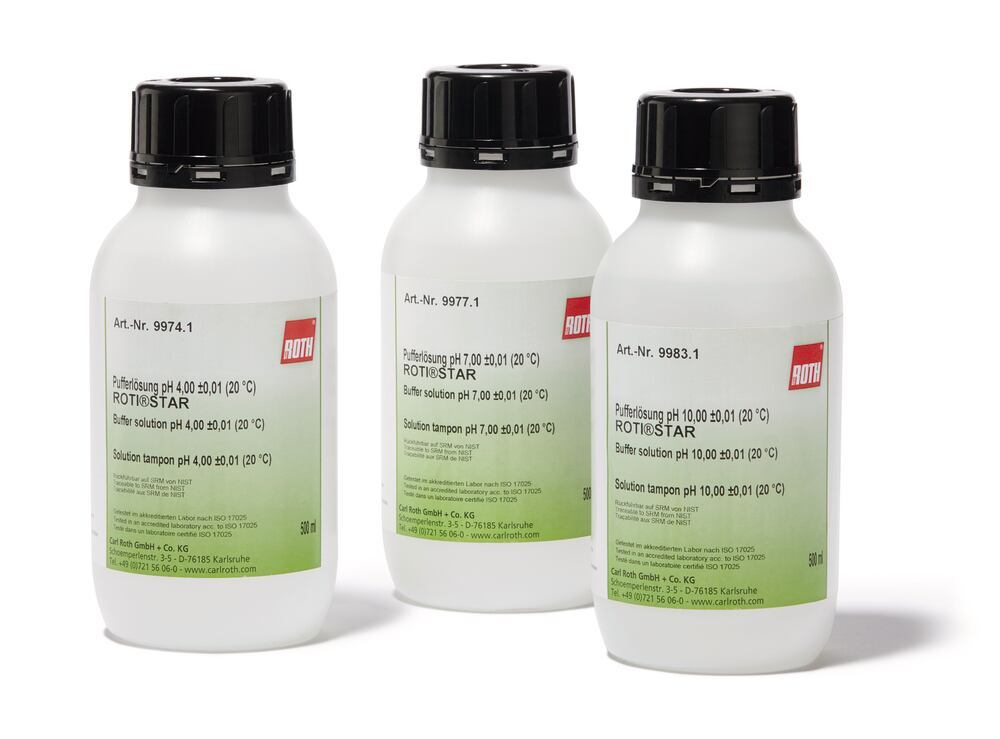


Beschrijving
Bufferoplossing pH 9 ±0.01 (20 °C) is een boraatvrije ROTI®Star-kalibratiestandaard, geformuleerd voor nauwkeurige bepaling van de pH-waarde bij 20 °C. De tolerantie van ±0.01 ondersteunt betrouwbare elektrodekalibratie, systeemgeschiktheidscontroles en routinematige analytische controle waar een alkalisch referentiepunt nodig is zonder boraat. Gegevens van de fabrikant vermelden een dichtheid van 1.006 g/cm³ en een kookpunt van 100 °C, wat een waterige matrix weerspiegelt die geschikt is voor de dagelijkse laboratoriumpraktijk. Het product is Deze boraatvrije buffer van fabrikant Carl ROTH past bij workflows die de voorkeur geven aan boraatvrije media en tegelijk het ROTI®Star-specificatieprofiel behouden. Typische toepassingen omvatten de bepaling van fysische eigenschappen, methodeverificatie en instrumentkalibratie in onderzoeks-, industriële en onderwijslaboratoria. Gebruikt u volgens standaard laboratoriumprocedures en raadpleegt u het veiligheidsinformatieblad vóór hantering. De gedefinieerde pH, de boraatvrije samenstelling en de vermelde dichtheid ondersteunen consistente kalibratie zonder interne bufferbereiding.
Dit artikel maakt deel uit van pH-buffers & geleidbaarheidsstandaarden, in Buffers & pH-oplossingen.
Kenmerken
- pH-waarde (20 °C): 8.99-9.01
- Verpakkingsgroottes: 500 ml, 1 l
- Dichtheid: 1.006 g/cm³
- Kookpunt: 100 °C
- Productlijn: ROTI®Star
- pH-waarde: 9 ±0.01 (20 °C)
- Technisch datablad:

- Veiligheidsinformatieblad:
Recent bekeken
Misschien vind je dit ook leuk
Browse related categories
Category
Sub-category
pH-buffers & geleidbaarheidsstandaarden
Catalogue
Brand
Questions about Bufferoplossing pH 9 ±0.01 (20 °C), ROTI®Star, boraatvrij, 500 ml, kunststof
What is this article?
Bufferoplossing pH 9 ±0.01 (20 °C), ROTI®Star, boraatvrij, 500 ml, kunststof is the article on this page. Luminix Health distributes Carl Roth for laboratory use. It sits in pH-buffers & geleidbaarheidsstandaarden, inside Buffers & pH-oplossingen, in Chemicaliën.
A pH buffer for calibration has a stated pH at a stated temperature, often traceable. A conductivity standard has a stated conductivity. They are not general reagents and they should not be poured back into the bottle. The temperature of the measurement has to be the temperature on the label, or the meter has to compensate.
A buffer resists a change in pH when a little acid or base is added. It does that because a weak acid and its conjugate base are both present. A pH buffer used to calibrate a meter has a stated value at a stated temperature. A biological buffer such as Tris or HEPES is chosen because it holds the pH of a living system and does not poison it. Conductivity standards are the sister articles for a conductivity meter. The ions are on PubChem. Electrode calibration practice sits with EURAMET and BELAC.
Which category should I open next?
The category is Buffers & pH-oplossingen. The sub-category is pH-buffers & geleidbaarheidsstandaarden. The catalogue is Chemicaliën.
Shelves beside this one are Biologische buffers (Tris, HEPES, MOPS) and Buffers (overig).
What should I check before I order?
The technical information on this page is the manufacturer's sheet. Read that, not a rewritten specification.
When this page shows a safety data sheet, use that manufacturer file. Hazard text does not belong in the sales description. For a pack size, a grade or a certificate that is not on the page, send a quote request or contact the team.
How does ordering and shipping work?
Luminix Health distributes this article from the heart of Europe. Articles in stock ship within 2–5 business days. Standard delivery is free from €250 excl. VAT. Cold-chain goods and dangerous goods under ADR are never included in that free delivery. The terms are in the Shipping Policy. The full brand index is on shop by brand. Who we are is on about us.
Which other categories should I open?
The seven catalogues are Labware, Lab chemicals, Lab instruments, Lab consumables, Chromatography equipment, Lab safety equipment and Life Science & Microbiology.