


Beschrijving
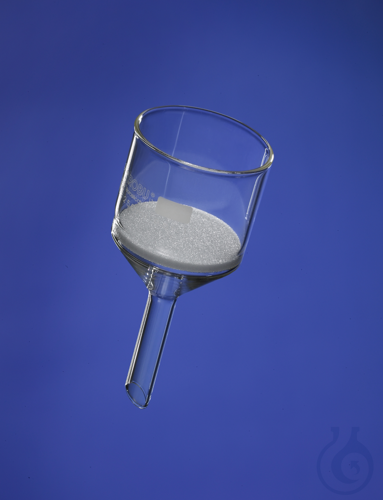
Filtertrechter, 250 ml, porositeit 1 is een laboratoriumfiltertrechter in Büchner-stijl, vervaardigd uit borosilicaatglas 3.3 voor vacuümondersteunde vast-vloeistofscheidingen. Hij bevat een gesinterde glazen VitraPOR® filterplaat met een diameter van 80 mm en porositeitsklasse 1, met een gedefinieerde poriestructuur die geschikt is voor grovere neerslagen, kristalverzamelingen en routinematige analytische filtratie. De vrije hoogte boven de filterplaat bedraagt 65 mm en biedt een praktisch werkvolume binnen de nominale capaciteit van 250 ml voor het toevoegen van slurry en wasstappen. Vervaardigd door ROBU - Stereon, combineert dit glaswerk chemische bestendigheid en thermische stabiliteit die typisch zijn voor borosilicaat 3.3 met een permanent versmolten filterschijf die in veel toepassingen de noodzaak van afzonderlijk filtreerpapier wegneemt. De trechter ondersteunt standaard vacuümfiltratie-opstellingen die worden gebruikt in de preparatieve chemie, kwaliteitscontrole en onderwijslaboratoria. Heldere glazen wanden maken visuele controle van de koekopbouw en de helderheid van het filtraat gedurende het hele proces mogelijk. Geleverd als een enkel stuk, is hij gereed voor integratie in bestaande filtratieopstellingen waar prestaties van porositeit 1 en een compact formaat van 250 ml vereist zijn.
Dit artikel maakt deel uit van Gesinterde glasfilterplaten & -schijven, in Filtratie.
Kenmerken
- Verpakkingsgrootte: 1 stuk
- Inhoud: 250 ml
- Materiaal: Borosilicate glass 3.3
- Filterplaat: VitraPOR® Ø 80 mm
- Porositeit: 1
- Hoogte boven filterplaat: 65 mm
Recent bekeken
Misschien vind je dit ook leuk
Browse related categories
Category
Sub-category
Gesinterde glasfilterplaten & -schijven
Catalogue
Brand
Questions about Filtertrechter, 250 ml, Por. 1
What is this article?
Filtertrechter, 250 ml, Por. 1 is the article on this page. Luminix Health distributes ROBU - Stereon for laboratory use. It sits in Gesinterde glasfilterplaten & -schijven, inside Filtratie, in Verbruiksartikelen.
A sintered glass filter is a disc of fused glass particles with a porosity grade, often 0 to 5, from coarse to fine. It is cleaned and reused. The porosity number, not a micrometre guess, is the specification. Hydrofluoric acid and strong alkali attack the glass.
Filtration holds back what is larger than the pores and lets the rest through. Paper is the ordinary laboratory filter. A membrane has a stated pore size and a polymer that must survive the solvent. A syringe filter is that membrane in a housing on a syringe. Glass fibre takes a higher dirt load. Ultrafiltration holds back macromolecules and passes salts. The pore size, the chemical compatibility and the volume are the three choices. Laboratory apparatus around filtration is indexed under ISO laboratory apparatus.
Which category should I open next?
The category is Filtratie. The sub-category is Gesinterde glasfilterplaten & -schijven. The catalogue is Verbruiksartikelen.
Shelves beside this one are Filterpapier, Spuitfilters, Filterpatronen & capsules, Membraanfilters, Glas- & kwartsvezelfilters, Flesopzet- & vacuümfiltratie-eenheden, Ultrafiltratie & concentratoren, Filtratieaccessoires, Extractiehulzen and Dialyseslangen & apparaten.
What should I check before I order?
When this page shows a safety data sheet, use that manufacturer file. Hazard text does not belong in the sales description. For a pack size, a grade or a certificate that is not on the page, send a quote request or contact the team.
How does ordering and shipping work?
Luminix Health distributes this article from the heart of Europe. Articles in stock ship within 2–5 business days. Standard delivery is free from €250 excl. VAT. Cold-chain goods and dangerous goods under ADR are never included in that free delivery. The terms are in the Shipping Policy. The full brand index is on shop by brand. Who we are is on about us.
Which other categories should I open?
The seven catalogues are Labware, Lab chemicals, Lab instruments, Lab consumables, Chromatography equipment, Lab safety equipment and Life Science & Microbiology.