


Beschrijving
Perchloric acid, ROTIPURAN® Ultra 70 % is een sterk zuur van hoge zuiverheid met empirische formule HClO₄, CAS-nummer 7601-90-3 en EG-nummer 231-512-4. De molaire massa is 100.46 g/mol, de dichtheid is 1.68 g/cm³ en het kookpunt is 198 °C; UN-nummer 1873 identificeert de transportklasse. Het ondersteunt monsterontsluiting, oxidatiestappen en andere veeleisende natchemische bereidingen waarbij een gedefinieerde perchloric acid-matrix vereist is. De ROTIPURAN® Ultra-kwaliteit van fabrikant Carl ROTH biedt een consistent laboratoriumzuur voor methoden die afhankelijk zijn van gecontroleerde zuiverheid en concentratie. Gedocumenteerde fysische eigenschappen vereenvoudigen de integratie in gevalideerde procedures en veiligheidsdocumentatie. Selecteert u deze FEP-presentatie wanneer een robuuste verpakking en betrouwbaar perchloric acid van Ultra-kwaliteit nodig zijn voor analytische en onderzoekstoepassingen.
Dit artikel maakt deel uit van Oplosmiddelen van analytische kwaliteit (p.a.), in Oplosmiddelen.
Kenmerken
- Gehalte (w/w): 65-71 %
- Aluminium (Al): ≤100 ppt
- Antimony (Sb): ≤100 ppt
- Arsenic (As): ≤100 ppt
- Barium (Ba): ≤100 ppt
- Beryllium (Be): ≤100 ppt
- Lead (Pb): ≤10 ppt
- Cadmium (Cd): ≤10 ppt
- Cesium (Cs): ≤10 ppt
- Calcium (Ca): ≤100 ppt
- CAS-nummer: 7601-90-3
- Verpakkingsgroottes: 500 ml, 250 ml, 1 l
- EG-nr.: 231-512-4
- Brutoformule: HClO₄
- Molaire massa: 100.46 g/mol
- Technisch datablad:

- Veiligheidsinformatieblad:
Compliance & Safety Information
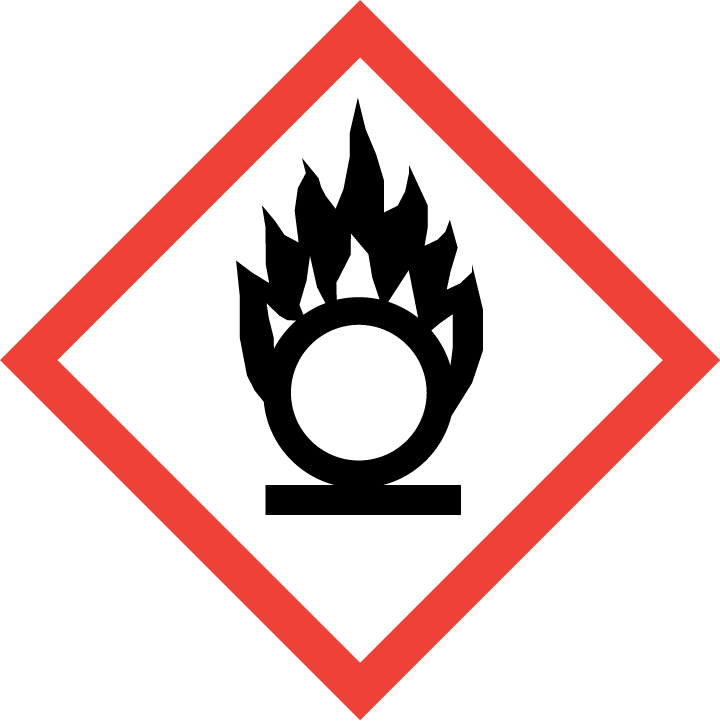
 Gevaar
Hazard Statements (H-Phrases)
Precautionary Statements (P-Phrases)
Recent bekeken
Misschien vind je dit ook leuk
Browse related categories
Category
Sub-category
Oplosmiddelen van analytische kwaliteit (p.a.)
Catalogue
Brand
Questions about Perchloric acid , ROTIPURAN® Ultra 70 %, 500 ml, kunststof (FEP)
What is this article?
Perchloric acid , ROTIPURAN® Ultra 70 %, 500 ml, kunststof (FEP) is the article on this page. Luminix Health distributes Carl Roth for laboratory use. It sits in Oplosmiddelen van analytische kwaliteit (p.a.), inside Oplosmiddelen, in Chemicaliën.
An analytical-grade solvent, often marked p.a., has impurity limits tight enough for classical analysis and for preparing reagents. It is not automatically low enough in UV absorbance for HPLC, and it is not dry enough for a water-sensitive reaction. The grade is the purchase.
A solvent dissolves. The grade says which impurities are low enough for the method. Analytical grade is the ordinary pure solvent. HPLC and LC-MS grades limit the absorbance and the ions that would become peaks or background. A dry solvent has had water removed. A deuterated solvent is for NMR, where the hydrogen signal would otherwise drown the sample. Technical grade is for cleaning and for synthesis that does not need a chromatogram. Identity is on PubChem. Names follow IUPAC. Hazards follow ECHA, the CLP Regulation and REACH.
Which category should I open next?
The category is Oplosmiddelen. The sub-category is Oplosmiddelen van analytische kwaliteit (p.a.). The catalogue is Chemicaliën.
Shelves beside this one are Oplosmiddelen van HPLC- & LC-MS-kwaliteit, Droge & gedeutereerde oplosmiddelen (NMR, synthese), Oplosmiddelen van technische & synthesekwaliteit and Groene & alternatieve oplosmiddelen.
What should I check before I order?
The technical information on this page is the manufacturer's sheet. Read that, not a rewritten specification.
When this page shows a safety data sheet, use that manufacturer file. Hazard text does not belong in the sales description. For a pack size, a grade or a certificate that is not on the page, send a quote request or contact the team.
How does ordering and shipping work?
Luminix Health distributes this article from the heart of Europe. Articles in stock ship within 2–5 business days. Standard delivery is free from €250 excl. VAT. Cold-chain goods and dangerous goods under ADR are never included in that free delivery. The terms are in the Shipping Policy. The full brand index is on shop by brand. Who we are is on about us.
Which other categories should I open?
The seven catalogues are Labware, Lab chemicals, Lab instruments, Lab consumables, Chromatography equipment, Lab safety equipment and Life Science & Microbiology.