
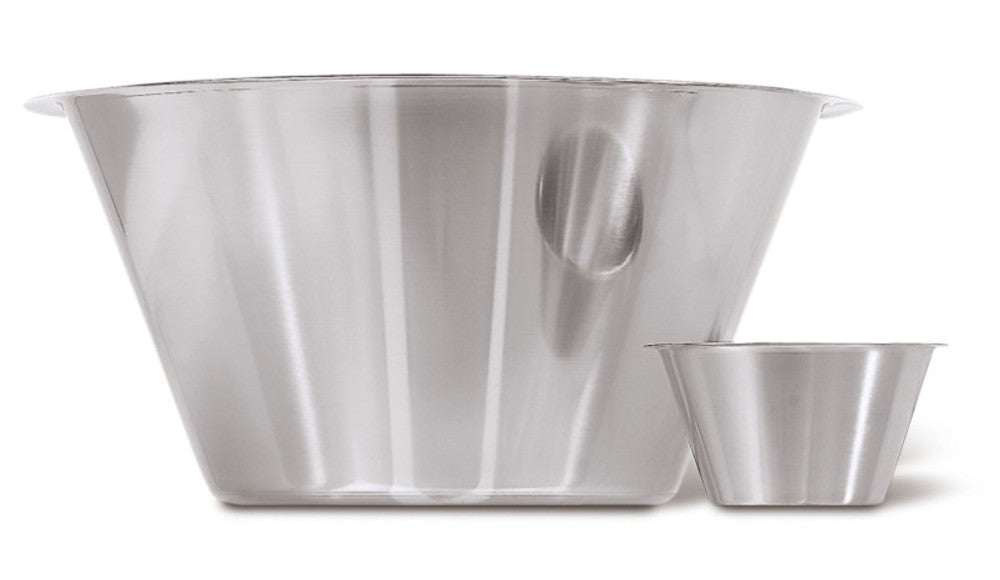


Beschrijving
Roestvrijstalen kommen, conisch, diep type, 5 l zijn ruime laboratoriumvaten bedoeld voor de bereiding, het mengen en het tijdelijk vasthouden van grotere vloeistofvolumes in wetenschappelijke en technische werkplekken. De conische dieptypevorm biedt een stabiel grondvlak en voldoende diepte voor het hanteren van oplossingen tijdens overbrengen, spoelen of verwerking naast de werkbank. Elke kom wordt geleverd als één stuk met een gewicht van 0.506 kg en brengt capaciteit in evenwicht met hanteerbare hantering voor routinematige laboratoriumlogistiek. Het volume van 5 l ondersteunt bulkbufferbereiding, monsterverzameling uit meerdere bronnen en algemene procesondersteuning waar roestvrijstalen materiaal de voorkeur heeft. Deze kommen van fabrikant ROTH SELECTION sluiten aan bij gangbare labmateriaalcategorieën voor kuipen, kommen, emmers en verwante vaten. De robuuste metalen constructie is geschikt voor herhaald gebruik en reinigingscycli in drukke voorbereidingsruimten. De diepe conische geometrie ondersteunt gietcontrole en helpt de inhoud vast te houden tijdens agitatie of verplaatsing tussen stations. Geleverd als een enkele eenheid is het artikel handig voor laboratoria die duurzame conische roestvrijstalen kommen van 5 l op voorraad houden voor dagelijkse werkzaamheden.
Dit artikel maakt deel uit van Dienbladen, schalen & kuipen, in Schalen, smeltkroezen & porselein.
Kenmerken
- Verpakkingsgrootte: 1 stuk
- Materiaal: Roestvrij staal
- Vorm: Conisch
- Uitvoering: Diep type
- Inhoud: 5 l
- Gewicht: 0.506 kg
Recent bekeken
Misschien vind je dit ook leuk
Questions about Roestvrijstalen kommen, conisch, diep type, 5 l, 1 eenheid
What is this article?
Roestvrijstalen kommen, conisch, diep type, 5 l, 1 eenheid is the article on this page. Luminix Health distributes Carl Roth for laboratory use. It sits in Dienbladen, schalen & kuipen, inside Schalen, smeltkroezen & porselein, in Labmateriaal.
A laboratory tray, bowl or tub is an open vessel for holding, staining, drying or carrying many small items at once. Polypropylene trays resist a knock and many aqueous liquids. Porcelain takes heat. The useful numbers are the bottom size and the depth, because that is the working area.
A dish is an open vessel for drying, evaporating or holding a solid. Porcelain and glazed ceramic take a higher temperature than borosilicate glass, which is why a crucible, not a beaker, goes into a furnace. A watch glass covers, or holds a small amount for drying. A mortar is for grinding. The temperature and the chemical, not the shape alone, choose the material. Laboratory ware of this family is listed under ISO laboratory ware.
Which category should I open next?
The category is Schalen, smeltkroezen & porselein. The sub-category is Dienbladen, schalen & kuipen. The catalogue is Labmateriaal.
Shelves beside this one are Kroezen, Vijzels & stampers, Horlogeglazen & kristalliseerschalen, Indampschalen and Schalen (overig).
What should I check before I order?
The technical information on this page is the manufacturer's sheet. Read that, not a rewritten specification.
When this page shows a safety data sheet, use that manufacturer file. Hazard text does not belong in the sales description. For a pack size, a grade or a certificate that is not on the page, send a quote request or contact the team.
How does ordering and shipping work?
Luminix Health distributes this article from the heart of Europe. Articles in stock ship within 2–5 business days. Standard delivery is free from €250 excl. VAT. Cold-chain goods and dangerous goods under ADR are never included in that free delivery. The terms are in the Shipping Policy. The full brand index is on shop by brand. Who we are is on about us.
Which other categories should I open?
The seven catalogues are Labware, Lab chemicals, Lab instruments, Lab consumables, Chromatography equipment, Lab safety equipment and Life Science & Microbiology.