
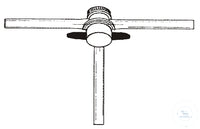


Beschrijving
3-wegkraan met PTFE-plug en capillaire slijpstukken NS 14.5 is een precisie-laboratoriumkraan voor gecontroleerde routering van vloeistoffen of gassen in glasapparatuur. Hij combineert een T-boringconfiguratie met nominale maat NS 14.5, een NS-PTFE-plug, capillaire slijpstukuiteinden en een schroefvergrendeling van de kraan. Capillaire armen meten 8 × 100 mm en de boringdiameter is 1.6 mm; de constructie volgt DIN 12554. Geleverd als één stuk met een nettogewicht van 0.062 kg, past de kraan van fabrikant Witeg in standaard assemblages met slijpstukken die in onderzoeks- en kwaliteitscontrolelaboratoria worden gebruikt. De PTFE-plug biedt chemische bestendigheid en werking met lage wrijving, terwijl de capillaire aansluitingen fijne of microschaalslangverbindingen ondersteunen. Een schroefvergrendeling houdt de plug stevig geplaatst tijdens meerwegschakeling en vermindert het risico op onbedoelde verplaatsing. Typische toepassingen omvatten verdeelstukken voor organische synthese, destillatieopstellingen en chromatografische monsterbehandeling waar inerte afdichtingsvlakken en reproduceerbare driewegstroomregeling essentieel zijn. Het compacte formaat integreert gemakkelijk in bestaande NS-slijpstuksystemen zonder extra adapters.
Dit artikel maakt deel uit van Rubber- & siliconenstoppen, in Stoppen, doppen & sluitingen.
Kenmerken
- Verpakkingsgrootte: 1 stuk
- Uitvoering: 3-wegstopkraan, T-boring
- Slijpstukmaat: NS 14.5
- Stekker: NS-PTFE met schroefvergrendeling
- Capillaire armen: 8 × 100 mm
- Boordiameter: 1.6 mm
Recent bekeken
Misschien vind je dit ook leuk
Browse related categories
Category
Sub-category
Catalogue
Brand
Questions about 3-wegkraan PTFE-plug capillaire zijarm ST14.5
What is this article?
3-wegkraan PTFE-plug capillaire zijarm ST14.5 is the article on this page. Luminix Health distributes Witeg for laboratory use. It sits in Rubber- & siliconenstoppen, inside Stoppen, doppen & sluitingen, in Labmateriaal.
A rubber or silicone stopper is pushed into a mouth. The size number corresponds to a top and bottom diameter. Silicone survives higher temperatures and more autoclave cycles. Natural rubber is attacked by oils and by some solvents.
A closure is the part that decides whether a bottle stays shut and whether the contents attack the seal. A ground-glass stopper matches a ground neck. A screw cap needs the right thread and a liner that survives the liquid. Rubber and silicone stoppers push into a mouth. The liner, not the colour of the cap, is the chemical choice. The vessels they close are indexed under ISO laboratory glassware.
Which category should I open next?
The category is Stoppen, doppen & sluitingen. The sub-category is Rubber- & siliconenstoppen. The catalogue is Labmateriaal.
Shelves beside this one are Schroefdoppen & sluitingen, Glazen slijpstoppen, Deksels & afdichtingen and Sluitingen (overig).
What should I check before I order?
When this page shows a safety data sheet, use that manufacturer file. Hazard text does not belong in the sales description. For a pack size, a grade or a certificate that is not on the page, send a quote request or contact the team.
How does ordering and shipping work?
Luminix Health distributes this article from the heart of Europe. Articles in stock ship within 2–5 business days. Standard delivery is free from €250 excl. VAT. Cold-chain goods and dangerous goods under ADR are never included in that free delivery. The terms are in the Shipping Policy. The full brand index is on shop by brand. Who we are is on about us.
Which other categories should I open?
The seven catalogues are Labware, Lab chemicals, Lab instruments, Lab consumables, Chromatography equipment, Lab safety equipment and Life Science & Microbiology.